Every payroll run used to start with managers chasing team leads to confirm hours. Now they just check the record.
Overview
This marketing agency pays a large team every two weeks. Employees log their hours against different clients and projects, and a manager has to review and approve those timesheets before payroll can go out. That approval step was the bottleneck.
Challenge
Payroll waited on a chain of manual confirmations.
The agency ran on a mix of manual timesheets and an old tracking tool. Neither gave operations a record they could just trust, so every cycle meant going back to team leads to check what people had actually worked.
That took time from the wrong people. Team leads were pulled off client work to verify hours, and operations sat waiting on replies before payroll could move. The old tool needed supervision and still left room to disagree about logged hours. So some cycles ended in an argument instead of a payment.
“We moved from a mix of manual timesheets and a legacy tracking tool that required too much oversight and produced disputes over logged hours.”
— Chief Executive Officer (CEO)
Solution
A record operations can validate on its own.
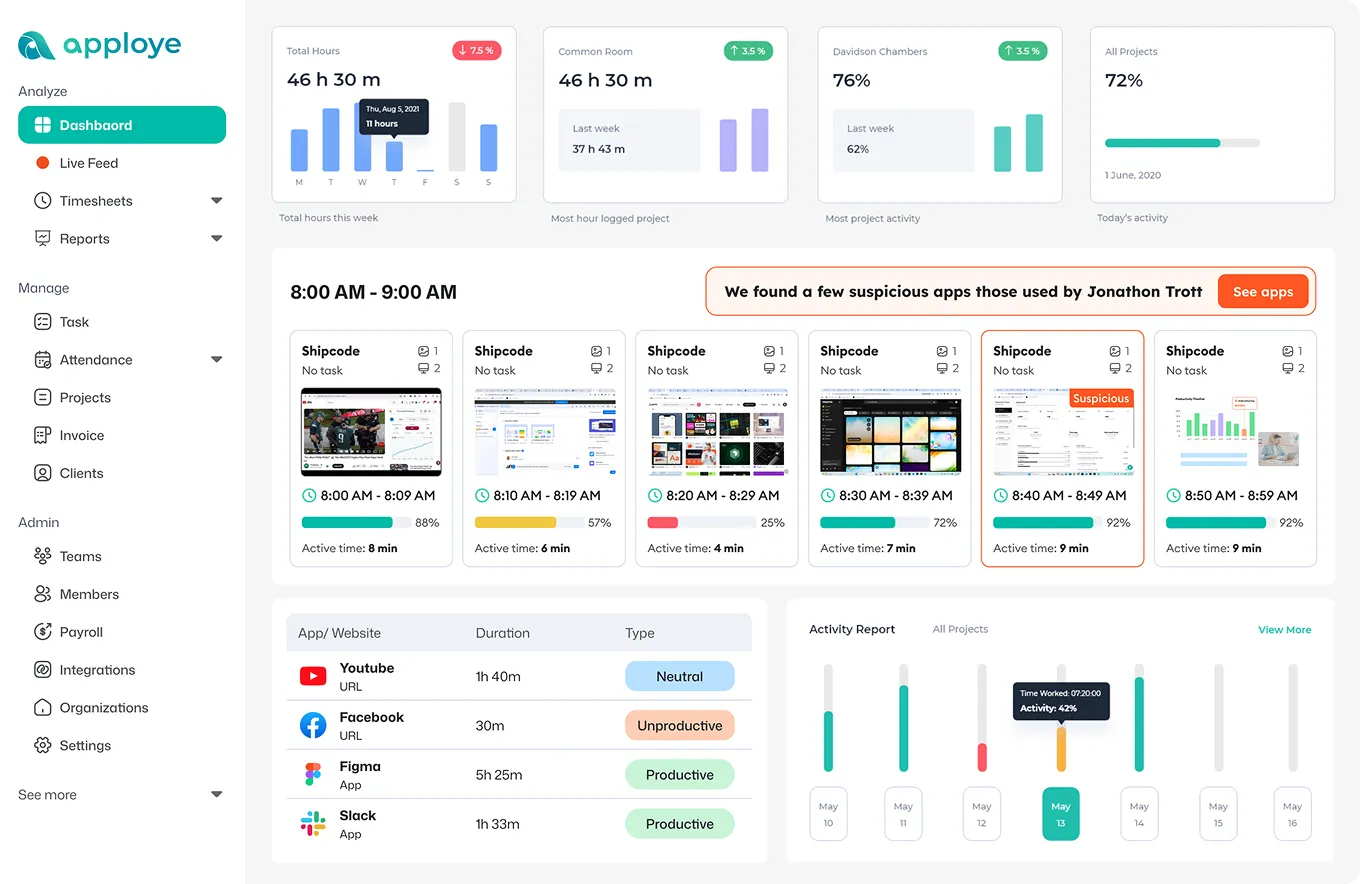
Hours are recorded automatically against the work they belong to, so whoever approves them doesn't need someone else to confirm them first. Operations managers open the timesheet, check it, and done.
It's a small change that makes a big difference. Approving hours used to take two people and a conversation. Now it takes one person and a minute.
“Our operations managers can validate hours without going back and forth with team leads.”
— Chief Executive Officer (CEO)r
Results
Payroll doesn't wait on manual confirmations anymore. The chasing that used to start every cycle is gone, and most of the disagreements went with it.
Approvals happen in one step.
Team leads are back on client work.
Fewer disputes over logged time.
Looking for a simpler way to understand where your team's time goes?

 Productivity TrackingMeasure daily performance
 Workforce AnalyticsGet workforce intelligence
 Activity MonitoringCheck user behaviour
 Screenshot MonitoringMonitor screen activity
 Employee TimesheetTrack work hours
 Screen RecordingRecord work sessions
 Payroll & InvoiceOrganize projects efficiently
 Payroll & InvoiceAutomated payment processing
 ReportingGenerate insightful reports
 EnterpriseProductivity for larger organizations
 Computer MonitoringTrack computer usage
 Staff MonitoringOversee team performance
 Time RecordingCapture work hours
 Online TimesheetsDigital time logging
 Attendance TrackingMonitor employee presence
 Insightful ReportsInsightful time reports