






Free Timesheet Template - Download and Customize

Daily, weekly, bi-weekly, monthly, and project timesheets. Excel, Google Sheets, Word, and PDF. Overtime and pay are calculated automatically. No email required.
A timesheet template is a pre-built form for recording when an employee started work, when they stopped, how long they took for breaks, and how many hours that adds up to.
This free timesheet template works in Excel and Google Sheets, calculates regular and overtime hours against the threshold you set, multiplies them by your hourly rate, and gives you a signed record you can file for payroll. Print the PDF version if you need a paper time card.
Free Timesheet Template
Don't build your timesheet from a blank spreadsheet. Use this ready-made template to record:

when work started and stopped;
unpaid breaks and net hours worked;
regular hours versus overtime;
billable versus non-billable time;
hours by project, client and task;
pay at your own hourly and overtime rates;
daily, weekly, bi-weekly and monthly periods; and
employee and approver sign-off.

Why track time manually
when you can do it automatically
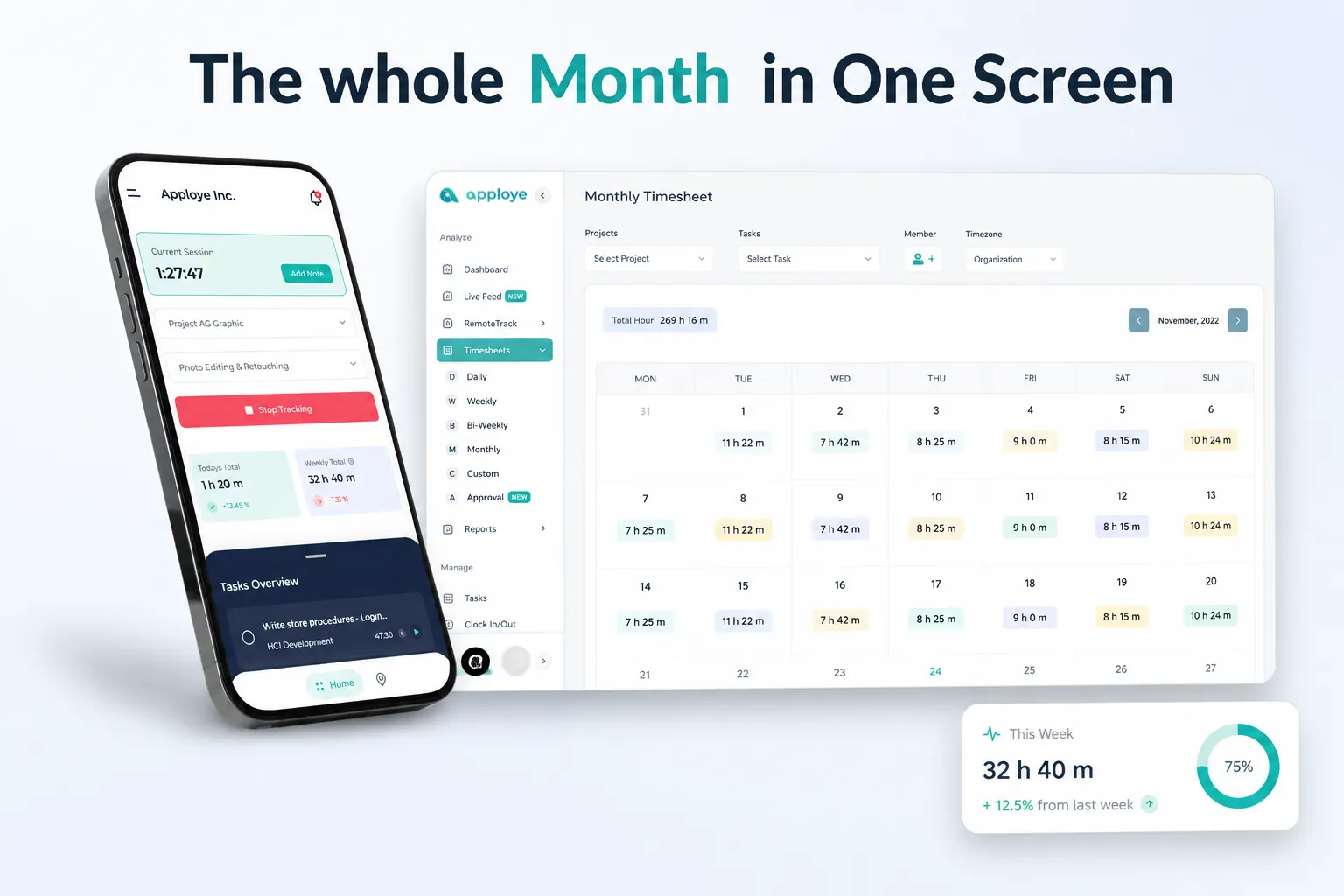
Apploye records clock-ins, work hours, projects, attendance, and timesheets.
Choose Your Timesheet Template Format
Pick the format you already work in. Every version includes the same five timesheets: daily, weekly, bi-weekly, monthly, and project, and the spreadsheet versions do the maths for you.
What's Inside the Employee Timesheet Template
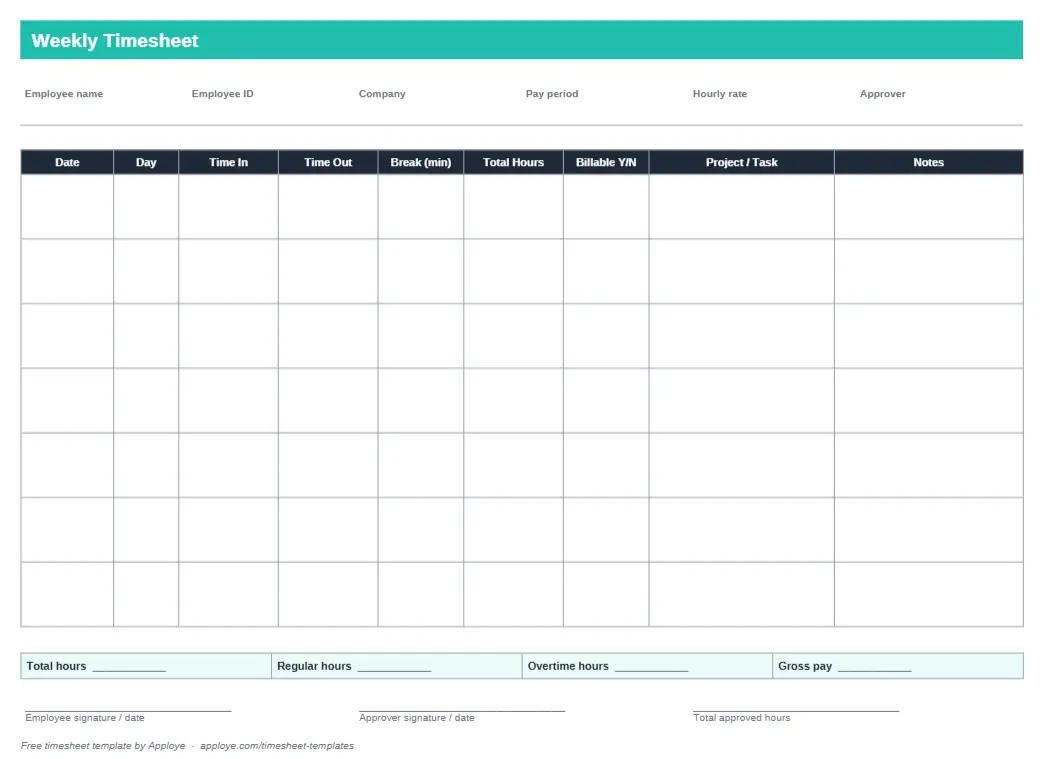
Here is every column and what it does, so you know what you're getting before you download.
A separate Settings tab holds your hourly rate, overtime threshold and overtime multiplier. Change them once and every calculation across the workbook updates.
The summary block on each tab returns: total hours, regular hours, overtime hours, billable hours, regular pay, overtime pay and gross pay.
The 5 Free Timesheet Templates Included
Weekly Timesheet Template
Seven rows, one per day, with a running weekly total. This is the format most hourly teams use, because overtime under the US Fair Labor Standards Act is calculated per workweek, not per day and not per pay period. Set your threshold on the Settings tab (40 hours by default) and anything above it is paid at your overtime multiplier.
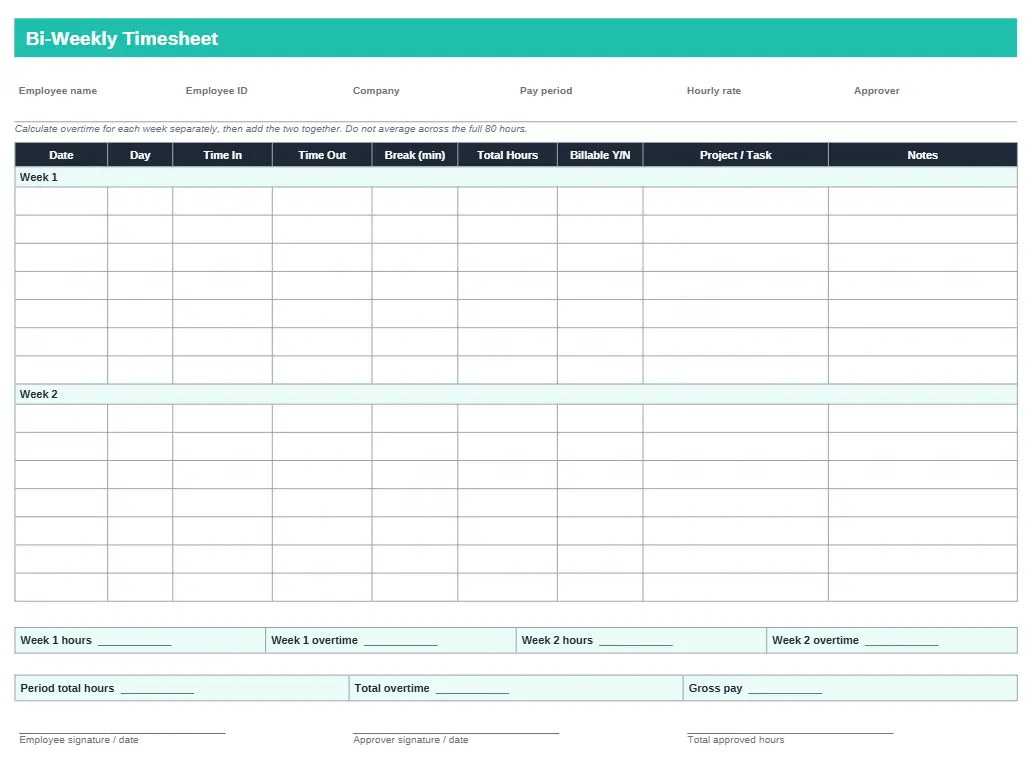
Bi-Weekly Timesheet Template
Fourteen rows, split into two separate weeks. This split matters: if you pay every two weeks but calculate overtime across the whole 80 hours, you will underpay someone who worked 50 hours one week and 30 the next. This template computes each week's overtime independently, then adds them.
Monthly Timesheet Template
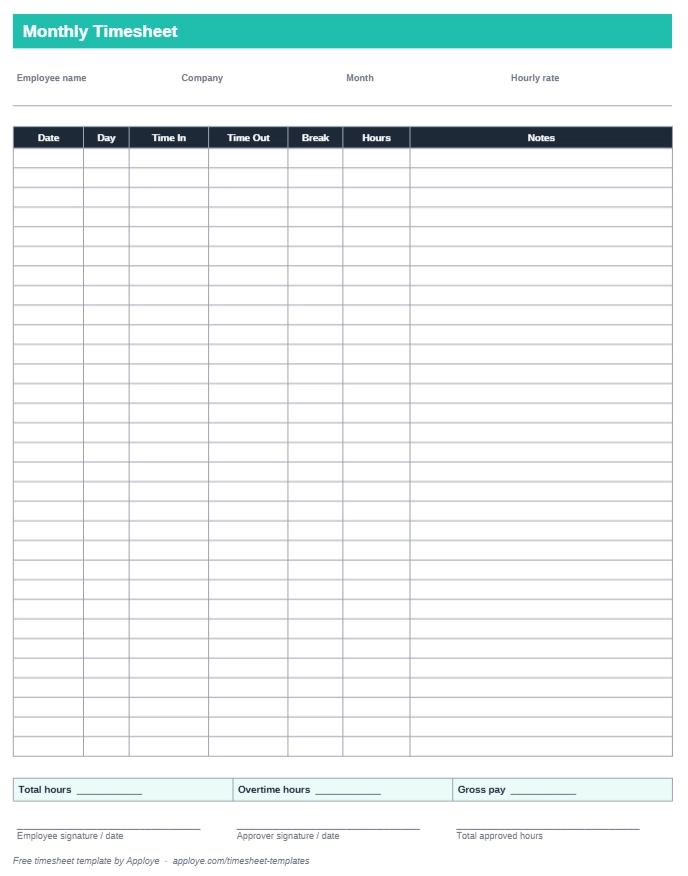
Thirty-one rows covering a full month, with a single month-end total. Best for salaried staff whose hours you're recording for compliance or project costing rather than for hourly pay.
Daily Timesheet Template
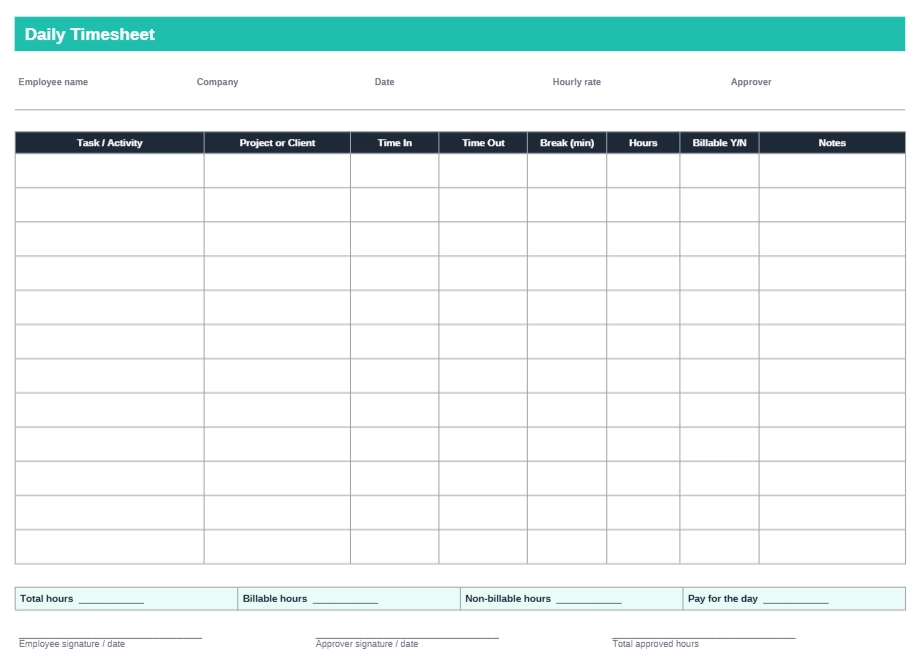
One day, broken down by task rather than by shift. Twelve task rows, each with its own start and stop time. Use it when you need to know where a single day actually went. This is useful for agencies justifying an invoice line, or for anyone auditing their own time before quoting a job.
Project Timesheet Template
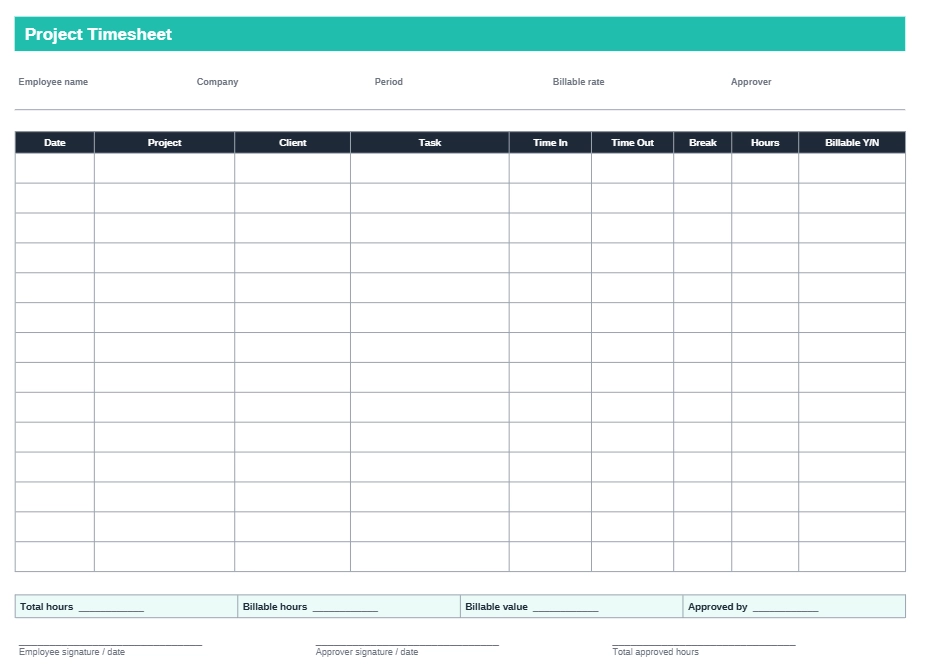
Twenty-five rows tagged by project and client, plus a rollup table that totals hours, billable hours and billable value per project. This is the one to use if you bill clients by the hour.
How to Use This Timesheet Template
Step 1: Set Your Rates
Open the Settings tab. Enter the employee name, hourly rate, overtime threshold (40 hours per week in most US jurisdictions), and overtime multiplier (1.5 for time-and-a-half). Every other tab reads from here.
Step 2: Pick Your Pay Period Tab
Weekly, bi-weekly, monthly, daily, or project. You only need the one that matches how you pay.
Step 3: Delete The Example Row
Each tab has one grey example row showing the expected format. Remove it before you start.
Step 4: Enter Clock Times, Not Durations
Type 9:00 AM and 5:30 PM, and put the break in as a number of minutes. The hours column fills itself.
Step 5: Review The Summary
The block below the table shows total hours, the regular/overtime split, and gross pay. Check the overtime line before you approve anything.
Step 6: Get It Signed
Print or export to PDF, have the employee and approver sign, and file it. Under the FLSA, employers must keep payroll records including daily and weekly hours, and the required retention period is longer than most managers assume. Check the current requirement for your jurisdiction.
Who This Timesheet Template is For
- Small business owners with hourly staff: You need a defensible record of hours worked and a correct overtime calculation. The weekly and bi-weekly tabs handle both.
- Agencies and consultants billing by the hour: Use the project tab. Tag every entry to a client and project, mark billable rows, and the rollup gives you the invoice line.
- Freelancers and independent contractors: The daily tab breaks a day down by task, so you can see whether that fixed-fee job was actually worth it.
- Remote and distributed teams: The Google Sheets version can be shared with the whole team. Be honest with yourself about this one: shared spreadsheets get overwritten, and you have no version trail when someone disputes a number.
- HR and payroll teams: The Settings tab keeps rate assumptions in one place, so the same file works for every employee with one edit.
Where a Spreadsheet Timesheet Stops Working
Spreadsheet timesheets are free, familiar, and completely adequate for a handful of people. However, they break down in five predictable ways.
Hours Get Remembered, Not Recorded
Most people fill in their timesheet on Friday afternoon for the whole week. Research on time reporting consistently finds retrospective entry is less accurate than real-time capture, and the error runs in the employer's disfavour more often than not.
No Audit Trail
When a client disputes an invoice or an employee disputes a paycheck, a spreadsheet cell gives you a number and nothing else. No timestamp, no record of who changed it, no evidence of what was actually worked on.
Chasing Costs More Than the Template Saved
Collecting, correcting, and consolidating timesheets from fifteen people every week is a recurring admin job that never gets smaller.
Overtime Errors Compound Quietly
One wrong threshold, one bi-weekly file that averages overtime across two weeks, and you have a systematic underpayment sitting in your payroll history.
It Doesn't Scale Past a Certain Headcount
Somewhere around ten to fifteen people, the file-per-employee approach turns into a consolidation project every pay period.
If you're a team of three, none of this matters much. But if you're growing, it starts to.
How Apploye Handles this Automatically
Apploye records the hours as they happen, so the timesheet builds itself.
- Accurate time tracking. Desktop, mobile and web timers. Employees start work; the timesheet fills in.
- Auto-timesheets from tracked hours. Daily, weekly and monthly views generate from tracked time, with approval workflows built in.
- Overtime and payroll from real hours. Set pay rates once and Apploye calculates wages from actual tracked time, splitting billable and non-billable.
- Evidence behind every entry. Optional screenshots, activity levels and app/URL tracking mean an hour on the timesheet has something behind it.
- Client invoices in one click. Billable hours convert straight into an invoice.
- Offline tracking. Time syncs when the connection comes back.