

11 TimeCamp Alternatives Worth Switching To in 2026
Last updated: June 18, 2026
The Best TimeCamp Alternatives to Try in 2026
DISCLAIMER: How We Test, Evaluate, and Select Apps
Our roundup of apps is totally based on human research and testing. We have spent long hours evaluating the apps, after using each app exactly in the way it is meant to be!
Each app mentioned here is tested against the criteria of the standard time tracking and employee monitoring apps. We are never paid by the apps for their placement in our reviews and for any link provided here.
We value the trust of our readers and put all the effort into offering on-point evaluations of the apps we review.
For more details, checkout our software review and test methodology.
Is TimeCamp Worth It? Why Users Switch?
High pricing on advanced plans, a mobile app with limited features, and inconsistent GPS are some of the common complaints about TimeCamp. Users also report that the reporting options are quite limited.
Here's what real users say:
“The reporting functions are a bit limited, and the filtering options are not always what we need.”
- Heidi W., G2
"The mobile experience and some of the 'on-the-go' features didn’t feel as polished."
- Dominic Y, Capterra
"Sometimes it tracks time even though nothing is being done in the computer, so it might not be as accurate as the app tells you it is."
- Verified User, G2
A common theme across user reviews is that TimeCamp's project profit analysis and payroll management require too many manual steps, and the billing and invoicing workflow hasn't kept pace with modern alternatives. If any of this sounds familiar, this list is for you.
How Do We Choose the TimeCamp Alternatives?
We don't pick alternatives randomly. Every tool on this list was evaluated against the core features that TimeCamp users rely on, making sure each alternative offers at least the same, and in most cases, better value. Our criteria:
- Accurate time tracking (automatic and manual)
- AI-powered capabilities and AI suggestions
- Reporting and analytics depth
- Project profit analysis and project budgeting
- Payroll management or native payroll integrations
- Attendance and leave management
- Billing and invoicing support
- Integration count and ecosystem
- Affordable pricing relative to features offered
- Strong user ratings on Capterra and G2 (4.4+ average)
TimeCamp vs Competitors: A Detailed Comparison






Native QuickBooks users



Key Features
- Time and productivity tracking
- Track time on tasks and projects
- Team timesheets and approvals
- App and website use monitoring
- Billable rates and client billing
- Project budget and cost tracking
- Screenshots & screen recording
- Quick sync without any time lag
- Supported on multiple platforms, including Android & iOS
- Customizable functions with multiple integrations
- Affordable pricing plans
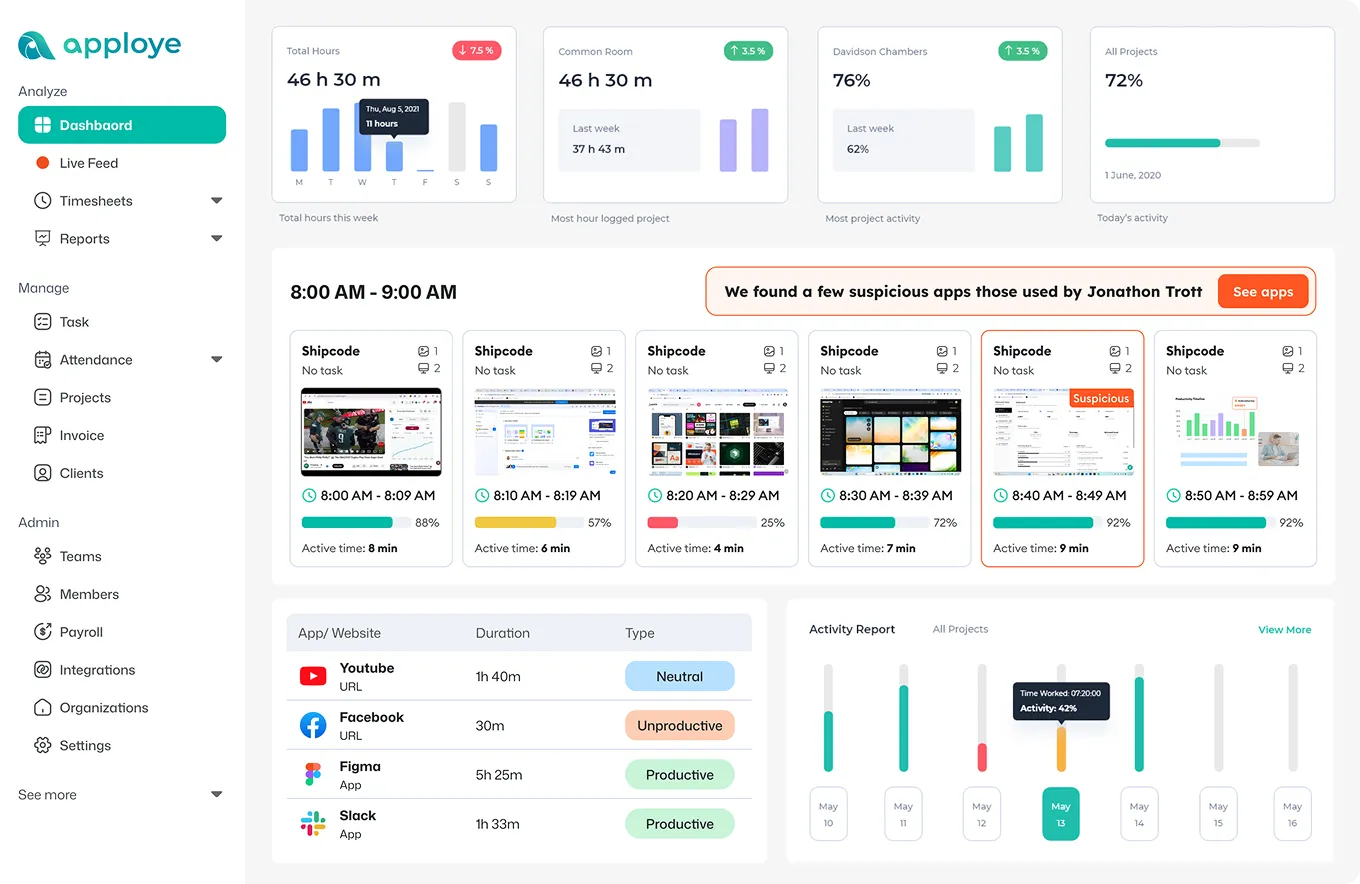
Since Apploye is our product, let’s address the elephant first. It's not on the top just because we built it, but because Apploye manages to clear all the concerns of TimeCamp perfectly. Here's the honest breakdown.
Apploye Tracks What's Happening With Tracked Time
TimeCamp's core loop is: start timer → log time → generate report. That works fine until you need to know where the hours actually went. TimeCamp doesn't answer that question. It tells you that the hours were logged, and that’s it.
Apploye adds an employee monitoring layer that TimeCamp doesn't have. Screenshots at configurable intervals, app and URL tracking, keyboard and mouse activity scoring, and idle time detection. These all work together to give managers the ability to visualize traceability. And that makes the world of difference.
Payroll Without the Spreadsheet in the Middle
A very common TimeCamp workflow looks like this: export timesheet → open spreadsheet → calculate pay by employee → import to payroll provider. That manual step is both time-consuming and a source of errors.
Apploye's payroll management handles this natively. Pay rates are set per employee inside the platform, and payroll reports are generated directly from tracked and approved hours. Multi-currency support means global remote teams can run payroll in local currencies without converting everything manually. It connects with Deel, QuickBooks, and PayPal for direct processing.
Stealth Mode that Prevents Proactively
TimeCamp doesn’t offer a unique feature, found in Apploye. Stealth mode or hidden mode monitoring, which hides the presence of a time tracker on devices that employees use. Why would anyone need to go to such lengths?
Businesses where data is everything, tracking is not just monitoring; it’s a prevention tool. That’s exactly what Apploye offers to healthcare, security, and finance industries. TimeCamp’s simple tracking can’t match that.
Customization that Businesses Love
White-labeling or using your own branding is something very few apps offer. Apploye is among the very few. For larger organizations (minimum 100 users), Apploye provides a white-labeling add-on that allows you to apply custom branding to the platform.
TimeCamp does not list a native white-labeling option. So, if that’s on your checklist, Apploye is the only option.
Apploye covers similar ground on payroll automation, activity tracking, and screenshot proof, minus the trial wall. The free plan runs for up to 10 users before anyone needs a card.



User Reviews & Ratings
- Verified User.
- Kazi M.
2. Hubstaff - Best for remote & field team workforce management
.webp)
Pricing
Key Features:
- Automatic time tracking with desktop and mobile timers
- GPS tracking and geofencing for field teams
- Screenshots, app and URL monitoring, activity level tracking
- Native payroll automation with PayPal, Wise, Gusto, and Deel
- Project and task-based time logging
- Team productivity and attendance reporting
- Project budgeting with cost alerts
- Invoicing with customizable billing rates
TimeCamp is not a bad tool for daily use. But using Hubstaff after TimeCamp feels like a genuine upgrade in scope. Where TimeCamp focuses mainly on time logging and basic attendance, Hubstaff operates as a full workforce analytics system that captures far more data.
The first thing that stood out was the payroll automation. In TimeCamp, running payroll means exporting timesheet data, formatting it, and sending it to your payroll provider. All manual processes. In Hubstaff, payroll calculations update automatically based on tracked time and pay rates. That saves a large chunk of monthly time wasted on unproductive tasks.
Time tracking in Hubstaff is also more flexible than TimeCamp. Manual entries, desktop timer, mobile GPS timer, and geofencing for automatic clock-in/out - all are available. On top of that, screenshots monitoring and activity level tracking provide a layer of productivity insight that TimeCamp entirely lacks. The reporting dashboard also shows some basic insights like app usage, attendance trends, and project costs by default. On TimeCamp, I had to create those manually.
That said, Hubstaff's depth comes with trade-offs. The monitoring features can feel heavy for teams that prefer a lighter touch, and the mobile app occasionally has sync issues. There is no free plan, so I’ll recommend using the trial version seriously before committing.
User Reviews & Ratings
- Edlyn F.
- Dima P.
👉 Also, see the comprehensive list of the best alternatives to Hubstaff.
3. Clockify - Best free time tracker for unlimited users & teams
Pricing
Key Features:
- Unlimited users, projects, and time entries on the free plan
- One-click timer with manual time entry and editing
- Auto tracker for desktop app and URL activity logging
- Calendar view for visual time management
- Timesheet approvals with manager review workflows
- Billable and non-billable hours with custom rates
- Invoice generation with project-based billing
- Kiosk mode for shared device clock-in/out
- 100+ integrations via browser extension and API
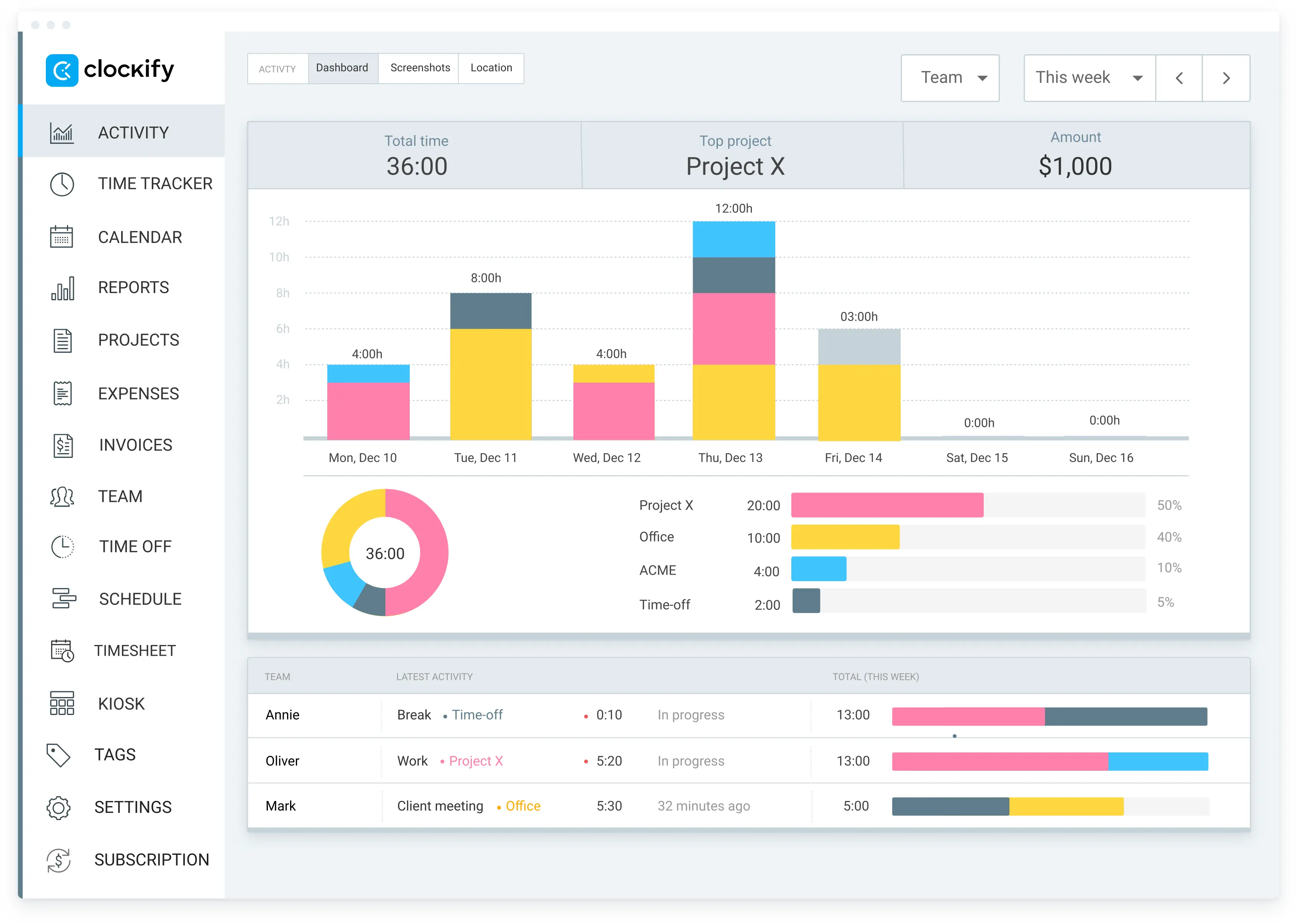
Clockify is the most compelling free time tracking tool available on this list - for various reasons. Obviously, TimeCamp is a great free tracker too, but Clockify performs better in multiple categories.
Time tracking is straightforward: start/stop timer, manual entries, timesheets, and auto-tracking via the desktop app. Compared to TimeCamp's keyword-based automatic tracking, Clockify's auto tracker is more versatile. It logs which apps and sites you use throughout the day and lets you convert those logs into time entries. A simpler, more reliable approach. Idle detection is also available.
Where Clockify genuinely surprises is in its reporting. The Summary, Detailed, and Weekly reports offer filtering by user, project, client, billable status, and tag. To me, it felt cleaner and more flexible than TimeCamp's reporting interface for project-based teams. The calendar view lets you see your time entries as blocks, and drag and drop to edit for easier customizations.
However, Clockify has some noticeable downsides. There is no native payroll processing. You'll need to integrate with QuickBooks, Xero, or ADP. Productivity monitoring is limited, and GPS tracking requires the Pro plan. But for teams that want reliable time tracking, solid reporting, and a genuinely free starting point, Clockify is hard to argue against.
If you want Clockify's free-plan generosity but with payroll and screenshots built in instead of bolted on, Apploye's free plan covers up to 10 users at $4.50/user after that.
User Reviews & Ratings
- Holly P.
- Imlisunep L.
👉Check out the list of Clockify alternatives to explore more tools.
4. Toggl Track: Best for simple & intuitive time tracking
.webp)
Pricing
(up to 5 users)
Key Features
- One-click timer with auto tracker and AI suggestions
- Pomodoro timer for structured work sessions
- Timeline view showing full daily activity log
- Advanced reporting with billable hours and project profitability
- Project budgeting with threshold alerts
- Project estimates vs. actuals comparison
- 100+ integrations, including Asana, Jira, and Google Calendar
- Browser extension for in-app time tracking
If you ever think that you just want a simple tracker with a stunning UI, Toggl Track is the one. It has a reputation for being the cleanest, most frictionless time tracking experience available. Where TimeCamp requires configuration, keyword setup, and complex navigation, Toggl is a download and track type of tool. Obviously, you have set up a few things, but it’s easier than most trackers.
Toggl and TimeCamp are similar in many ways: activity tracking, window title tracking, auto tracking via keywords, idle tracking, and more. However, where Toggl pulls ahead is in the seamless syncing. I rarely saw an app that syncs so perfectly with the web, desktop, and mobile app simultaneously. There’s almost no delay, and it impressed me a lot. TimeCamp, Hubstaff, all delay by multiple seconds, if not minutes.
Reporting is genuinely strong. Detailed, Summary, and Workload views with flexible filtering by client, project, tag, and user. The project profitability reports pull in tracked hours against set billing rates to give a live profit margin view. TimeCamp has no such reports by default.
The gaps in Toggl? It has no native payroll management, no leave management, and no GPS tracking. It is a focused time tracking and reporting tool, not a workforce platform, as it clearly mentions that everywhere. So, if that’s okay with you and you want a clean and intuitive interface, Toggl should be a clear choice.
Apploye fills in exactly those three gaps, leave, payroll, and billing, if you'd rather not bolt on separate tools later.
👉 Check our list of top alternatives to Toggl.
5. Harvest - Best for invoicing-first teams & agency billing
Pricing
Key Features
- Manual start/stop timer with timesheet reminders and approvals
- Billable and non-billable hour tracking by project and client
- Expense tracking alongside time entries
- Invoice generation from tracked time with online payment collection
- Project estimates and budget vs. actual reporting
- Team capacity and resource allocation reports
- Desktop widget for quick time entry
- Integrations with Asana, Slack, QuickBooks Online, and Xero
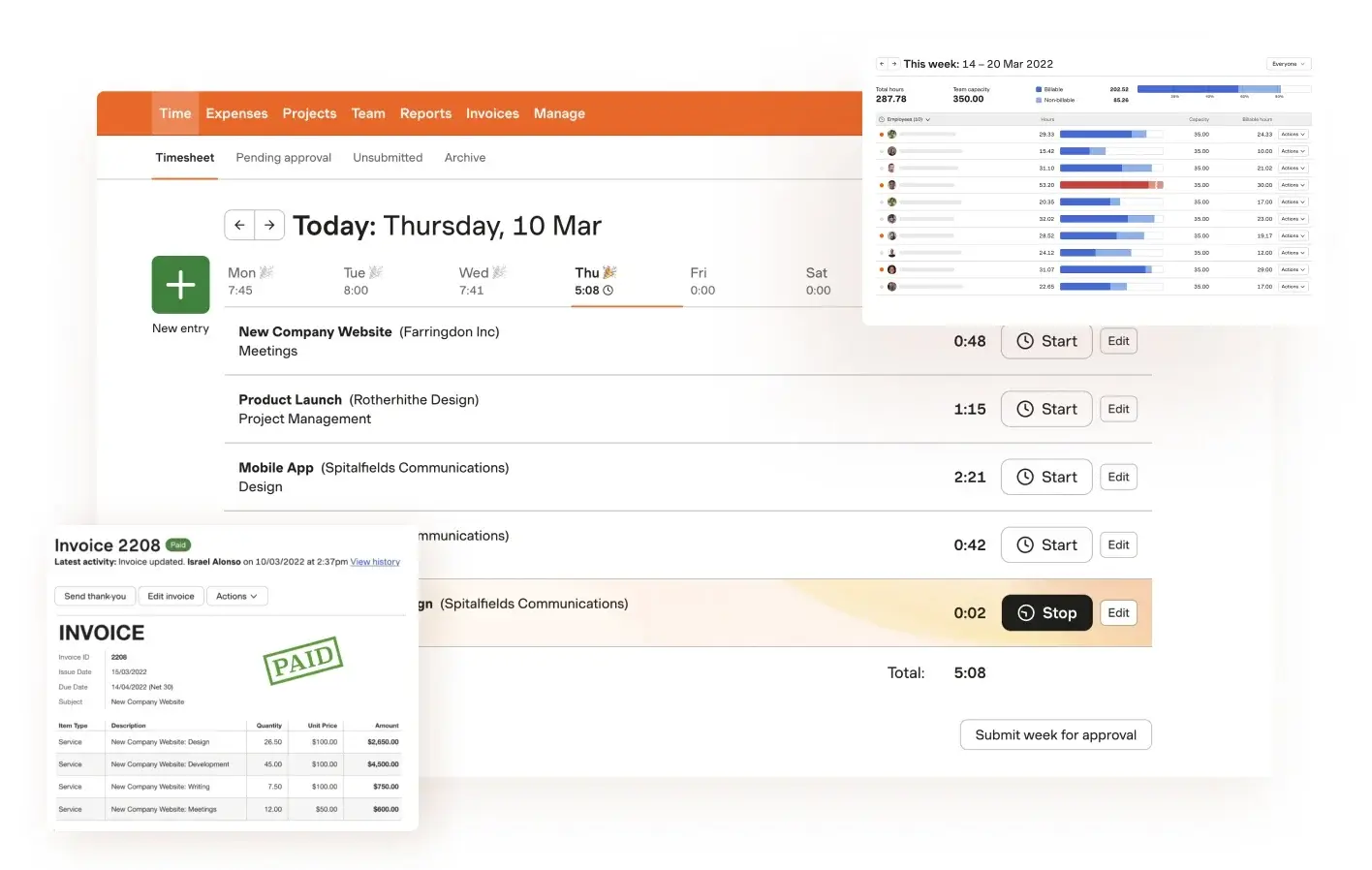
“Turn hours into profit.” That's how Harvest differentiates itself from others. Seemingly, it delivers on what it loudly declares. Harvest was built around the billable hour in a way TimeCamp simply wasn't.
The invoicing workflow is where Harvest earns its spot on this list. Tracked hours convert into professional, brandable invoices in a few clicks. Coming from Toggl to this, I couldn’t be more compelled. In TimeCamp, that process requires either a manual export or dependence on a connected QuickBooks account. Harvest handles it natively, including collecting payment through Stripe or PayPal without leaving the platform. For agencies and consultants, that's a meaningful time saver.
The project profitability reports are also significantly better visualized than TimeCamp's equivalent. I could immediately see the ROI on each client engagement and compare the budget to actual hours. The resource allocation view is particularly useful for forward-looking planning.
Similar to the goods, the bads are quite evident. Harvest has no automatic time tracking. Every entry requires a manual start. No GPS tracking, no activity monitoring, no attendance management. If employee management is your focus, Harvest isn't the right choice. And at $11/user/month, it isn't the cheapest option on this list for what it covers.
User Reviews & Ratings
- Ramana S.
- Verified User.
6. Time Doctor - Best for deep employee productivity monitoring
.webp)
Pricing
Key Features
- Automatic and manual time tracking with idle detection
- Screenshots and video screen recording for proof of work
- Keyboard and mouse activity level tracking
- Website and app classification (productive vs. unproductive)
- Real-time distraction alerts when employees visit off-task sites
- Attendance tracking with late arrival and absence reporting
- Payroll integration with PayPal, Wise, Gusto, and Bitwage
- Silent background tracking mode for automatic time capture
- Offline tracking with automatic sync on reconnect
Time Doctor describes itself as AI-powered workforce analytics software, and the effort shows after a week’s usage. Where TimeCamp provides basic activity summaries, Time Doctor builds a complete productivity picture from scratch. App usage, website visits, mouse & keyboard activity, and actual productivity metrics.
The distraction management system is unique on this list. Time Doctor classifies every visited website as productive, unproductive, or neutral, and sends real-time alerts to employees if they are visiting non-work sites. In practice, this creates a natural accountability loop if it’s implemented accurately. Otherwise, it can become a hindrance real fast.
The payroll integration is solid. Tracked hours feed directly into payment calculations for platforms like PayPal, Wise, and Gusto without requiring manual exports. The attendance system logs clock-in times, flags late arrivals, and tracks absences automatically, reducing the administrative overhead that TimeCamp users typically handle manually.
The honest downsides are no free plan, and the most useful features require the Standard plan or above. The monitoring depth can also feel heavy-handed for teams that aren't accustomed to this level of visibility. If your team culture values autonomy, some features require informed implementation.
If the lack of a free tier is the sticking point, Apploye's free plan covers up to 10 users, with paid plans starting well below Time Doctor's Standard tier.
User Reviews & Ratings
- Paul C.
- Shikher G.
7. Timely - Best for AI-powered automatic time tracking
.webp)
Pricing
Key Features
- Memory AI captures every app, document, website, and meeting privately
- AI-Powered Timesheets suggest time entries from Memory data
- One-click timesheet approval from AI suggestions
- Project and task progress reporting with visual dashboards
- Project budgeting with real-time overrun alerts
- Data encryption with privacy-first architecture
- All Memory data is private to the user by default
- 50+ integrations, including Google Calendar, Office 365, and Jira
TimeCamp's keyword-based automatic tracking has a fundamental flaw. It’s not necessarily the most accurate when assigning time entries to the right projects. Here, Timely takes a completely AI-based approach that understands you more as you use it.
Timely's Memory AI runs silently in the background and records every activity on your device. Documents opened, websites visited, meetings attended, apps used. It’s a completely encrypted local timeline that only you can see. It then analyzes that data and generates AI-Powered Timesheets with suggested entries for each project and task. All I had to do was approve those entries; that’s it. TimeCamp’s tracking is not this easy and seamless.
What makes Timely's approach genuinely different is the privacy model. Memory data is stored locally on the user's device and is never visible to managers or teammates. Unless the user explicitly approves and logs an entry from it. This is a much more privacy-focused tracking compared to TimeCamp’s instant sync tracking.
The reporting and project budgeting features are strong too, with visual dashboards showing planned vs. actual hours, profitability trends, and budget alerts.
No native payroll management, no GPS tracking are the Achilles heels of Timely. And invoicing requires QuickBooks integration. For the premium pricing, it could definitely add more features for teams.
Apploye closes that exact gap. Timesheets, payroll, and invoicing live in the same plan instead of needing a QuickBooks add-on.
User Reviews & Ratings
- Josh K.
- Mandi L.
8. QuickBooks Time: Best for payroll-integrated time tracking
%20(1).webp)
Pricing
User Reviews & Ratings
- Brooke M.
- Angie T.
👉 Check our list of top alternatives to QuickBooks Time.
9. DeskTime - Best for automatic productivity & URL tracking
%20(1).webp)
Pricing
Key Features:
- Fully automatic time tracking — no start/stop required
- App, URL, and document activity monitoring with productivity categorization
- Desktop widgets showing real-time personal productivity scores
- Private Time mode to pause monitoring during breaks
- Absence calendar and shift scheduling (Premium and Enterprise)
- Project tracking with automated time allocation
- Screenshot capture at configurable intervals
- Offline tracking with sync on reconnect
DeskTime's key differentiator is this: no start/stop timer when you launch it. Yes, you literally have to dig out the manual timer from settings. So, this is where DeskTime is different from TimeCamp. It fully commits to the auto tracking where TimeCamp plays it safe. Other than that, most of the tracking functions are the same. Apps, URL, document tracking, and categorizing it by productive, unproductive, or neutral based on rules you configure.
DeskTime is always active, but only tracks time when you work. Otherwise, it stays silent in the background.
The desktop widgets are a thoughtful touch. Employees can see their own productivity metrics right on their desktops. That creates a natural self-management loop without managers looming over the dashboard. The Private Time feature allows employees to pause monitoring during personal breaks, which preserves user privacy and builds trust in the system.
Where DeskTime falls short relative to TimeCamp is in payroll management (no native feature) and billing. The invoicing capabilities are basic, and I found client billing workflows quite limited. If you prefer a modern outlook, DeskTime won’t fulfill your needs.
User Reviews & Ratings
10. Connecteam - Best for Deskless workforce management
.webp)
Pricing
Key Features
- Mobile time clock with GPS tracking and geofencing
- Multiple clock-in methods: mobile, web, kiosk, NFC, and QR code
- Drag-and-drop shift scheduling with overtime and labor law alerts
- Job and task-based time tracking
- PTO, break rules, and overtime management
- In-app team chat (1:1 and group) with file sharing
- Custom digital forms and checklists
- HR tools: onboarding, training, surveys, and more
- Centralized Contract Storage for employee records
TimeCamp has GPS location tracking, but it’s not always accurate. For retail, hospitality, construction, cleaning, logistics, and healthcare teams, Connecteam offers reliable real-time tracking.
The time clock options alone make Connecteam superior for non-desk teams. Employees can clock in via mobile GPS, kiosk with PIN, NFC tag, or QR code. Other than Connecteam, I’ve only seen this variety of login options in Jibble. Overtime rules, break tracking, and labor law compliance settings are all configurable. An easy sell for industries with strict compliance requirements.
Scheduling in Connecteam is noticeably more advanced than TimeCamp. Managers can create recurring shifts and auto-assign based on availability. Additionally, employees can request shift swaps directly through the app. The notifications system keeps everyone updated without requiring any pings.
However, if you need it, Connecteam also has an in-app team chat. On top of that, digital forms, training modules, and centralized contract storage make it easier to remove content switching significantly. That consolidation has real value for businesses managing large frontline workforces.
With great features comes great pricing. Connecteam's pricing increases significantly as you enable communication and the HR hub. With all of that in one place, the app can feel overwhelming to many. There's also no native project profit analysis.
Project profit analysis is exactly what Apploye pairs with billable rates and payroll, without needing Connecteam's pricier HR hub tier to get there.
User Reviews & Ratings
- Kriszti K.
- David L.
11. Paymo: Best for project tracking with seamless management
.webp)
Pricing
Key Features
- Full project management with Kanban, Gantt, timeline, and calendar view
- Automatic time tracking via desktop app and widget
- Pomodoro timer built into the desktop widget
- Project budgeting with profitability analysis and cost alerts
- Invoice generation with QuickBooks and Xero integration
- Online payment collection directly from invoices
- Team scheduling with resource allocation and availability tracking
- Expense tracking with mobile receipt capture
- Leave management with multiple leave type support
From a project tracking perspective, Paymo is the exact opposite of TimeCamp. That’s why it ranks at the bottom, but with unique functionalities. Paymo is a project management platform with time tracking baked in at every level. If your agency requires accountability in every step of a project, Paymo is easy to recommend.
In Paymo, users can switch between Kanban board, Gantt chart, timeline, list, and calendar view depending on the project team. TimeCamp stops at the calendar view with a simplified board-style view. For task management, Paymo offers subtasks, due dates, assignees, priority levels, file attachments, and @mention comments. It’s a complete platform to collaborate on every project.
That doesn’t mean Paymo forgets to tie time tracking to projects. Time tracking connects to every layer of the project. The desktop widget with a Pomodoro timer makes it easy to log focused work sessions. The automatic tracker records app and URL activity for passive time capture. All tracked hours flow directly into project budgets and client billing rates. That’s a great feature to see for a manager like me.
The invoicing workflow is well-built. Time entries and expenses convert to professional, brandable invoices in a few clicks. Clients can easily pay online directly from the invoice.
However, there are two major flaws of Paymo. The employee self-service leave requests aren't fully available yet. And Paymo's integration list of 13+ apps seems too limited, as others offer significantly more.
User Reviews & Ratings
- Verified User.
- Verified User.
👉 See similar tools like Paymo, that you can consider as better Paymo alternatives
Final Words
Switching from TimeCamp is easier than you think once you know which tool fits your workflow. Every alternative on this list outperforms TimeCamp in at least one meaningful way. Our honest recommendation? Try each for a while, and you’ll know which one fits the bill.

If you want monitoring, payroll, and attendance in one place
No credit card required
Cancel anytime
HIPAA & GDPR Compliant
Frequently Asked Questions
The strongest all-around alternatives are Apploye, Hubstaff, Clockify, Toggl Track, and Timely. Apploye covers the widest range of features at the most affordable price. Hubstaff leads for field teams. Timely is the best choice for AI-powered automatic tracking.
The most common reasons are: unreliable keyword-based automatic tracking, a limited and frustrating mobile app. Additionally, users also report manual payroll and billing workflows, inconsistent GPS tracking, and a lack of real employee productivity insights.
Yes. Clockify and Apploye both offer free plans. Clockify is free for unlimited users. Apploye's free plan covers up to 10 users. Even the paid plans for Clockify ($3.99/user/mo) and Apploye ($4.5/user/mo) are priced significantly below TimeCamp's equivalent feature tiers.
Apploye and Time Doctor provide the deepest employee monitoring. Apploye includes screenshots, app and URL tracking, activity levels, and idle detection without feeling intrusive. Time Doctor adds distraction alerts and video recording for teams that need the highest level of productivity accountability.
Clockify is the most popular free option with unlimited users and projects. But if you need monitoring and payroll alongside time management, Apploye's free plan is available for up to 10 users. For small teams, it covers significantly more ground without costing anything.
Toggl Track's free plan works well for solo freelancers. It has a clean interface, solid reporting, and no friction. If you also need invoicing and client billing from day one, Harvest's free plan is also worth considering.
Time Doctor is the deepest monitoring tool on this list. Apploye is the better choice if you want strong monitoring without it feeling invasive. The ideal employee monitoring tool depends on your requirements and employee adoption.
It depends on your team type. For remote and hybrid teams, Apploye gives you the most complete system. It includes automatic tracking, timesheets, approvals, attendance, and payroll in one place. For field teams, Hubstaff or QuickBooks Time adds the GPS layer that desk-based tools don't cover.