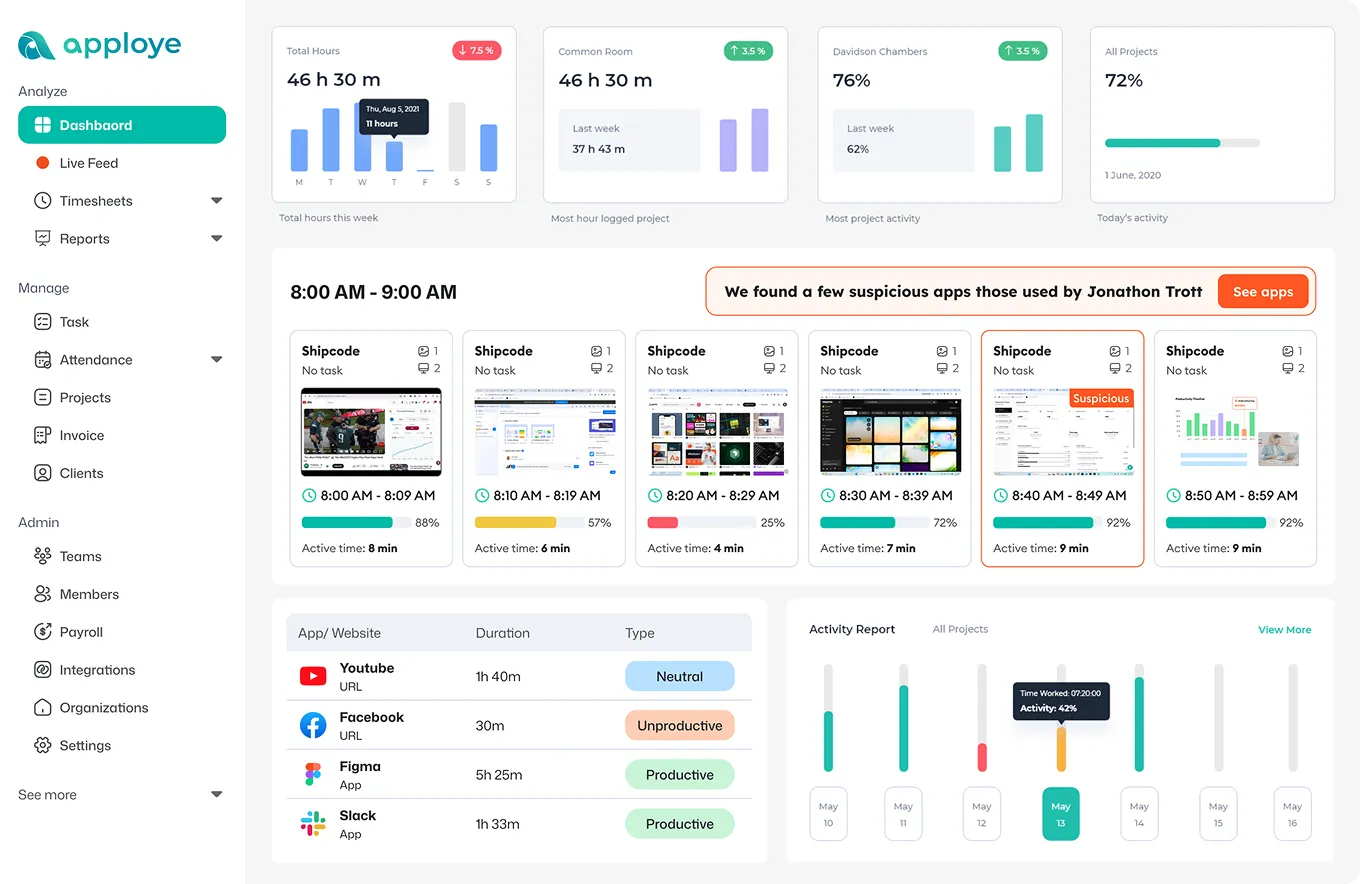
Billable hours were being reconstructed from manual notes, which meant they were regularly wrong. Fixing the record cut review time by about a third.
Overview
This real estate business charges clients by the hour, per case. One case might be worked on by several employees, and each employee usually juggles a few cases at once.
When you bill that way, the timesheet stops being routine admin. It's the document the invoice is built from. If the hours are wrong, the bill is wrong.
Challenge
Manual tracking meant the numbers didn't always agree.
Before Apploye, the team tracked time by hand. People wrote down what they'd worked on and for how long, usually after the fact, and someone else reviewed it before it went anywhere near a client.
The trouble with reconstructing a day from memory is that two people reconstruct it differently. Entries came in inconsistently, and reviewing them turned into a negotiation. A manager questioning a figure, a team member defending it, neither of them holding anything more solid than a recollection.
This also made review slow. Every entry that looked odd had to be reconsidered, and there was no independent record to check it against.
“The team used to rely on manual tracking, which caused inconsistencies and disputes.”
— Managing Director
Solution
Three things changed the day-to-day.
Apployes’ time tracking that runs quietly in the background. It doesn't need constant manual input, so hours are captured as work happens rather than written down later.
Managers can look at what was logged and verify it without going to the person and asking. That single change is what removed most of the back-and-forth.
And finally, time is broken down by case, so the numbers that go onto an invoice come straight out of the record.
The point isn't that anyone was logging hours dishonestly. It's that a memory can't be checked and a record can.
“The tracking works quietly in the background and doesn't need constant manual input. We can review timesheets and screenshots without having to ask the team for updates.”
— Managing Director
Results
About a third less time spent reviewing, and far less arguing about it.
“Timesheet reviews are around 30% faster now, and tracking is more transparent for everyone.”
— Managing Director
The more interesting change is what stopped happening. Disputes over logged hours largely went away, because there's now something to point at other than two conflicting recollections. Internal back-and-forth dropped along with them.
What the business got out of it
Timesheet reviews around 30% faster.
Billable hours tracked per case, without manual notes.
Fewer internal disputes over logged time.
Looking for a simpler way to understand where your team's time goes?

 Productivity TrackingMeasure daily performance
 Workforce AnalyticsGet workforce intelligence
 Activity MonitoringCheck user behaviour
 Screenshot MonitoringMonitor screen activity
 Employee TimesheetTrack work hours
 Screen RecordingRecord work sessions
 Payroll & InvoiceOrganize projects efficiently
 Payroll & InvoiceAutomated payment processing
 ReportingGenerate insightful reports
 EnterpriseProductivity for larger organizations
 Computer MonitoringTrack computer usage
 Staff MonitoringOversee team performance
 Time RecordingCapture work hours
 Online TimesheetsDigital time logging
 Attendance TrackingMonitor employee presence
 Insightful ReportsInsightful time reports