This company has multiple development teams, and they all work in sprints. These are fixed blocks of time (usually one or two weeks) in which a set amount of work is planned and completed. Planning a sprint means estimating how long each task will take. Those estimates only improve over time if the team looks back at the previous sprint and compares what they predicted against what actually happened.
Challenge
With several dev teams running projects at once, the company couldn't get a clear picture of where sprint time was going. Developers forgot to log hours. This happens when logging is a separate job from the work itself, and managers ended up checking entries by hand.
The tool they had wasn't helping. It cost more per user than a team this size wanted to pay, came with complexity they didn't need, and still left the manual cleanup in place.
“Developers forgot to log time and managers ended up verifying entries manually.”
— Chief Technology Officer
Solution
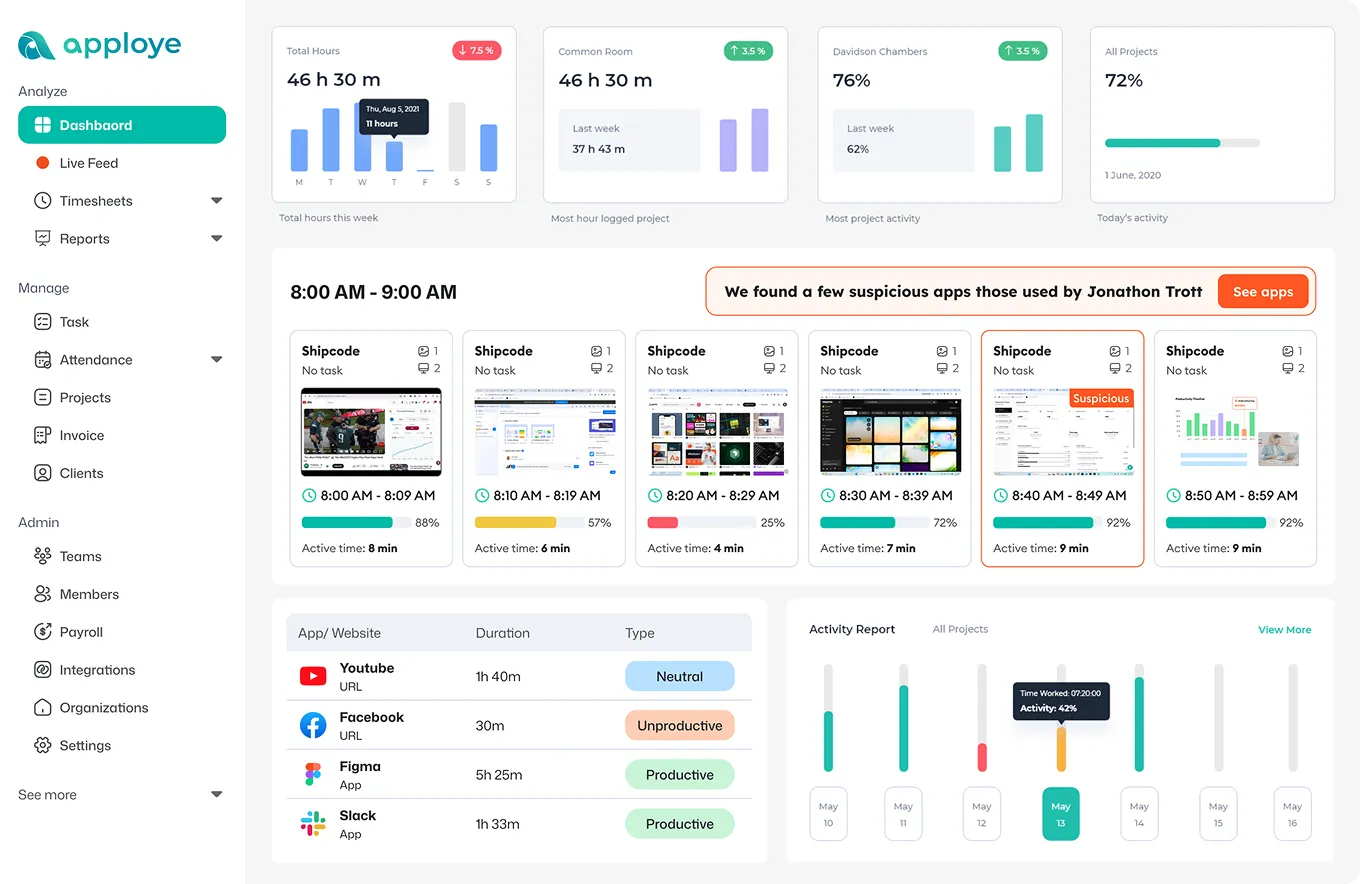
Apploye runs in the background and tracks time automatically against the project it belongs to, and it can be read at the level engineers actually work in; specific tickets and modules, not whole sprints.
That's what makes the data worth having. A sprint total tells you the team was busy. Time against a module tells you which tasks are taking the most time.
“We use project-based time logs to review time spent on specific tickets or modules.”
— Chief Technology Officer
Results
Sprint time is now visible where the decisions get made, on a tool that costs less and asks less of the people using it.
Time is visible at ticket and module level.
Developers no longer manually correct logs.
Replaced a costlier, more complex tool.
Looking for a simpler way to understand where your team's time goes?

 Productivity TrackingMeasure daily performance
 Workforce AnalyticsGet workforce intelligence
 Activity MonitoringCheck user behaviour
 Screenshot MonitoringMonitor screen activity
 Employee TimesheetTrack work hours
 Screen RecordingRecord work sessions
 Payroll & InvoiceOrganize projects efficiently
 Payroll & InvoiceAutomated payment processing
 ReportingGenerate insightful reports
 EnterpriseProductivity for larger organizations
 Computer MonitoringTrack computer usage
 Staff MonitoringOversee team performance
 Time RecordingCapture work hours
 Online TimesheetsDigital time logging
 Attendance TrackingMonitor employee presence
 Insightful ReportsInsightful time reports