
Free Employee Productivity Calculator

Calculate how efficiently your team turns working time into results. Enter your team's output, number of employees, and hours worked to calculate output per employee, output per labor hour, and productivity against your target.

Employee Productivity Calculator

Fill in the details below to calculate your team's productivity.

Measurement period

Select period:

Total output

Output can be units produced, tasks completed, tickets resolved, orders processed, sales, revenue, or another measurable result.

Use one consistent output measure for the selected period.

Number of employees

Total hours worked

Add the total hours worked by all employees during the selected period.

Include hours from every contributing employee.

Target output per employee — Optional

Add your expected output per employee to see what percentage of your target the team achieved.

Leave blank to skip target achievement.

Total labor cost — Optional

Include salaries, wages, or direct labor cost for the period if you want to calculate labor cost per unit of output.

USD for the selected period. Leave blank to skip cost per unit.

Enter your details, then calculate to see your results.

Your Employee Productivity Results

Here's what your numbers mean for your team's performance.

Output per Employee

0

This is the average amount of output generated by each employee during the selected period.

Formula:Total Output ÷ Number of Employees

Output per Labor Hour

0

This shows how much output your team generated for every hour of labor.

Formula:Total Output ÷ Total Hours Worked

Target Achievement

0%

This compares actual output per employee with the productivity target you entered.

Formula:(Output per Employee ÷ Target Output per Employee) × 100

Enter a target to calculate this result.

Labor Cost per Unit

$0

This estimates how much direct labor cost was required to generate one unit of output.

Formula:Total Labor Cost ÷ Total Output

Enter a labor cost to calculate this result.

Use the same measurement period for output, hours, targets, and labor cost.

Want to understand what is driving these numbers?

Understand where the workday went with employee time tracking, productivity insights, and much more.

Track Productivity Free
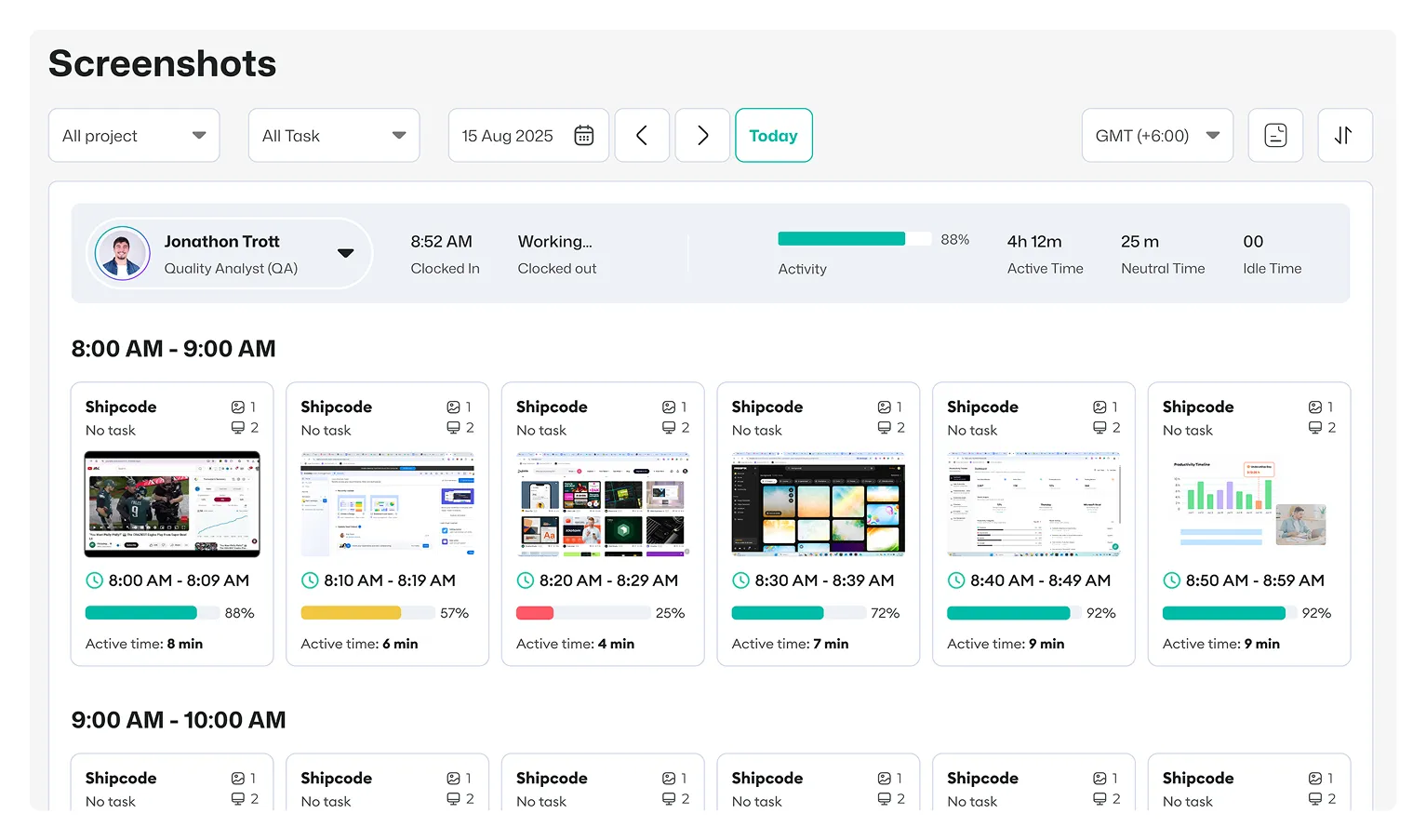
Screenshots Work Summary App usage Time

What is Employee Productivity?

Employee productivity measures how efficiently work inputs are converted into useful outputs. The productivity formula is:

Employee Productivity = Output ÷ Input

Output is the result your team produces. Depending on the type of work, that could mean:

Input is the resource used to produce that output. For workforce productivity, the most useful inputs are usually employee count or hours worked.

The basic idea is straightforward: when a team produces more useful output from the same amount of labor, or produces the same output using fewer labor hours, its measured labor productivity has increased.

How to Calculate Employee Productivity

There isn't one productivity metric that works equally well for every role.

A manufacturing company measures units produced per hour. A support team uses tickets resolved per agent. A sales organization looks at revenue per employee. A service company measures completed client work relative to the hours required.

This labor productivity calculator gives you several ways to examine productivity rather than forcing every business into a single score.

1. Productivity per Employee

Use this when you want to understand average output across your workforce.

Productivity per Employee = Total Output ÷ Number of Employees

2. Productivity per Hour

For teams with different schedules, overtime, part-time employees, or changing headcount, output per hour can provide a more useful comparison.

Productivity per Hour = Total Output ÷ Total Hours Worked

Labor productivity is commonly measured using output relative to hours worked because working hours account for differences such as part-time schedules and changing amounts of labor.

3. Productivity Against a Target

Sometimes the important question isn't simply “How much did we produce?”

It's:

“Did we produce what we expected?”

Use:

Target Achievement = (Actual Output per Employee ÷ Target Output per Employee) × 100

If employees averaged 40 completed orders and your target was 35:

(40 ÷ 35) × 100 = 114.3%

The team achieved approximately 114% of its target.

A percentage above 100% means the stated output target was exceeded. A percentage below 100% means the output was below that target.

It does not automatically mean an employee performed well or poorly. Quality, task complexity, workload, available tools, training, interruptions, and many other factors can affect output.

4. Labor Cost per Unit of Output

Productivity can also be considered from a cost perspective.

Labor Cost per Unit = Total Labor Cost ÷ Total Output

Tracking this number over time can help you see whether processes are becoming more or less labor-efficient.

What Counts as “Output” When Measuring Employee Productivity?

Choose an output that represents meaningful work for the role you're measuring.

Here are some examples.

Customer Support

Possible outputs:

Don't rely only on ticket volume. Consider quality indicators such as customer satisfaction, resolution quality, and reopened tickets.

Sales

Possible outputs:

Sales productivity may also need to account for territory, deal size, sales cycle length, and lead quality.

Software Development

Possible outputs:

Avoid treating raw lines of code, mouse activity, or hours online as direct measures of useful software output.

Marketing

Possible outputs:

Volume alone can be misleading if quality or business impact declines.

Manufacturing

Possible outputs:

Quality, scrap rates, defects, and downtime should be considered alongside raw production volume.

Professional Services

Possible outputs:

Time spent can also be particularly important when client work is billed hourly.

Operations and Administrative Teams

Possible outputs:

Choose a metric that reflects useful completed work rather than activity for activity's sake.

What Is a Good Employee Productivity Rate?

There is no universal productivity percentage that tells you whether every employee or team is productive.

A good result depends on:

Comparing a developer's output with a customer support representative's output would not be meaningful. Even employees with the same job title may handle work of very different difficulty.

Instead of looking for one universal “good productivity score,” establish a consistent metric and compare:

The same team over time

Similar roles performing comparable work

Actual performance against realistic internal targets

This makes changes in the metric much more informative.

Frequently Asked Questions

What is the employee productivity formula per employee?

Use: Productivity per Employee = Total Output ÷ Number of Employees. If 10 employees complete 600 tasks during one month: 600 ÷ 10 = 60 tasks per employee.

How do you calculate employee productivity per hour?

Divide total output by the total number of labor hours required to produce it. Output per Hour = Total Output ÷ Total Hours Worked. For example, 400 completed orders divided by 200 labor hours equals 2 orders per labor hour.

How do you calculate employee productivity percentage?

If you have an established output target, compare actual output with that target: Productivity Against Target = (Actual Output ÷ Target Output) × 100. For example, if an employee completes 55 tasks against a target of 50: (55 ÷ 50) × 100 = 110% of target.

Can revenue be used to calculate employee productivity?

Yes. Revenue can be used as the output when it makes sense for your business. For example: Revenue per Employee = Total Revenue ÷ Number of Employees or Revenue per Labor Hour = Total Revenue ÷ Total Hours Worked. Keep the measurement period consistent when making comparisons.

Is productivity the same as efficiency?

They are related, but they aren't always identical. Productivity focuses on the amount of output generated relative to an input such as labor hours. Efficiency generally focuses on producing the desired result while minimizing wasted time, cost, or resources. A team can increase output while using more resources, so interpret productivity numbers in context.

Should I calculate productivity using employees or hours worked?

Both can be useful. Output per employee is easy to understand and useful for workforce-level comparisons. Output per labor hour is usually better when employees work different schedules, your workforce includes part-time employees, or total hours change significantly between periods. For the strongest analysis, calculate both.

Does high computer activity mean high productivity

Not necessarily. Keyboard and mouse activity can indicate computer interaction, but it does not measure the value or quality of the employee's output by itself. Activity data is most useful when considered alongside completed work, time spent, role expectations, and other relevant context.

How often should employee productivity be measured?

The right interval depends on the work. Operational teams with frequent measurable output may monitor weekly productivity. Other teams may get more useful information from monthly or quarterly trends. Choose a period long enough to reduce the effect of unusual short-term fluctuations while still allowing you to identify meaningful changes.

Can this employee productivity calculator be used for remote employees?

Yes. The employee productivity formula does not depend on where employees work. You can calculate productivity for office, remote, or hybrid teams as long as you have consistent output and labor-input data.

Can I compare employee productivity between team members?

You can, but make comparisons only when employees perform similar work under similar conditions. Differences in task difficulty, experience, tools, customer assignments, working hours, and quality requirements can make simple comparisons misleading.

Is employee productivity only about completing more work?

No. More output can indicate increased productivity when the amount of labor stays constant, but quantity should not come at the expense of quality. Depending on the role, combine productivity measures with indicators such as customer satisfaction, accuracy, defect rates, project outcomes, revenue, or other quality metrics.

Stop Measuring Productivity With Guesswork

Get the data you need from tracked hours and project time to idle time, activity patterns, apps, websites, and productivity reports.
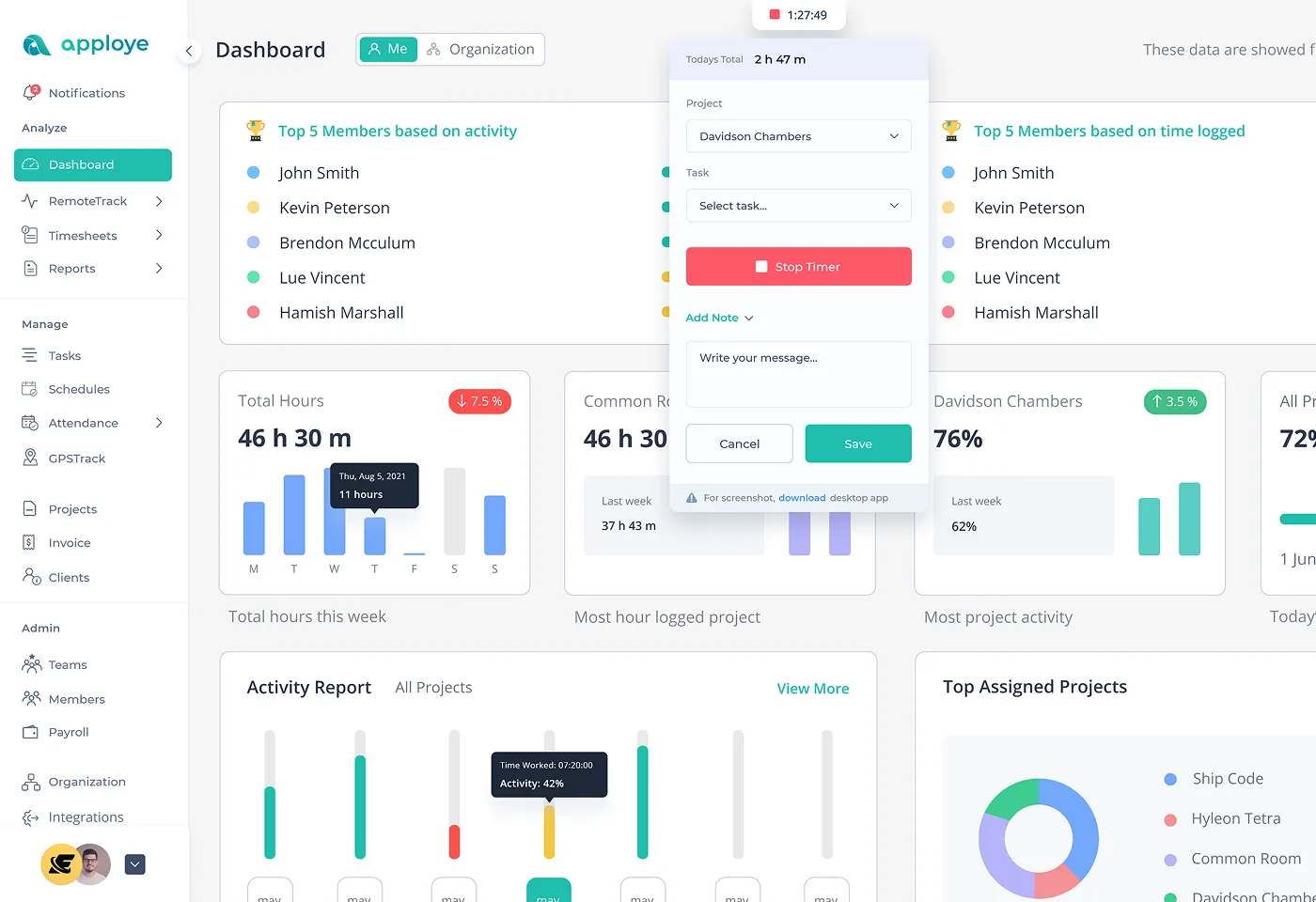
Apploye Dashboard - Employee Productivity Tracking