Time was being split across too many tools, so some of it never made it onto an invoice. One retainer client had been under-billed for months.
Overview
This marketing agency runs a mix of SEO work, ad management, and client reporting, often for the same client, sometimes on the same day. Because the agency sells time, its ability to bill correctly depends on accurate time tracking, and it discovered its tracking wasn't accurate enough. This was costing it money.
Challenge
Hours were being logged late, or not at all.
The agency's people move between very different kinds of work throughout the day. Someone might spend the morning on SEO, shift to ad management after lunch, and finish by pulling together a client report. Every one of those switches is a moment where time either gets recorded or gets lost.
“Team members were logging hours late, or forgetting to track time altogether when switching between SEO work, ad management, and client reporting.”
— Client Services Director
Mostly it got recorded late. People would remember at the end of the day, or the end of the week, and fill in what they could. Some of it never got logged at all.
On top of that, time was spread across more tools than it should have been. No single place held the full picture of what had been spent on a given client. This made it hard to check an invoice against work hours.
The agency was also paying for the privilege. Its previous tool had become expensive per user and heavier than a team this size needed, and it still required manual corrections to timesheets. This rather defeated the point of automating them in the first place.
Solution
Two things carry the day-to-day work.
Accurate time tracking. Hours get captured as work happens rather than remembered afterwards. The switch from SEO to ads to reporting stops being a moment where time can go missing.
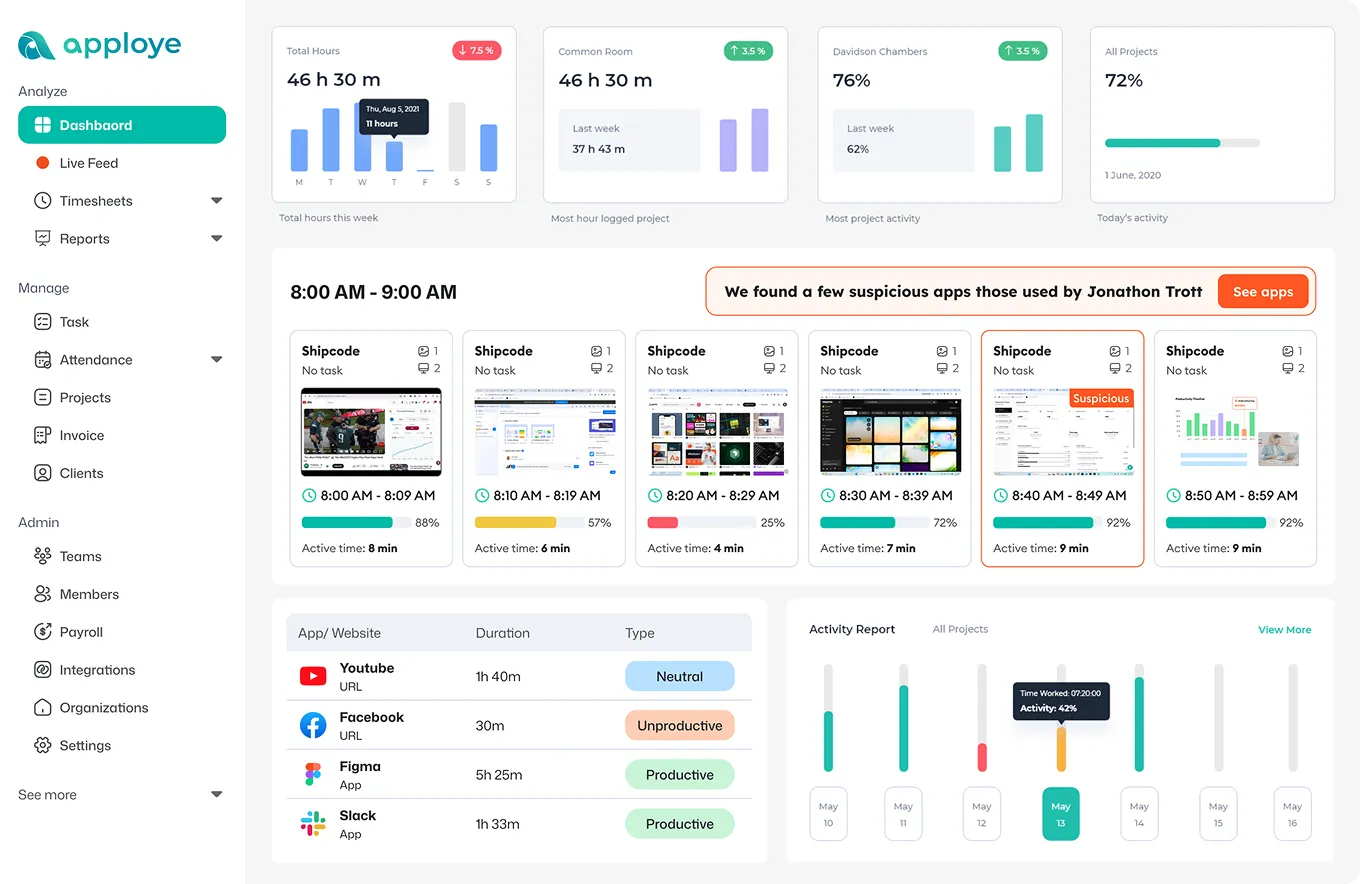
The timesheet and productivity reports view. This is where the agency spends most of its time. Work can be broken down per client and per project, so a retainer can be looked at on its own rather than pulled out of a larger total.
Together they replaced a setup that was costing more and asking for more manual cleanup. For an agency this size, the practical test wasn't features; it was whether the automation actually stayed automatic.
“We rely heavily on the timesheet view, where we can break down work per client and per project.”
— Client Services Director
Results
A retainer client had been billed for less work than it received.
Once the agency could see time laid out by client, something showed up that had been invisible before: one of its retainer clients was being under-invoiced. The work had been done. It just hadn't all landed in the same place, because it had been split across too many tools to add up properly.
That's the kind of gap that doesn't announce itself. Nobody complains about an invoice that's too small, and the client had no reason to notice. It only surfaced when the agency had a single view to look at.

 Productivity TrackingMeasure daily performance
 Workforce AnalyticsGet workforce intelligence
 Activity MonitoringCheck user behaviour
 Screenshot MonitoringMonitor screen activity
 Employee TimesheetTrack work hours
 Screen RecordingRecord work sessions
 Payroll & InvoiceOrganize projects efficiently
 Payroll & InvoiceAutomated payment processing
 ReportingGenerate insightful reports
 EnterpriseProductivity for larger organizations
 Computer MonitoringTrack computer usage
 Staff MonitoringOversee team performance
 Time RecordingCapture work hours
 Online TimesheetsDigital time logging
 Attendance TrackingMonitor employee presence
 Insightful ReportsInsightful time reports