Organizational Inertia Explained: Spot It, Fix It, and Change!
Key Takeaways:
-
Organizational inertia is when a company keeps doing things the same way because change feels hard, risky, or expensive. Even when the world around it changes and the old way no longer works.
All of your employees are working tirelessly, but the business? Hardly even moving. No new ideas, no creative decisions, just old ways of doing things.
That’s organizational inertia, the immovable force that keeps even smart teams stuck. Without breaking the resistance, even top businesses turn into history.
If you really want to change, you have to start now.
In this article, our goal is to learn how to spot and stop it!
What is Organizational Inertia? Exploring the Different Types
It is the tendency of businesses to resist change or inaction. It can be due to culture, management, technology, and more. Mostly, it’s because the business is not ready to take a risk to grow.
In today’s digital economy, innovation leads the way. Inertia is what stops us from growing and evolving.
According to a study, digital transformation is crucial for organizational enhancement. Organizational inertia isn’t an exclusive issue; it’s a web of multiple complexities.
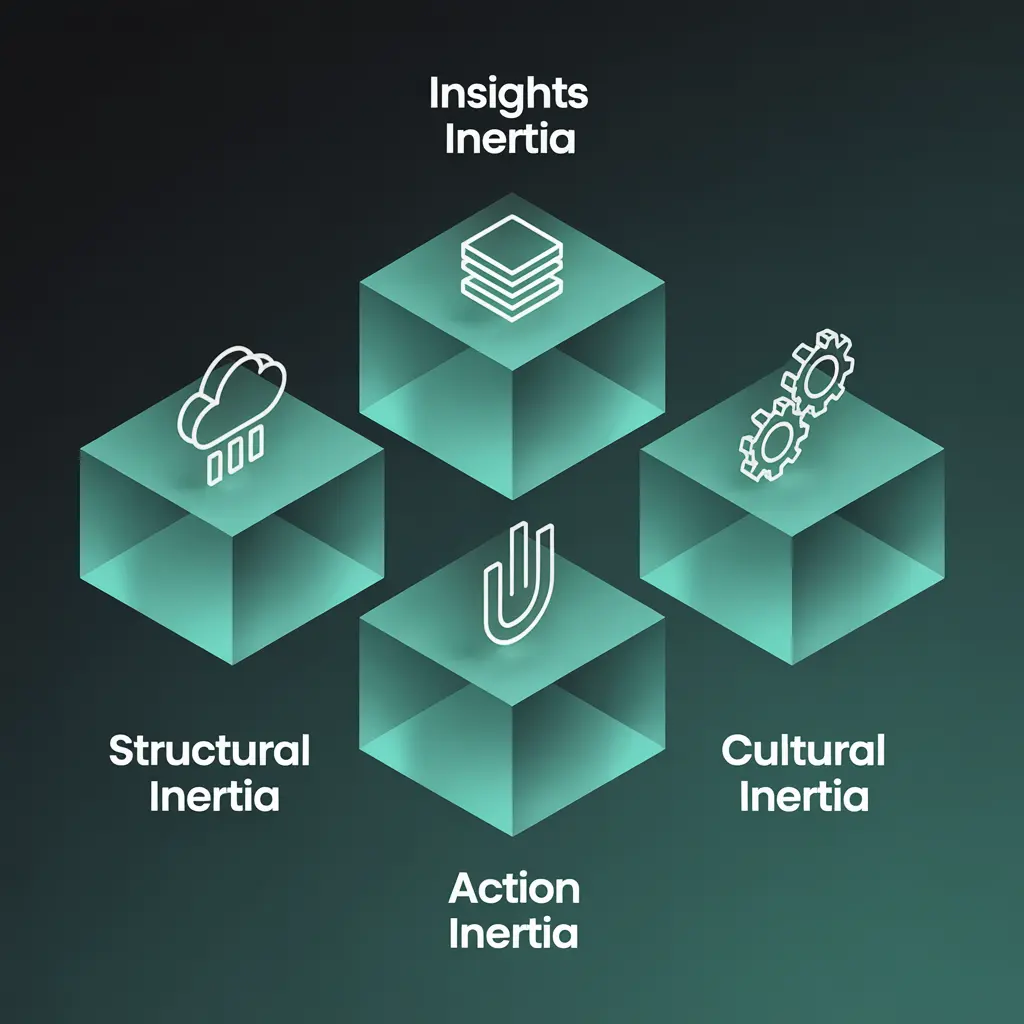
Here are the major types of inertia, found by multiple studies:
1. Insights Inertia
Inertia due to a lack of relevant and crucial information and insights. It mainly occurs because of management’s inefficiency. Making them unable to use insights to drive growth.
As a result, more competent and insightful businesses push through. Such businesses usually have great CIOs and CXOs. Studies show these managements have a great success rate. More than 71% contribute to their digital initiatives.
Get the team insights you've been missing
2. Structural Inertia
If the company structure is not dynamic, then inertia is present. Dynamic structure doesn’t mean changing SOPs every month. It means that when the industry undergoes a change, the company adapts accordingly.
The rigidity to stick with the old structures is fatal. That’s what makes it hard for the company to pivot or adapt. You’ll see examples of such businesses in every industry. The notion of one-structure-fits-all is lethal. Ironically, legacy companies show unwavering faith in their outdated strategies.
The management becomes the destructive force.
3. Action Inertia
Sometimes, leaders lack nothing. Insightful, no chaos, dynamic structure. Yet, fall victim to inertia. This is an example of action inertia. Knowledge that does not translate to action is of no use.
In manufacturing companies, this type of inertia is very common.
4. Cultural Inertia
Outdated values and behaviors resist rapid adaptation.
For example, a logistics company CEO hardly ever takes risks. So, the CEO’s values turn into the company culture. As a result, most employees avoid risks and stop thinking creatively.
According to Forbes, 84% executives agree on the negative effect of outdated values. Thus, confirming the significance of cultural inertia.
See what's shaping your team's behaviors
5. Technology-Lock Inertia
Legacy systems create dependency. I have seen this enough in many businesses.
Yes, slapping an AI tag into everything is absolutely absurd. But not changing the technology is the real silent killer. Outdated software and poor digital literacy are the reasons for many businesses’ failure.
For example, banks rarely ditch their old mainframe systems. Hence, you’ll hardly see innovation by any legacy bank.
Why Organizations Fall Into Inertia
Organizational inertia rarely appears overnight. It grows through repeated comfort, confidence, and risk aversion.

Just as there’s no overnight success, similarly, there’s no such thing as overnight inertia. There will be signs long before, and these are what you need to notice:
Overconfidence in Legacy Models
We all let success get into our heads once in a while. However, many successful businesses often fail to recognize market shifts. That’s why they stick to their old models.
These businesses become overconfident. And fail to invest in business model innovation, resulting in a slow demise.
Cultural Comfort and Fear of Uncertainty
An established organizational culture values predictability. Employees, fearing blame or disruption, resist and reject new ideas or changes. Over time, this leads to employee silence and declining employee engagement.
Structural Complexity
Large organisations often implement internal organisational change slowly, and we know why. Layers of approval and internal protocols cause structural inertia. This leads to increased time to decision and reduced speed of digital transformation.
Skills and Capability Gaps
Without proper digital & technical skills, no transformation plan can actually take off.
The World Economic Forum reports that 39% of employees’ skills will be either transformed or, worse, outdated. Yet most legacy organizations lack structured training in digital literacy, AI, machine learning, or cloud computing.
Change Fatigue
When organizations continuously make changes without actual outcomes, employees lose faith in management. Moreover, proper communication or surveys lead to further complications.
The Impactful Cost of Inertia
Most businesses don’t realize that inertia is not just structural. It has economic and moral drawbacks too.
- Lost Agility: Businesses fail to capture/retain market share. Moreover, they lose on great chances for expansion and growth.
- Innovation Decline: Companies with high technological inertia don’t spend on innovations. As a result, it becomes another trivial player in the market.
- Engagement Erosion: When management is rigid, employees get disengaged. According to Gallup, it has resulted in $8.8 trillion globally in lost productivity.
- Reputation Loss: Customers prefer new things. Companies that don’t offer anything new lose brand value and consumers.
Ultimately, organizational sustainability erodes. What does not evolve goes into oblivion.
Find out where your team's time really goes
How to Overcome Organizational Inertia: A Step-by-Step Guide
Overcoming inertia requires dedication to change and a structured plan to execute.
Here’s a very basic framework of how to bring the change naturally in your company:
Step 1: Acknowledge the Issue
You can solve the issues only when you know them properly.
An employee monitoring tool can hugely help with finding inefficiencies. It can be delayed initiatives, financial budget, or talent turnover. When you have data to understand the issues, the solutions become clear.
Spot inefficiencies before they spread wide
Step 2: Reassess the Business Model
Start reviewing the business model and break it down into smaller pieces. Just because it worked for 10 years doesn’t mean it will work in the digital-first environment.
Analyze your competitors, introduce innovative business models/subscription plans. Otherwise, no digitalization or transformation will work.
Step 3: Simplify Structures and Empower Teams
Flatten the structural rigidity and encourage autonomy. Give ownership to each team and drive creativity. Otherwise, the teams won't be proactive.
Teams like that perform in cross-functional tasks. Plus, they create a healthy culture of collaboration and innovation.
Step 4: Create Early Wins
Implement the changes with very small, achievable, visible goals. For example, start by adopting digital platforms for communication and collaboration. Track how teams actually use the tools and how it impacts the overall productivity.
Step 5: Build a Culture of Continuous Learning
Without a feedback-driven environment, innovation dies without you realizing it. That’s why it’s important to practice and nurture a feedback-driven environment.
Host monthly seminars and feedback surveys to upskill your employees. Digital literacy programs are also helpful for human capital management and organizational learning.
Step 6: Leverage Data for Accountability
Use analytics to monitor improvement. From productivity, engagement, and project completion, tracking will reveal how exactly the team is owning up. This reinforces progress and sustains momentum toward organizational sustainability.
Build accountability with real-time data
How Apploye Can Help with Institutional Inertia?
The simple answer is yes, Apploye is built for that. It’s a complete employee management software. When you have a tool to optimise your management, the team always gets an extra boost. And that’s all you need to remove inertia.
Apploye can:
- Expose Inefficiencies: Reveal resource bottlenecks and workflow delays.
- Track Digital Readiness: Show the current state of your team. Data will report who needs help and who’s ready to adopt digital changes.
- Improve Accountability: Create a culture of openness, trust, and liability. You, as a leader, will encourage employees to uphold that.
- Support Continuous Change: Data insights help sustain the changes. Watch for the irregularities and issues. Make sure to solve them before they make everything stop.
In essence, Apploye leaders change inertia into innovation. The data reveals where your business stops. And where you need to act for a rapid change.
Conclusion: From Regidity to Agility
Inertia is inevitable. There’s no denying it. Yet, some companies are better than their bad days.
Only when you understand your weakness can you overcome it. That’s why you first need to know what’s not working. A good monitoring tool will surely help in finding that. The final step will be to use that data to remove your organizational rigidity.
Start removing inertia with smarter data
Frequently Asked Questions
What are the main types of organizational inertia?
Structural, cultural, insight, and action inertia are some common examples. There are some others, like resource, psychological, and cognitive rigidity. These mainly highlight the inability of organizations to change.
How does organizational inertia impact digital transformation?
Organizational inertia slows down change. It delays technology adoption and reduces digital agility. As a result, companies fall behind and don't grow digitally.
What is the difference between action inertia and insight inertia?
Action inertia occurs when leaders do nothing to change. Insight inertia occurs when organizations fail to understand or use new information.
How can leaders reduce organizational inertia?
Leaders can encourage learning and open thinking. They should motivate teams to act faster. Strong digital leadership and change management help drive momentum.
Why is organizational culture important in overcoming inertia?
Culture shapes how people respond to change. A culture that supports innovation and collaboration reduces resistance. It helps organizations adapt over the long term.
About Author