The Productivity Paradox: Why Our Best Performers Work the Least Traditional Hours

Last month, I noticed something strange in our employee monitoring software.
Our top-performing developer, Sarah, was logging in at 10 AM and leaving at 2 PM. Meanwhile, Tom clocked perfectly 9 to 5, but his code was getting the most errors than others.
This new finding changed my idea of how we measure productivity. I took the initiative to move away from that traditional method, and the outcome opened a new world.
What the Employee Monitoring Software Actually Revealed
To uncover the real model of productivity measurement, I decided to dig into our team’s data. At first, I turned to our old time tracking tool. But it would hardly give us detailed data. The tool was all about screenshot taking and recording employees' active times.
So, I started searching for a tool that could go deeper. After some careful research and a few trials, I found the Apploye employee monitoring tool.
Here’s how the platform allowed us to know why Sarah was performing the best even after logging the most unusual time for work—
- Sarah’s short but regular breaks actually increased her focus.
Her activity graph showed a sharp rhythm, 90 minutes of deep work, followed by 10-minute breaks. Those breaks helped her reset and come back sharper. - Tom’s consistent 9-to-5 schedule caused focus fatigue.
Even though his total work hours looked perfect, the data showed long stretches of low activity in the afternoon. He was active, but his attention was not available for work. - Late-night hours became Sarah’s creative peak.
The app’s focus-time tracker revealed that her most productive commits happened after 10 PM. That means Sarah was not lazy during the day. Her focus time just works differently. - Frequent context switching slowed down our entire project.
Many team members were jumping between multiple tasks every hour. Once we visualized it, we realized how much time we are wasting just from switching focus.
Map context switching and reduce time loss
The Bold Step
Now, once I knew how productivity can vary person to person, I wanted to count outcomes to measure each of our employees' abilities. Instead of counting their work hours, I wanted to set goals to evaluate.
But, when I told it to my boss, he got totally off of me after hearing it!
So, I showed him why we need to think differently for productivity measurement:
- Longer hours didn’t mean better results. Tom worked more hours than anyone, yet his error rate was the highest.
- Short breaks improved focus. Sarah took frequent short breaks, and her code review success rate was nearly 40% higher.
- Night hours boosted creativity. Some of our developers produced their best work after 9 PM.
- Overtracking kills motivation. The team was too focused on “looking busy” instead of “doing impactful work.”
Besides, I proposed a simple pilot plan for just three months. We will pick one team. Maybe start with development since they're already showing these patterns.
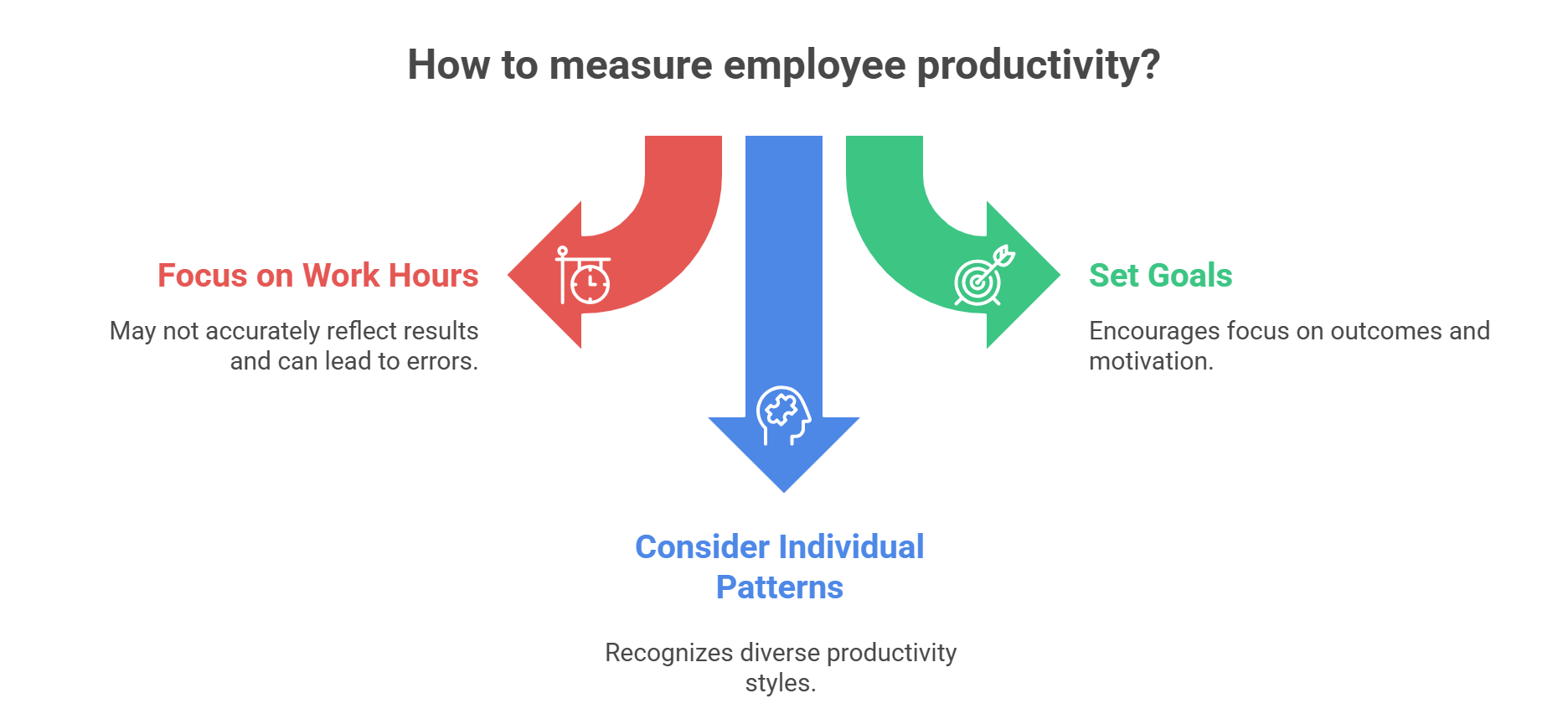
My boss agreed on that, and we started measuring the dev team’s progress, code quality, and feature delivery speed.
Run a 90-day productivity pilot with data
What the Data Told Us This Time
Now, before I share the results with you, let me tell you the consistency we have been getting for three months during the experiments.
For the first time, we have found consistency in feature updates from the entire dev team. All of them were submitting their work almost without errors. So, it was all a combined enhancement in team performance that we have noticed.
And can you tell what the data revealed when we sat with our employee monitoring tool’s insights? Here’s what we got:
- Our top performers had longer blocks of uninterrupted deep work.
- They took regular breaks, and when they logged off, they sat at the boundary of their personal horse. This was a reflection of their dedicated work hours.
- They worked during their personal peak hours instead of continuously working even when they had no focus at all.
- Their "idle time" often preceded their biggest breakthroughs.
- The overall dev team’s goal achievement has increased by 50%.
Build schedules around true peak performance
Closure
Tracking employees’ active hours is not an ideal method to measure their productivity. Instead, this traditional method often pushes teams toward burnout and meaningless activity.
On the other hand, when you start measuring the outcomes, it starts putting value into more focused and intentional growth.
When we stopped counting hours and started measuring impact, the entire scenario of how the team saw their goals changed. Our team worked smarter, stayed more engaged, and delivered better results. In the end, we found that productivity is not about staying busy. Instead, it’s the little progress that helps a company move forward, and this should be the priority of all modern teams.
About Author