


Free Working Hours Policy Template

Create clear rules for when employees work, how working hours are recorded, when breaks are taken, and how overtime, flexible schedules, remote work, and schedule changes are handled.
Download this employee working hours policy template in Word and customize it for your company, team structure, and local employment requirements.
Download Your Free Working Hours Policy Template
The editable template covers:

Working hours
Attendance
Timekeeping
Breaks and Overtime
Flexible work and Remote work
Schedule changes
After-hours communication
Responsibilities
Hours of work policy acknowledgment
What Is a Working Hours Policy?
An employee working hours policy is a written company policy explaining when employees are expected to work and how the organization manages working time.
A clear employee working hours policy answers practical questions such as:
- When does my workday start and finish?
- How many hours am I expected to work?
- How do I record the hours I actually work?
- What should I do if I'm late or absent?
- Do I need approval before working additional hours?
- When am I allowed to take breaks?
- Can I start earlier or later?
- Which time zone applies to remote employees?
- Am I expected to respond to messages after work?
Why Use a Written Working Hours Policy?
Working arrangements that seem obvious to one person may not be obvious to everybody. A written work hours policy template is particularly useful when:
You're hiring your first employees
Documenting working hours early helps establish consistent expectations before informal practices become the default.
Different teams follow different schedules
Some employees may work standard office hours while others work shifts, flexible schedules, part-time arrangements, or different time zones. An hours-of-work policy can clarify which rules apply across the company and where individual schedules may differ.
Your team works remotely or in a hybrid model
Remote employees need clear guidance about availability, time zones, working-time records, meetings, and after-hours communication.
Employees sometimes work overtime or additional hours
Your policy can explain when additional hours require approval, how actual hours must be recorded, and where employees can find the rules governing overtime compensation.
You need more reliable working-time records
A written hours of work policy can establish which timekeeping process employees should follow and how incorrect or missing records should be corrected.
You're introducing flexible working hours
Flexible schedules work better when employees understand core hours, availability requirements, approval procedures, and what flexibility does and doesn't change.
What Should a Working Hours Policy Include?
Most organizations should consider the following areas.
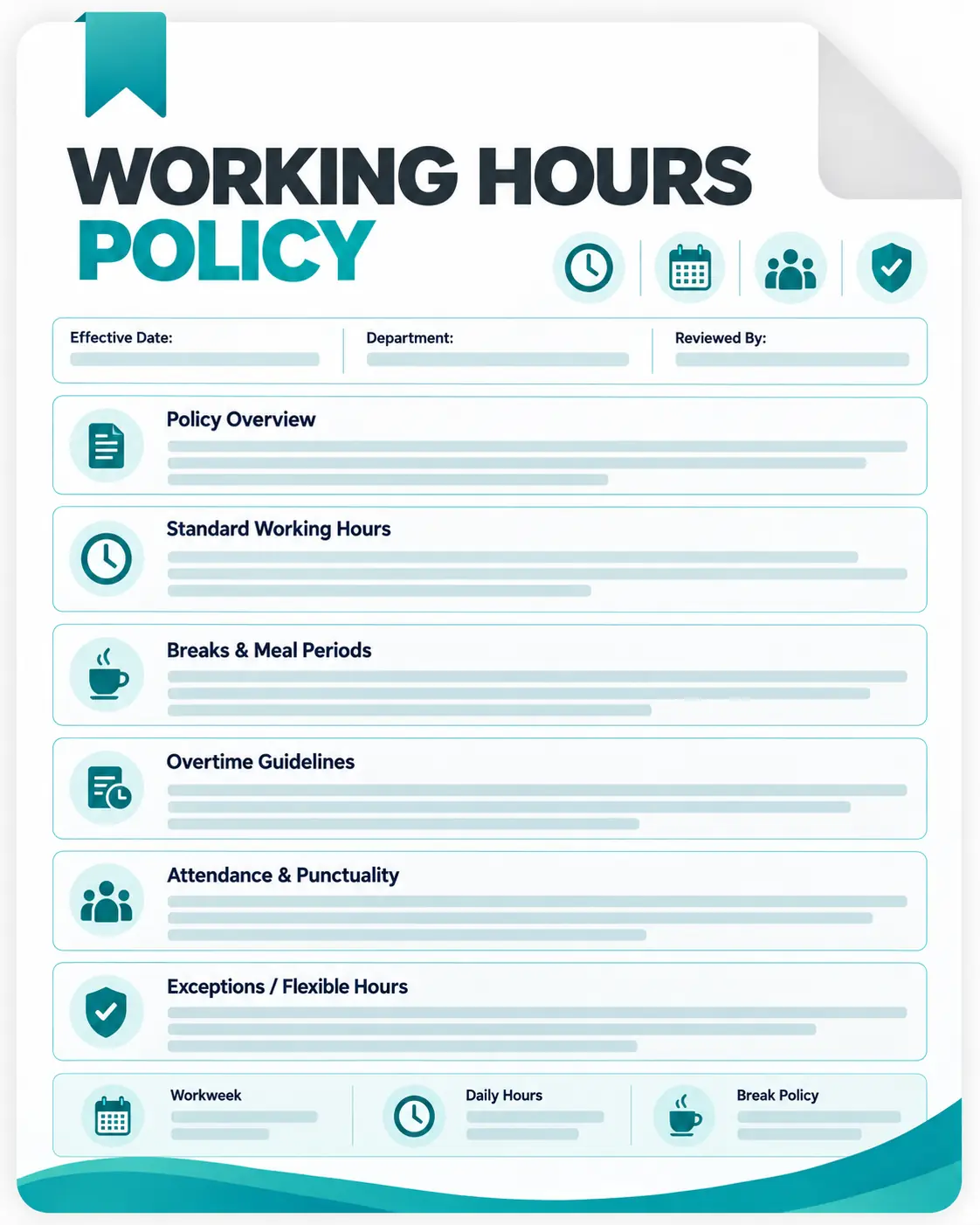
1. Standard Working Hours
State the normal number of hours employees are expected to work and when those hours are usually worked. Individual schedules may vary because of part-time arrangements, shifts, flexible working agreements, customer coverage, or role requirements. Do not copy a generic 40-hour, 48-hour, or 9-to-5 schedule simply because another company's policy uses one. Enter the schedule that applies to your organization.
2. Attendance and Punctuality
Explain when employees should be ready to work and how they should report lateness, absence, or early departure.
Your policy should make clear:
- Who employees should contact
- How they should notify the company
- When notice should be provided
- How planned and unplanned absences are handled
- Whether another attendance or leave policy contains additional rules
3. Recording Working Time
Explain how employees must record the time they actually work.
Your policy can identify:
Timekeeping system: [SYSTEM OR PROCESS]
Employees must record: [START/FINISH TIMES / TOTAL HOURS / BREAKS / PROJECT TIME]
Corrections should be submitted to: [MANAGER / HR / APPROVER]
Time records should reflect actual working time rather than simply copying scheduled hours.
Employees should know what to do if they forget to record time, make an incorrect entry, or need an existing entry corrected.
4. Breaks and Rest Periods
Document your organization's rules for meal periods and other rest breaks.
Specify:
- Meal break
- Other breaks
- Paid/unpaid status
- Scheduling requirements
5. Overtime and Additional Hours
Explain what employees should do before working beyond their normal schedule.
For example:
- Overtime approval required from: [ROLE]
- Approval method: [PROCESS]
- How additional time is recorded: [PROCESS]
- Where overtime compensation rules are documented: [POLICY / CONTRACT / AGREEMENT]
6. Flexible Working Hours
If your company offers flexible schedules, describe what flexibility actually means. Depending on the organization, flexible working arrangements could include:
- Earlier or later start and finish times
- Staggered schedules
- Core collaboration hours
- Compressed workweeks
- Split schedules
- Individual arrangements approved by management
7. Shift and Schedule Changes
Explain how employees can request a change to an existing schedule.
Include:
Minimum notice: [TIME PERIOD]
Request submitted through: [PROCESS]
Approver: [ROLE]
Shift-swapping rules: [DETAILS]
Managers should communicate material schedule changes as early as reasonably possible and follow applicable scheduling requirements.
8. Remote and Hybrid Working Hours
Remote work changes location, but it doesn't eliminate the need for clear working-time expectations.
Define:
Applicable time zone: [TIME ZONE / EMPLOYEE LOCAL TIME]
Expected availability: [HOURS]
Core collaboration hours: [HOURS]
Timekeeping requirements: [PROCESS]
Remote schedule exceptions: [DETAILS]
Employees working remotely should understand whether the same attendance, break, overtime, and time-recording rules apply outside the office.
9. After-Hours Communication
Clarify whether employees are expected to respond to messages outside their scheduled working hours.
A policy might state:
Employees are not expected to remain continuously available outside scheduled working hours unless their role includes an agreed-upon on-call, emergency, or after-hours responsibility.
A message sent outside someone's normal working hours should not automatically be treated as requiring an immediate response unless your policy or the employee's role specifically says otherwise.
Adapt this provision to any applicable right-to-disconnect or working-time requirements.
10. Employee and Manager Responsibilities
Employees are responsible for:
Following their approved schedule, recording working time accurately, taking required breaks, requesting schedule changes through the appropriate process, obtaining required approval for additional hours, and raising problems with incorrect records.
Managers are responsible for:
Communicating schedules clearly, applying working-hours rules consistently, reviewing working-time records where required, responding to schedule requests, allowing legally required breaks, and addressing recurring excessive hours or workload concerns.