7 Call Center Management Skills That Drive Results
Key Takeaways
-

Call center management skills to have: Leadership, data analysis, workforce management, technical proficiency, strategic thinking, communication, and conflict resolution
-
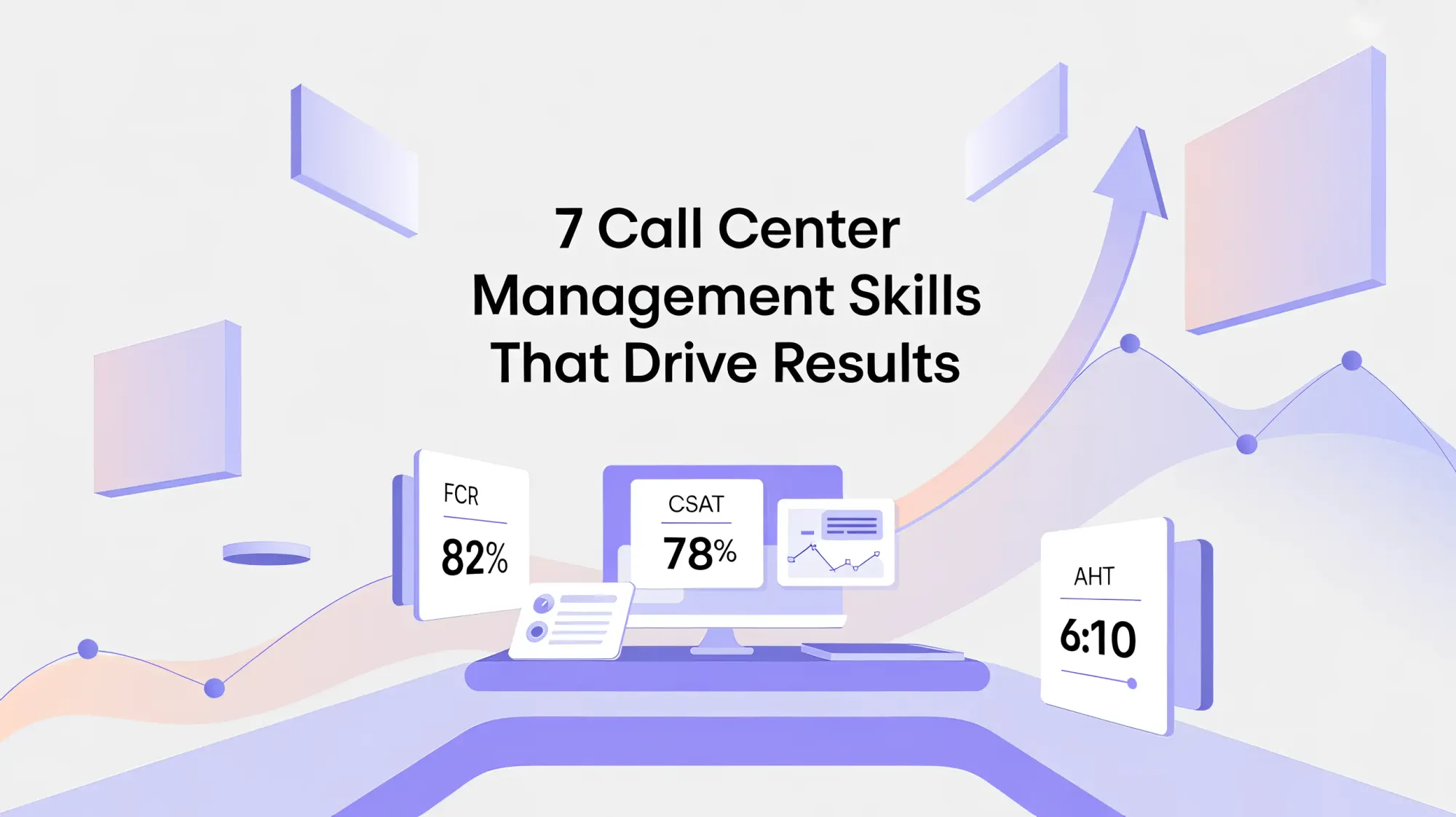
Key benchmarks to track: FCR (70–79% good; 80%+ world-class), AHT (6 min 10 sec average), CSAT (78% average), and Call Abandonment Rate (under 5%).
-
Best practices include regular QA checks, tight SOPs and SLAs, ongoing agent development, and building a culture of empathy and recognition.
Most call center managers are promoted because they were excellent agents — not because they were trained to lead. That mismatch is costly. Agent turnover in contact centers ranges from 30% to 45% annually. Poor management is one of the top drivers of this issue.
The skills that help you resolve a customer complaint are not the same ones that help you run a contact center. Leadership, data analysis, call center workforce management, and conflict de-escalation are all different muscles — and most managers build them on the job, the hard way.
This guide breaks down the call center management skills that matter most. Whether you run an in-house support center, a virtual call center, or a hybrid team, these are the competencies that separate reactive managers from effective ones.
What Skills Does a Call Center Manager Need?
Leadership and Team Motivation
A contact center lives or dies by its people. When agents feel unseen or undervalued, they leave. And the cost of replacing one agent? In the ballpark of $10,000 to $20,000. That means leadership is not just a soft skill; it's a financial lever.
Strong managers build trust through consistency. If you want to be one, you need regular one-on-ones, provide timely feedback, and publicly recognize efforts. You might think rewards will add too much cost. However, it doesn’t have.
A shout-out in a team channel or a small performance reward is good enough. Stats also indicate the same: 69% of employees state that they work harder if efforts are better recognized.
Culture matters more in a call center than in most other environments. Why? Because agents are always tested for their patience and stress management. Managers who create a psychological safety culture win in the long run.
As a result, agents experience lower burnout and better First Call Resolution (FCR) rates. Coaching also helps if it is conducted regularly (ideally every week, with 15–30 minutes allocated per agent).
Reducing staff turnover also comes down to offering a clear career path. Agents want a clear progress graph. If you can show them that, they tend to stay longer and perform better. Leadership means making that path visible.
See team productivity trends with Apploye
Data Analysis and Performance Metrics
A manager who does not track KPIs is flying in uncharted territories. The core metrics for any help desk or call center service operation are not limited to:
- Average Handle Time (AHT): Total talk time + hold time + after-call work ÷ number of calls. The current industry average is 6 minutes 10 seconds. AHT should be balanced against quality. A too-short AHT often signals rushed calls and lower CSAT.
- First Call Resolution (FCR): The % of issues resolved on first contact. A good FCR rate is 70–79%; world-class is 80% or higher.
- Call Abandonment Rate: Customers who hang up before reaching an agent. An industry-standard target is under 5%. Abandonment spikes sharply when hold times exceed 2 minutes.
- Customer Satisfaction Score (CSAT): Usually, the scores are collected via post-call surveys. The industry benchmark average is 78%, with world-class centers hitting 85% or above.
- Net Promoter Score (NPS): Measures how likely customers are to recommend your service. A score above 20% is considered good.
Data analysis means more than going through a dashboard. It means spotting patterns that reveal issues or anomalies. Which call types drive long AHT, which agent cohort has low FCR, and when abandonment rates spike during the week? That pattern recognition is what turns KPIs into action.
Track apps, URLs, time, and activity in Apploye
Workforce Management (WFM)
Remote Workforce Management system is the discipline of having the right number of skilled agents available at the right time. In a call center, over- and understaffing both have direct costs.
Resource-related costs account for approximately three-quarters of a contact center's full operating budget. Overstaffing wastes that budget; understaffing leads to agent burnout, longer wait times, and a higher abandonment rate.
The foundation of WFM lies in accurate forecasting. Good managers utilize historical call volume data, seasonal trends, and day-of-week patterns to create effective schedules. They also account for shrinkage.
Shrinkage means the % of paid time that agents spend on non-customer-facing activities. That includes breaks, training, meetings, and unplanned absences. The acceptable range is 25–35% (industry standard).
The formula is:
Skills-based routing is another WFM lever. It’s a manager's job to route the call to agents who can solve the specific issue customers are having. This skill has two benefits: reduced handle time and better CSAT.
Advanced WFM tools using this approach can improve first-call resolution by 15–20%.
Technical Proficiency and Adaptability
The technical skills for a call center manager have expanded significantly. Running a modern contact center now requires working with multiple tools:
- CRM platforms (Salesforce, HubSpot, Zendesk) for customer history, ticket management, and agent context
- Automated call routing and IVR systems that reduce misdirected calls
- AI-powered QA tools that can analyse 100% of calls rather than a sample
- Workforce management software (WFM) for forecasting, scheduling, and adherence tracking
- Omnichannel support systems that unify phone, chat, email, and messaging into one agent interface
Technical proficiency makes sense when looking at industry growth data. The global call center software market was valued at over USD 41.7 billion in 2025. Throughout 2033, it is projected to grow with a 21.9% CAGR through 2033.
That’s why managers need to learn the QA, WFM, and CRM platforms. Without being proficient, it’s extremely difficult to have a significant piece of the growth pie. Adaptability, willingness to learn new platforms and change old processes, is itself a core management competency.
Use Apploye screenshots and screen recording for QA visibility
Strategic Thinking and Problem-Solving
Managers who only respond to problems are always behind the curve. Strategic thinking means identifying root causes, not just symptoms. If AHT is rising, is it a training gap? A broken IVR script? Strategic thinking means understanding why the problems are happening.
When a complex customer issue escalates to a manager, the approach to resolution matters. Start with acknowledgment: validate the customer's frustration before jumping to solutions. Then isolate the issue, confirm what the customer actually needs, and offer a clear path forward.
Callback and text-back options are highly effective in this scenario. Most callers will hang up after waiting around 1 minute if there is no update/wait time. Offering a callback eliminates that frustration. It also signals that the service center values its time.
However, many managers tend to think of problem-solving as separate issues. What they don’t realize is that resolving issues is a system. It involves the management of reducing repeat calls, AHT, abandonment, and improving CSAT simultaneously.
Clear Communication
Communication in a call center flows in multiple directions. Upward to leadership, laterally to peers, and downward to agents. Each requires a different communication language, and managers sit right at the center.
With agents, clarity and specificity matter most. Just a 'You need to improve your AHT' is directionless and unactionable.
'Your average hold time is 90 seconds above the team median. Let’s take 3 calls together and figure out why that’s happening' is. Feedback should be specific, guided, and tied to an actionable step.
The same can be said for company goals. An agent does not inherently care about the company's NPS target. That’s why tying monthly performance rewards and recognition to company targets matters. The manager's job is to do that.
Clear communication also means keeping agents informed in each process. Target changes, product updates, and policy shifts require a clear flow. A help desk agent blindsided by a policy change on a live call will fall onto the manager’s shoulders.
Use activity data from Apploye for better and clearer coaching
Conflict Resolution
Conflict is a common occurrence in a call center environment. It shows up between agents, between agents and team leads, and most importantly, between agents and customers.
For agent-to-agent conflict, managers should address issues early and privately. Unresolved friction spreads, reduces team morale, and diminishes the overall productivity of the workforce.
For agent-customer conflict, the priority is de-escalation. Train agents to use lowered volume, slower speech pace, and empathetic phrasing. For example: I understand why that's frustrating — let me see how I can help you. Managers should listen to escalation calls regularly and identify patterns. If the same issues continue, it’s a process problem, not an agent issue.
However, managers should always keep agents' best interests in mind. Problematic and abusive callers are very common. 88% of call center professionals agree that burnout is one of the biggest challenges. Unmanaged hostility from customers is a significant driver. Having a clear policy for ending calls and backing agents who use it is a legitimate management skill.
How Do High-Performing Call Center Managers Operate?
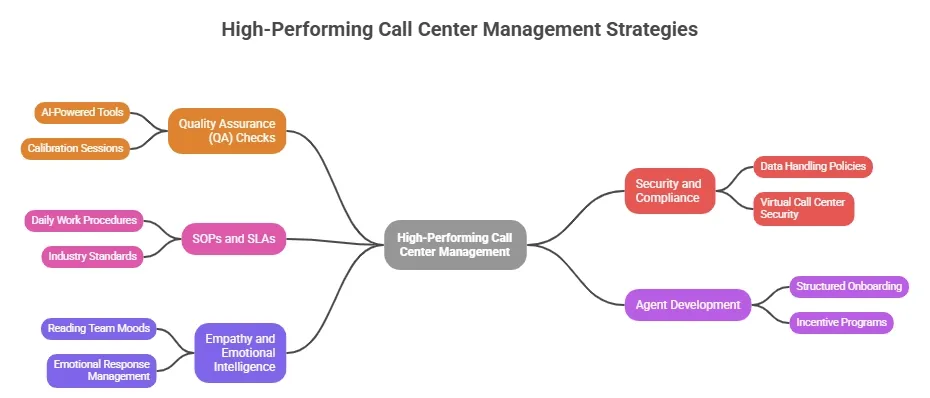
Great management comes down to consistency. Regular QA checks, clear SOPs, tight security protocols, and ongoing agent development are what separate the good from the best.
Quality Assurance (QA) Checks
Regular QA is the feedback loop that keeps a call center improving. Before AI, even the best programs could sample only 5-10% calls at times. However, AI-powered QA tools now enable the evaluation of 100% of calls at scale. It has completely changed how calls are flagging issues in real-time.
Why QA checks matter? When QA is effective, you can expect a 5-15% improvement in FCR. Effective QA means more than scoring calls. It means sharing findings with agents in a coaching context. Sharing updates of scripts and knowledge-base articles when patterns emerge. It also involves reviewing QA criteria regularly to reflect current customer expectations.
Additionally, managers should also conduct calibration sessions. Here, QA evaluators independently score the same call and then compare their scores. Inconsistent scoring undermines agent trust in the QA process entirely.
Security and Compliance
Call centers deal with sensitive data. That includes payment information, health records, account credentials, and personal details. Compliance obligations vary by industry and region. For example, PCI-DSS for payments, HIPAA for healthcare, and GDPR for European customers, but the baseline is the same. Agents must know boundary of handling sensitive customer data.
As a manager, you should start with a training module for data handling policies. In the module, compile the best practices: call recordings access & storage, accounting data, and other regulatory processes. A poorly handled security incident compounds the original problem.
In a virtual call center, security risks increase. Managers should ensure VPN usage, screen sharing policies, and clean desk rules are enforced. On top of that, using a complete call center monitoring tool ensures the policies are followed in real-time.
Use Apploye screenshots for audit-ready oversight
SOPs and SLAs
Standard Operating Procedures (SOPs) and Service Level Agreements (SLAs) are the infrastructure of a well-run support center. SOPs document how specific call types are handled in every step. It’s a daily work procedure that ensures quality remains unchanged, regardless of who’s handling the calls.
The industry SLA standard is answering 80% of calls within 20–30 seconds. It’s also commonly known as the 80-20 rule (80% calls in 20 seconds). Managers who treat SLAs as minimum standards create the conditions for a consistent customer experience.
However, managers should also review the SOPs regularly to modify and update them as per regulations or industry movement. Otherwise, the ‘standard procedure’ can become outdated.
Agent Development
Agent development is a retention strategy. 94% of employees say they would stay at a company longer if it offered better career development.
Development in a call center context starts from the structured onboarding (ideally 3–4 weeks minimum). Then followed by regular one-on-one coaching, self-paced learning access, and visible career growth. That can be toward senior roles like quality analyst positions or team lead opportunities.
Incentive programmes go hand-in-hand with career development. A company that recognises agents' performances is expected to offer a transparent career graph. Gamification - leaderboards, point systems, performance-based rewards - works well in environments where agents are doing repetitive work. Recognition should be immediate and specific to the behavior being rewarded.
Clear performance expectations matter equally. Agents perform better when they know exactly what ‘good’ looks like, how it is measured. And what the gap is between their current performance and the next level of excellence.
Empathy and Emotional Intelligence
Empathy is not just a customer-facing skill. In call center management, if a manager is an ex-agent, then he’s most likely to understand better. Because that person already knows what it feels like to take fifty escalated calls in a day. So, when the manager builds policies, they incorporate that empathy.
Emotional intelligence in management means accurately reading team moods. And adjusting communication styles for different team members. It also demands the knowledge of understanding who’s on the verge of burnout. Regular pulse checks, like short surveys or informal one-on-ones, surface early signals.
It also means checking your own emotional response under pressure. A manager who escalates during a volume crisis creates panic in the team. The manager who leads calmly gains the trust and respect of the agents.
Conclusion
Great call center managers aren't born — they're built through deliberate skill development. Track the right KPIs, coach consistently, build solid SOPs, and invest in your agents' growth.
Whether you run an in-house contact center or a virtual call center, these skills are what turn a reactive team into a high-performing one.
Start monitoring call center work with Apploye for free
Frequently Asked Questions
What are the 7 essential call center skills every agent should have?
The seven key skills are: active listening, clear communication, empathy, patience, problem-solving, product knowledge, and adaptability. Active listening helps agents resolve issues faster. Empathy and patience are critical during difficult calls. Adaptability matters as contact centers add new tools and channels.
How do you manage high call volumes while maintaining quality customer service?
Use historical data to forecast peak periods accurately. Skills-based routing ensures calls reach the right agent. AI chatbots can deflect routine inquiries effectively. Offer callbacks instead of long hold queues. This reduces abandonment and relieves agent pressure.
Which call center KPIs should a manager track?
Track FCR, AHT, CSAT, Call Abandonment Rate, and Service Level. Also monitor NPS, Average Speed of Answer, and agent occupancy. For workforce health, track shrinkage and employee satisfaction scores regularly.
How can I reduce AHT without hurting CSAT?
Reduce friction in the agent's workflow, not the conversation. Improve knowledge base access to cut mid-call search time. Use AI tools to streamline after-call wrap-up. Rushing customers lowers CSAT. Process improvements reduce AHT without sacrificing quality.
What is shrinkage in a call center, and how do you calculate it?
Shrinkage is the time agents spend on phones. It includes breaks, training, meetings, and unplanned absences. Formula: Shrinkage (%) = Total Shrinkage Hours ÷ Total Available Hours × 100. The acceptable industry range is 25–35%.
What are common call center management interview questions?
Expect questions about reducing turnover and handling underperformance. Interviewers often ask how you balance metrics with agent well-being. Questions like "How did you improve FCR?" are common. Strong answers are specific, data-driven, and outcome-focused.
What skills should I put on a call center manager resume?
List CRM platforms, WFM tools, and call center software experience. Highlight KPI management, QA, SLA compliance, and IVR knowledge. Include coaching, conflict resolution, and performance management skills. Always quantify results — numbers make your experience stand out.
About Author