What is remote employee monitoring software?
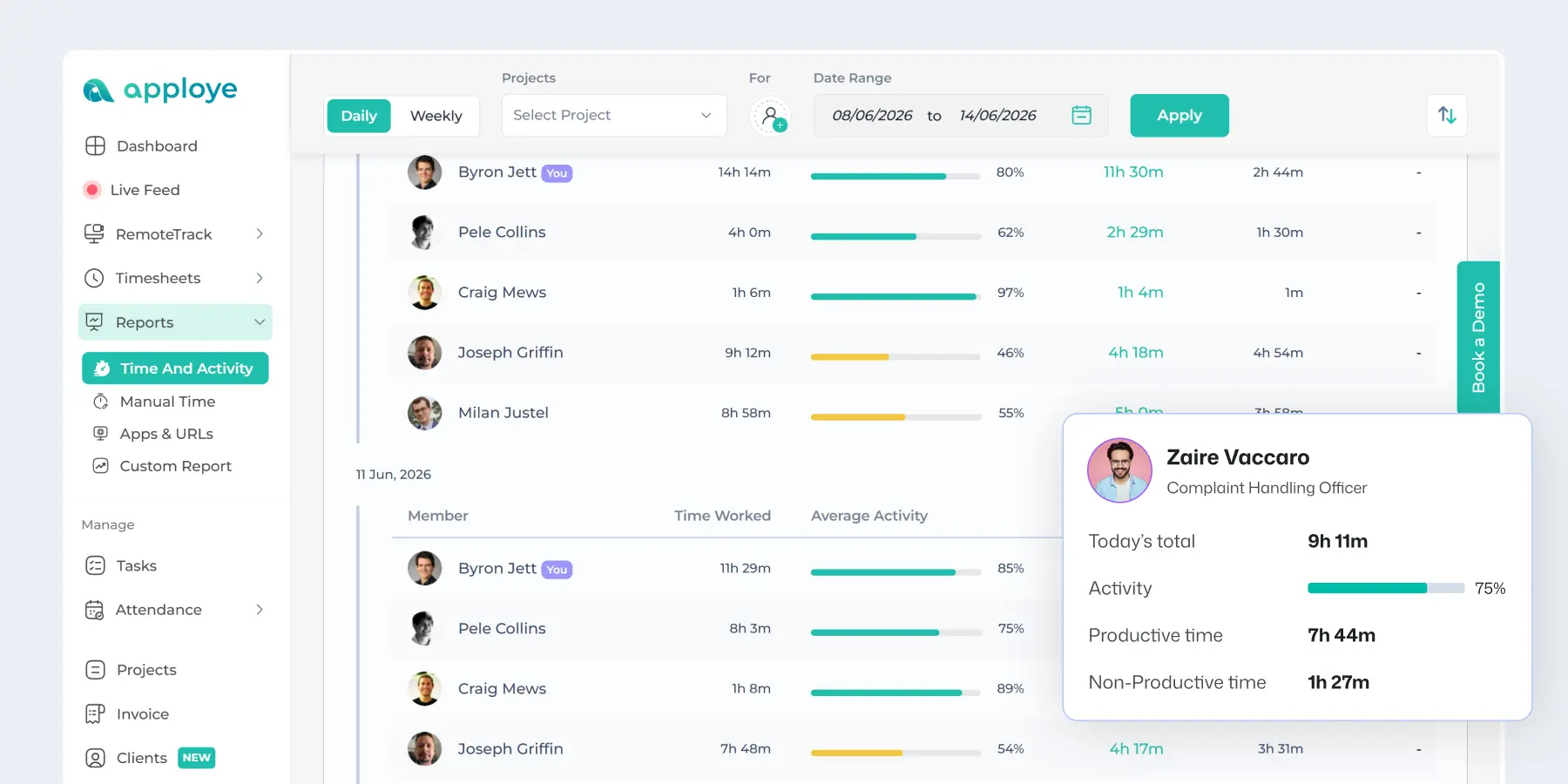
Remote employee monitoring software is a tool that shows you how your team spends their work hours when they're not in the office. It tracks time, apps, and websites used, activity levels, and screenshots, then puts it all in one dashboard you can actually read.
Think of it as the visibility you'd get from walking past someone's desk, except your team works from home, a café, or three time zones away.
You hire good people. You trust them. But trust doesn't tell you why a deadline slipped or which projects are quietly going over budget. That's the gap this software fills.
Why do companies use employee tracking software for remote teams?
When people work from home, it's good to keep track of how they spend their time. This helps them stay focused and get more done.
A user activity monitoring tool for remote teams that watches what workers do can help them stick to their tasks. And develop healthier work habits.
Working from home is nice because you can be comfy and do things your own way. But sometimes it's hard to focus at home in a remote environment.
Workers might end up scrolling Facebook, reading the news, or shopping online instead of working. These distracting activities affect productive work time.
If you're the boss, you can't see what your workers are doing at home. That's where virtual employee monitoring systems come in handy.
These remote employee performance tracking software show you what websites your workers visit. How much time do they spend working versus doing other things? This way, you can make sure everyone is using their time well and avoid burnout.
The remote team surveillance software gives you detailed reports that tell you exactly how your team spends their day. This makes it easier to spot potential issues. Then fix them quickly while maintaining work-life balance.
How does remote employee monitoring software work?
Your employees install a small app on their computer. It runs in the background while they work and sends data back to a dashboard that only managers can see.
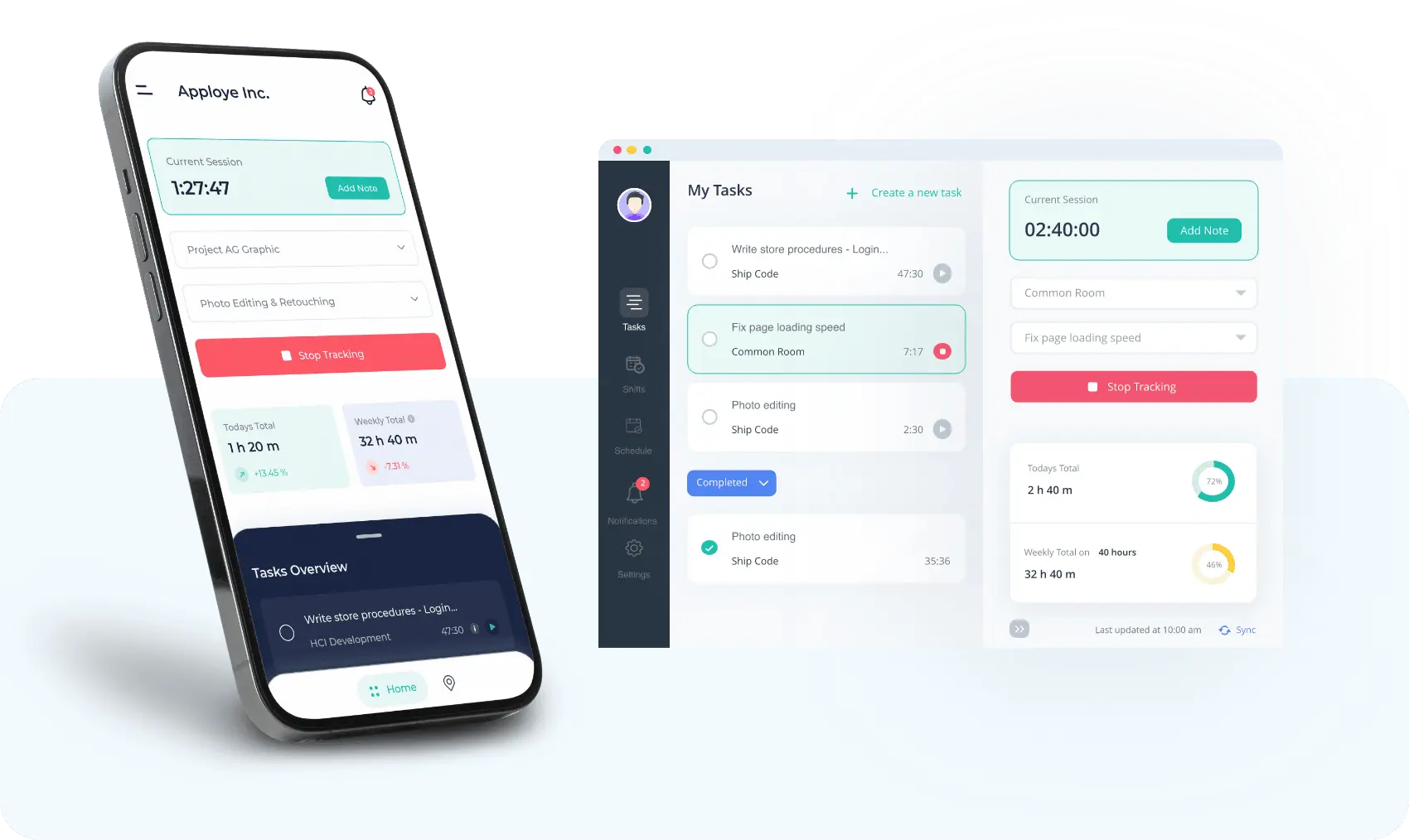
Apploye works through a desktop app, a mobile app, and a Chrome extension. It runs on macOS, Windows, Linux, and Android, so mixed-device teams aren't a problem.
The employee hits "Start Tracking" when they begin work. From there, the app logs hours, activity, and the rest automatically.
What does remote monitoring software actually track?
Most tools, Apploye included, track some mix of these:
- Time worked — clock-in, clock-out, and total hours per day
- Active vs. idle time — when someone is at the keyboard vs. away from it
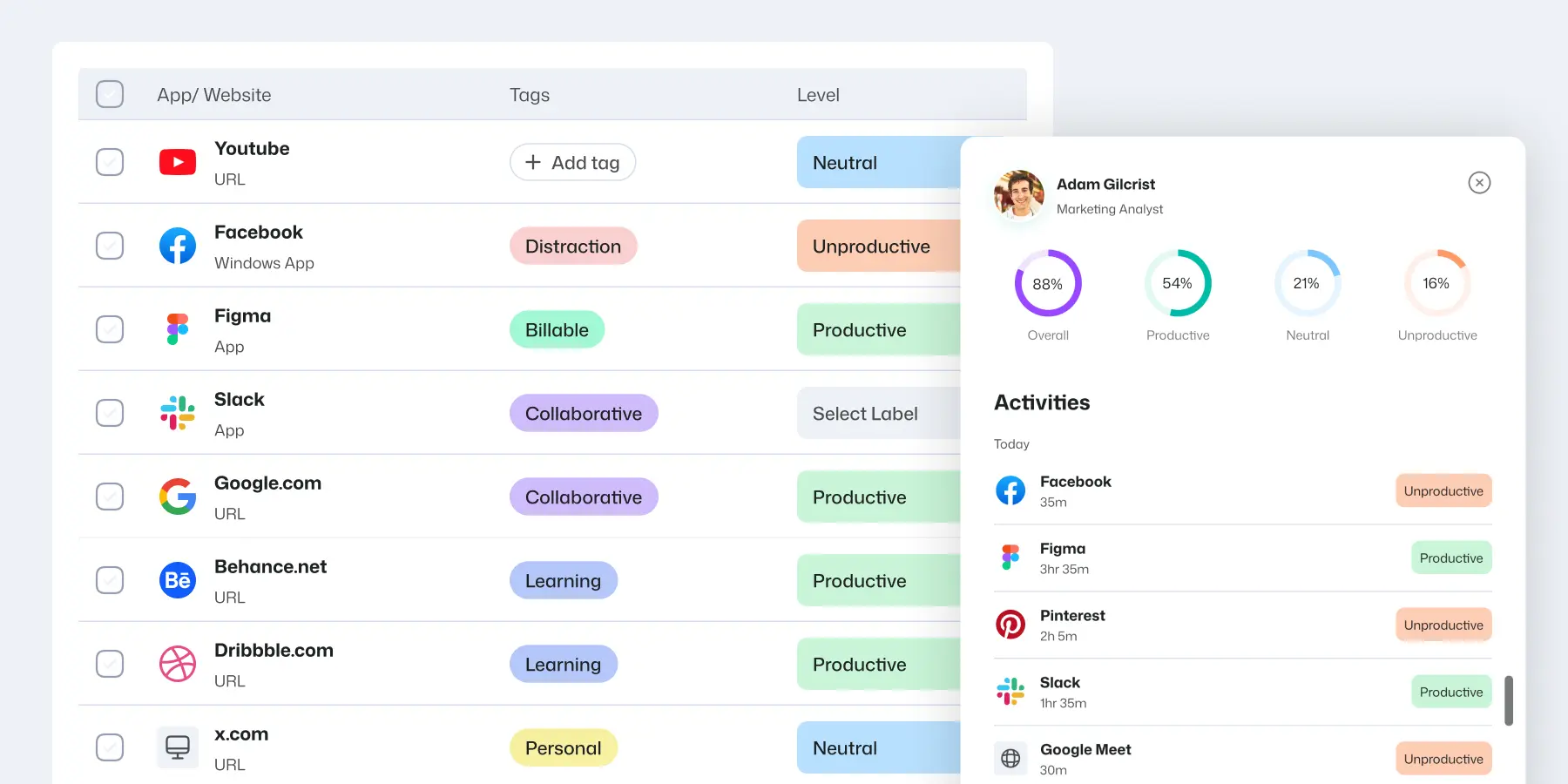
- Apps and websites — which software and URLs were used, and for how long
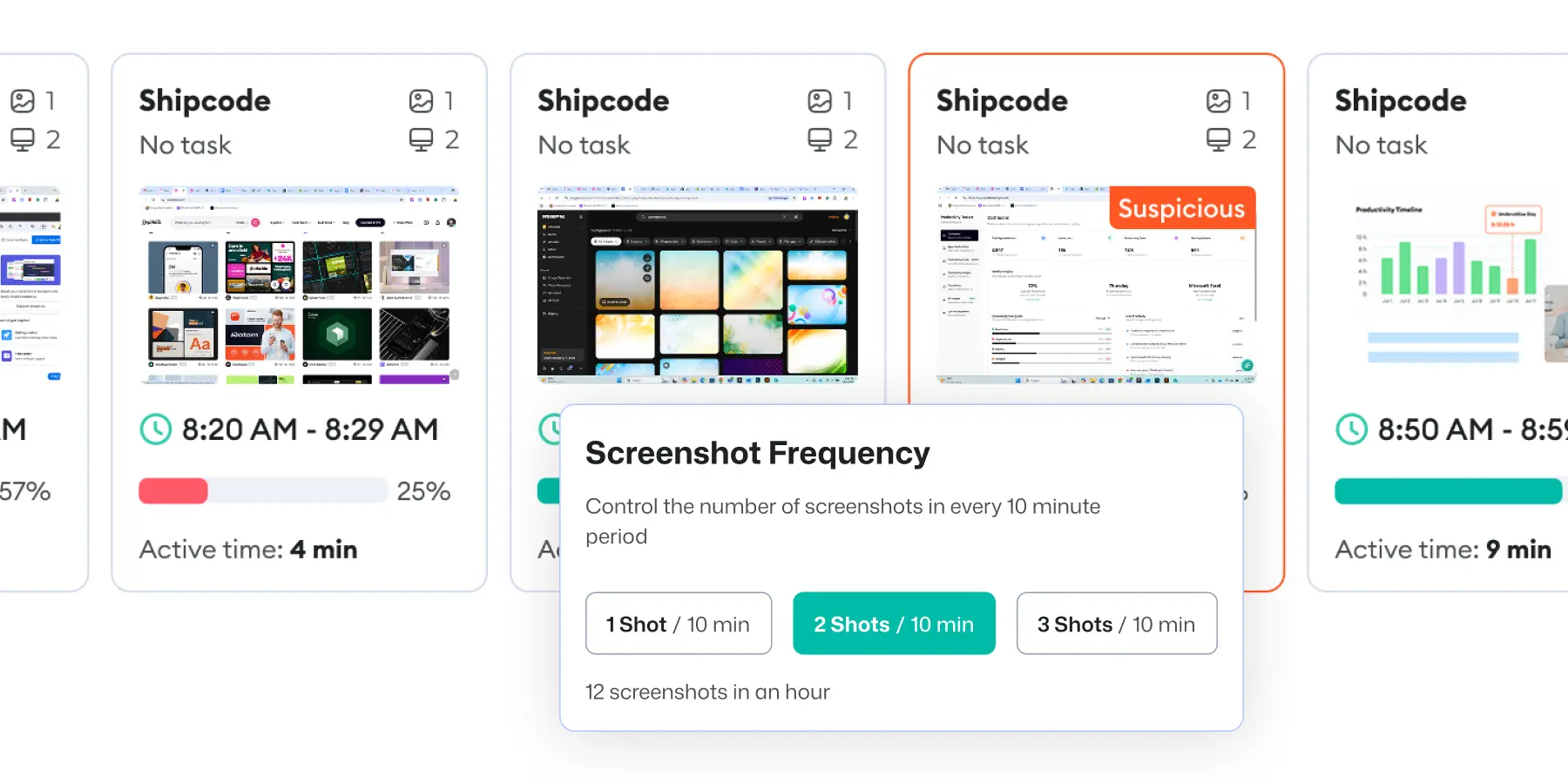
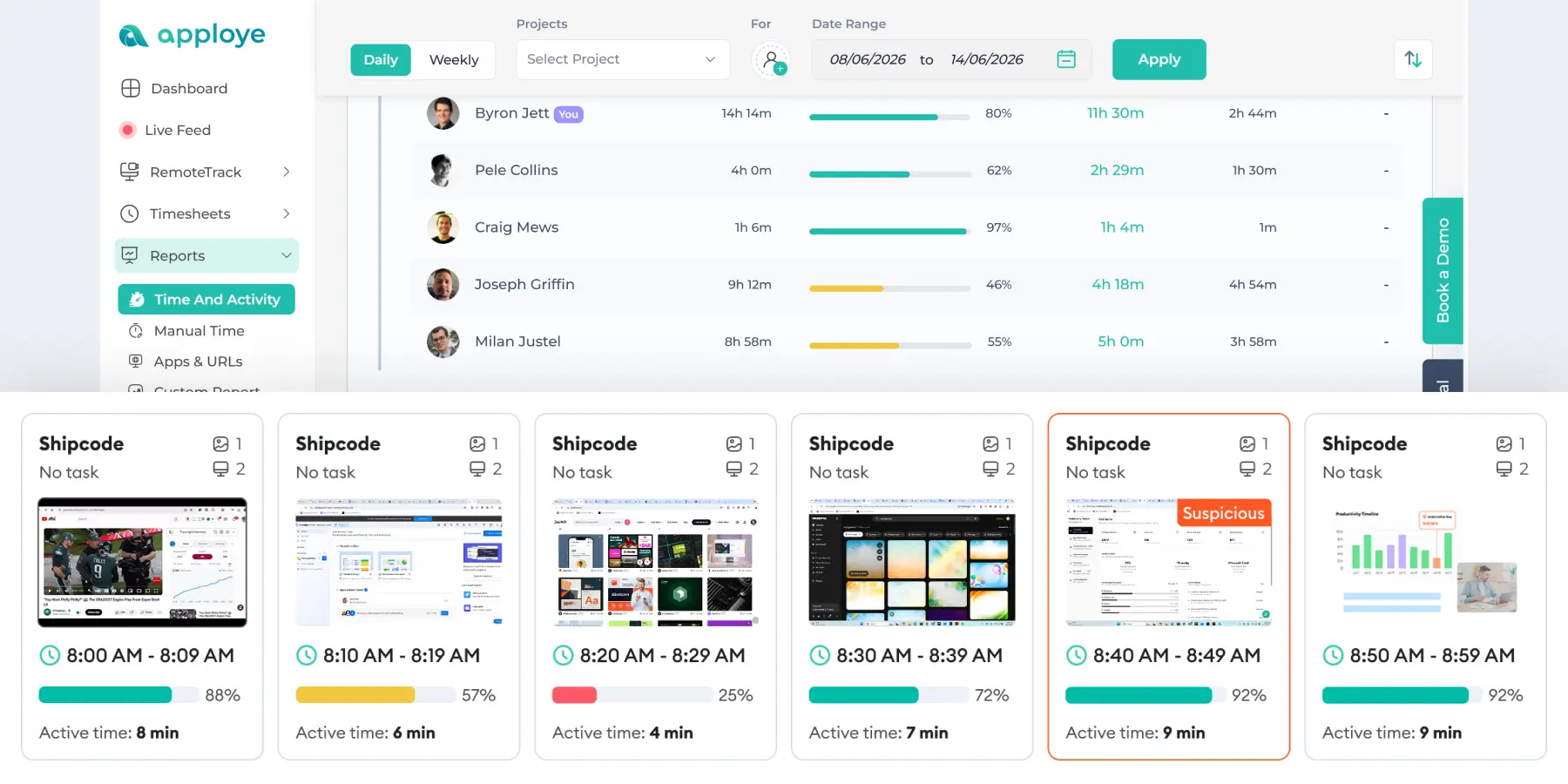
- Screenshots — periodic images of the screen as proof of work
- Screen recording — full session employee screen video recording
- Activity levels — a percentage based on keyboard and mouse use
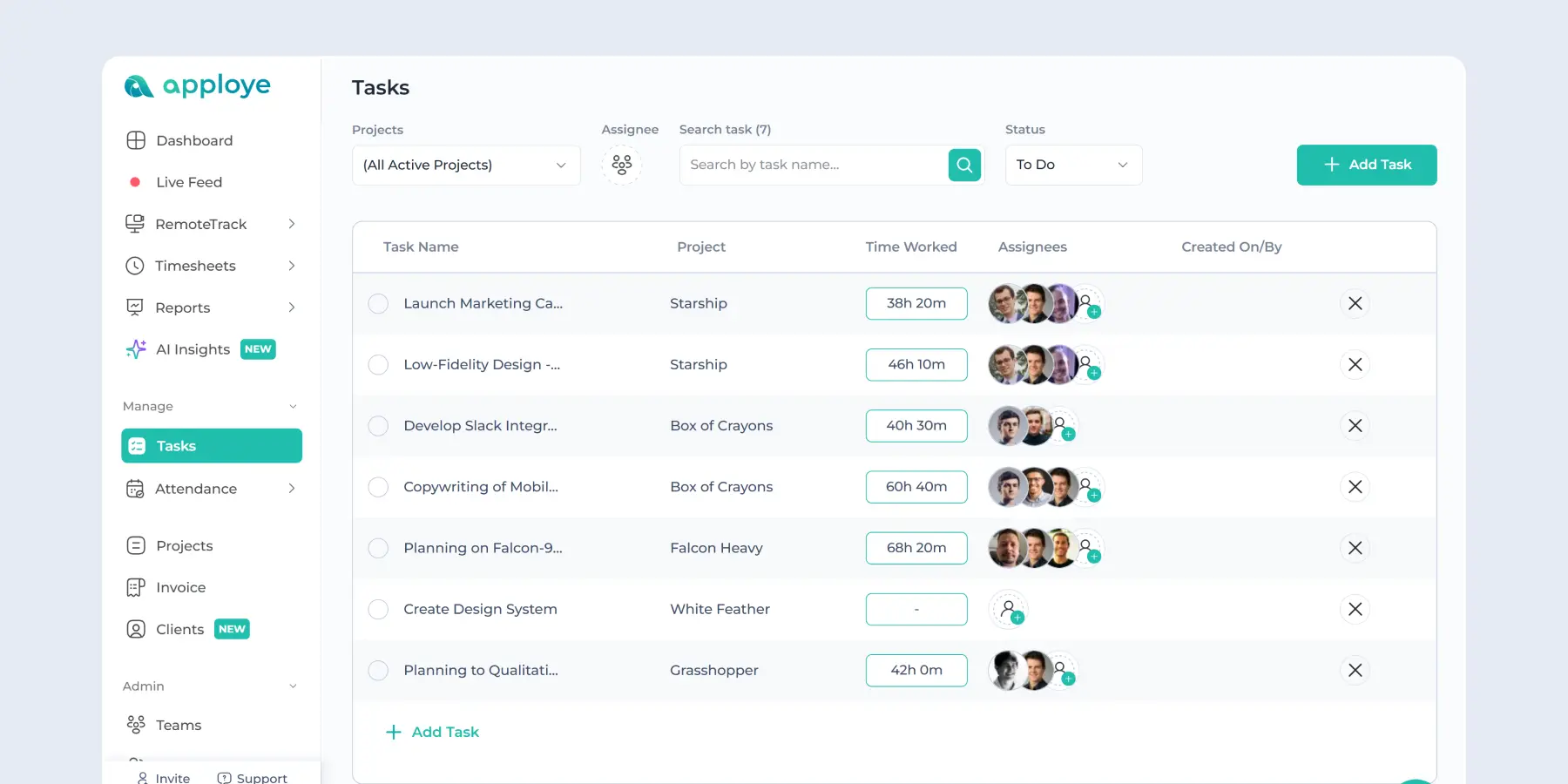
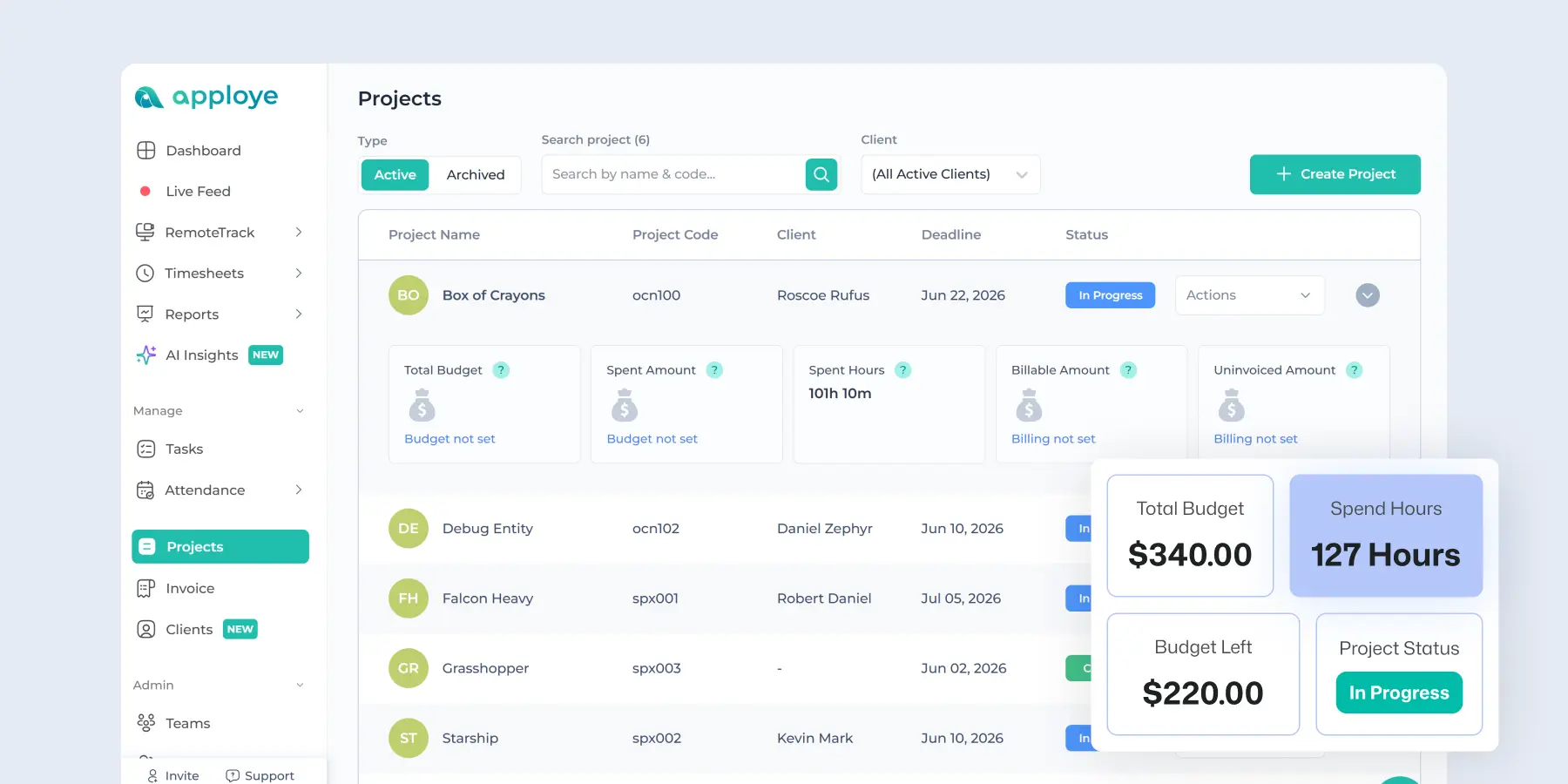
- Projects and tasks — time spent on specific work
Here's what good software does not do:
- snoop on personal devices
- Read private messages on personal accounts
- Watch people off the clock
What's the difference between time tracking and employee monitoring?
People mix these up all the time. The time tracking tools answer "how many hours?" Monitoring answers "what happened during those hours?"
Time tracking gives you a number. Monitoring gives you context — the apps, the activity, the screenshots behind that number.
You usually want both. And Apploye does both in one place, so you're not paying for two tools or stitching reports together.
How to monitor remote employees
How do I monitor remote employees effectively?
Good monitoring is a method, not just installing an app. Here's a six-step approach that keeps your team on board instead of on edge.
- Set clear goals. Decide what you actually need to see. Hours? Output? Project budgets? Start there.
- Write a simple policy. One page covering what you track, why, and how the data gets used.
- Pick the right tool. Match features to your team size and work style.
- Onboard openly. Tell people what's tracked before day one. Surprises break trust fast.
- Review the reports. Look weekly, not obsessively. Patterns matter more than single days.
- Coach with the data. Use what you see to support people, not to punish them.
Skip step four, and you'll get backlash. Nail it, and most teams barely notice the software is there.
How do employers monitor employees who work from home?
There are a handful of common methods, and most tools combine a few:
- Automatic time tracking — logs hours without manual entry
- Screenshots — captured at set or random intervals
- App and URL logs — show what was used during work time
- Activity percentage — measures keyboard and mouse use
- Screen recording — captures full work sessions for review
Apploye covers all of these.
How can I tell if my remote employees are actually working?
This is the question that sends most managers looking for software in the first place. The honest answer: you look at patterns, not single moments.
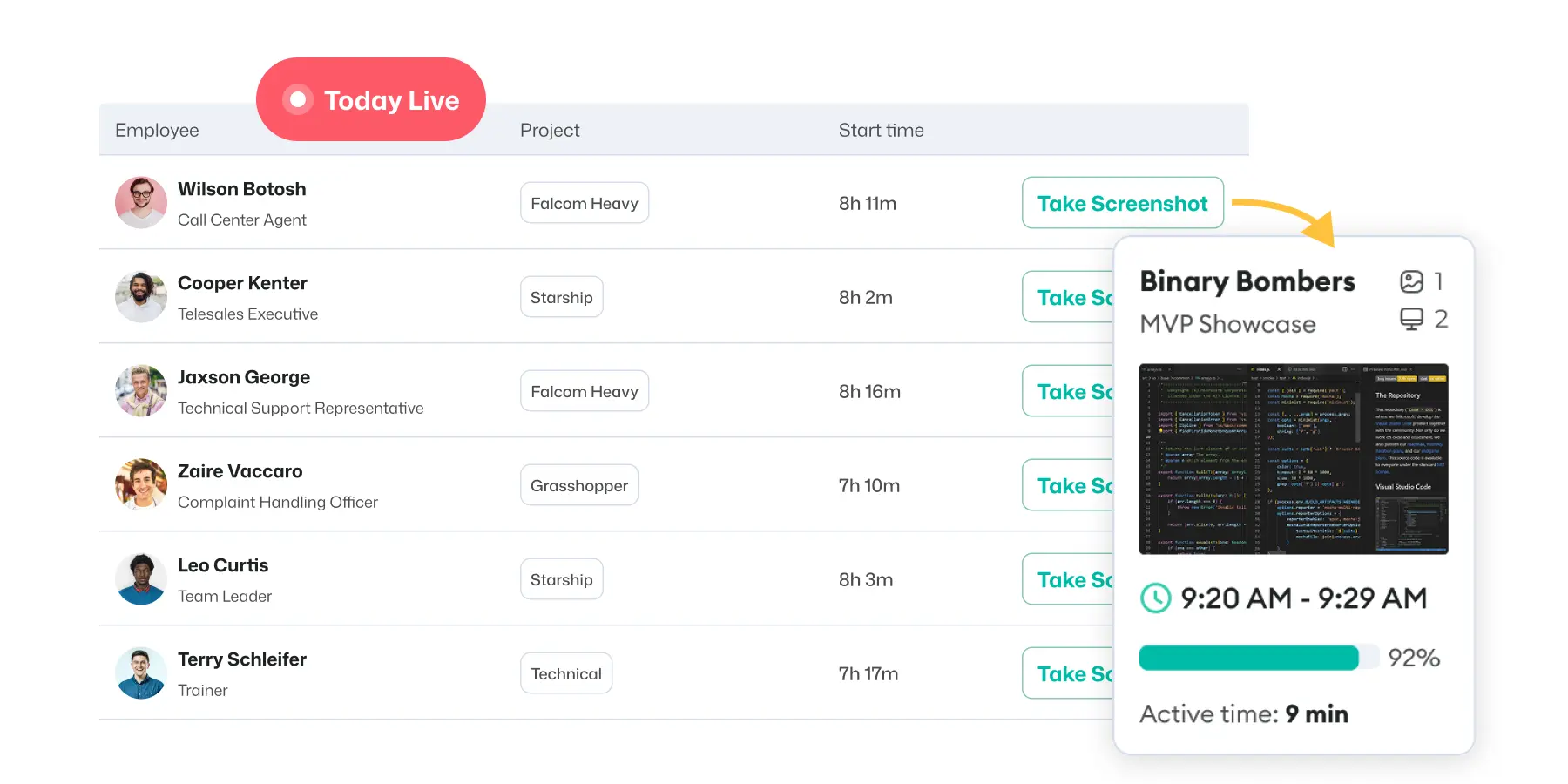
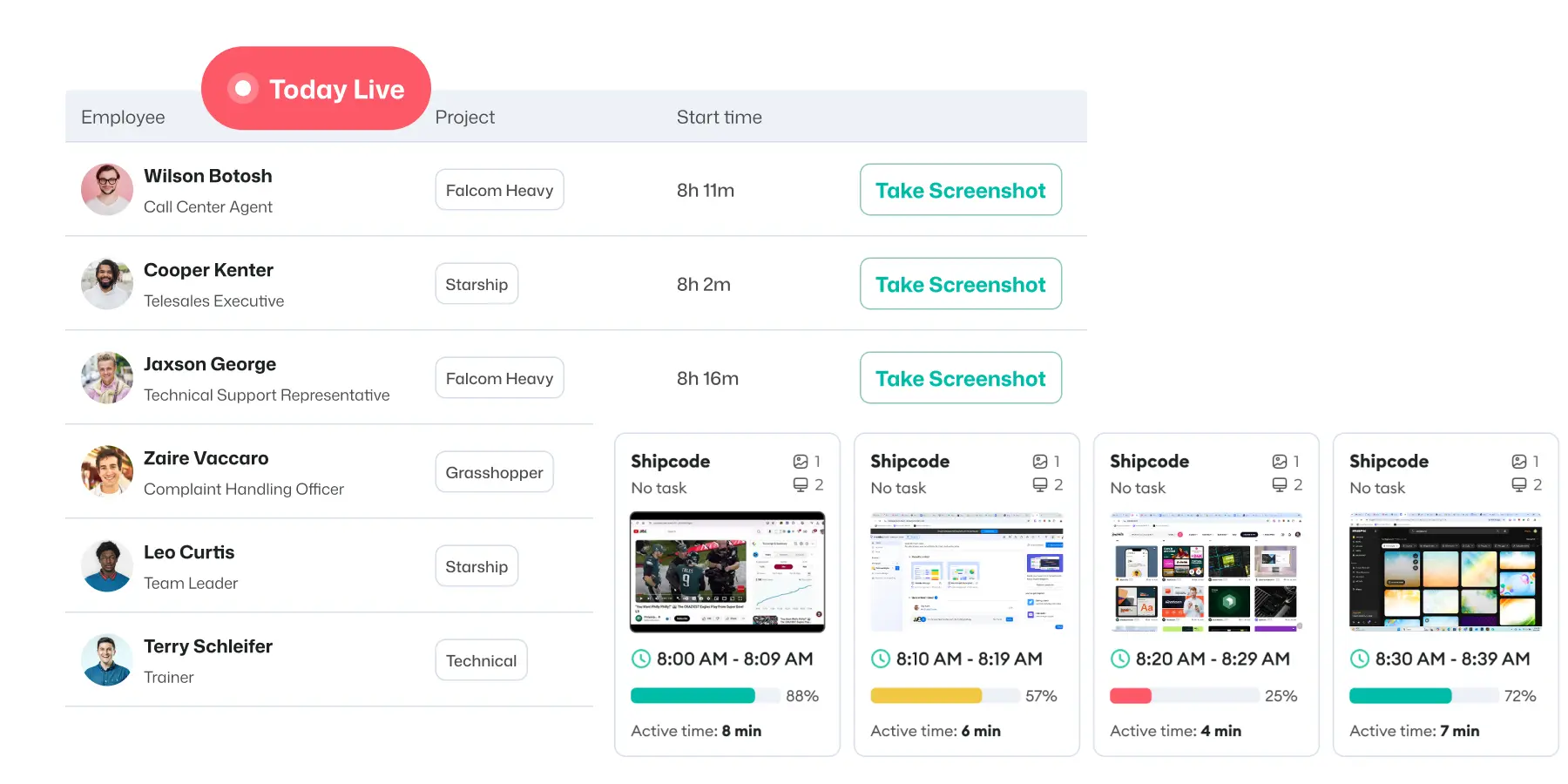
Apploye's Live Feed shows you who's working right now and on what. You can take a real-time screenshot to see exactly what's on screen at that moment.
Then there's screen recording. Most tools grab a screenshot every ten minutes. But, Apploye can record the full session, so if a support rep handled a tricky customer chat, you can watch the replay start to finish instead of guessing from three stills.
One caution: don't treat a quiet hour as proof someone's slacking. People read documents, take calls, and think. Activity data is a starting point for a conversation, not a verdict.
How do I have remote employees clock in and out?
Your team is spread across time zones, so you can't rely on a shared office clock. Software handles it instead.
With Apploye, employees clock in by hitting "Start Tracking" and clock out when they stop. It records their hours no matter where they are or what schedule they keep. Attendance and timesheets fill in on their own.
How do you monitor remote employees without micromanaging them?
Monitoring and micromanaging are not the same thing, even though nervous employees assume they are. The difference is what you do with the data.
Micromanaging watches every keystroke and reacts to every dip. Smart monitoring looks at trends over a week, focuses on outcomes, and gives employees access to their own numbers.
Give people their own dashboard. Let them see what you see. When the data is shared instead of kept secret, monitoring feels fair, and fair tools get used.
Is remote employee monitoring legal?
Quick note: This section is general information, not legal advice. Laws vary by country and state and often change. Talk to a qualified attorney about your situation before you set a policy.
Is it legal to monitor remote employees?
In most cases, yes. In the U.S., employers can monitor work done on company-owned devices for legitimate business reasons. It doesn't matter that the employee is working from home.
The catch is in the details: whose device is it, and were people told? Get those two right and you're on solid ground in most states.
Can my employer monitor my personal or home computer?
Usually not without consent. There's a real line between company equipment and personal property.
If the work happens on a company laptop or through a company account, employers generally have the right to track work activity. If it's a personal device, they typically can't monitor it unless the employee agrees to install the software. This is one reason many companies issue work-only devices.
Do employers have to tell employees they're being monitored?
It depends on where you operate. There's no general federal law requiring notice in the U.S., but several states have their own rules.
Connecticut and Delaware require employers to tell workers about electronic monitoring. New York has a notice requirement too. Even where the law stays silent, telling people is the smart move. Hidden monitoring is the fastest way to lose a team's trust.
What are the remote employee monitoring laws in the U.S.?
Monitoring on company equipment is broadly allowed under federal law, with the Electronic Communications Privacy Act of 1986 setting much of the framework. State laws add their own notice and consent rules on top.
Because the rules shift from state to state, the safe play is a clear written policy plus consent at onboarding.
Is employee monitoring legal under GDPR or outside the U.S.?
The bar is higher abroad. Under GDPR in the EU and UK, you usually need a documented lawful basis and often explicit consent before you monitor.
You also need to collect only what you actually need and tell people clearly. Apploye is GDPR and HIPAA compliant, which helps if you run a global team or handle sensitive data.
What should a remote employee monitoring policy include?
A good policy is short and plain. Cover these points and you've handled most of it:
- Purpose — why you're monitoring
- Scope — what's tracked and what isn't
- Devices — company-owned only, or personal too (with consent)
- Data handling — who sees it, how long it's kept, how it's secured
- Employee rights — can they see their own data and request deletions
- Consent — a signature at onboarding
Features and how to choose
What features should remote employee monitoring software have?
Not every tool does everything, and you don't need every feature. But this list covers what matters for most remote teams:
- Automatic time tracking that runs without manual entry
- Screenshots at set or random intervals
- Screen recording for full-session review
- App and URL tracking to see where time goes
- Idle time detection so away-from-desk time doesn't count
- Activity percentage based on keyboard and mouse use
- Reports you can export as PDF or CSV
- Payroll and invoicing built in
- Integrations with your project tools
- Cross-platform support for mixed-device teams
How do I choose the right remote monitoring tool for my team?
Start with your situation, not a feature checklist. Five questions sort most of it out:
- How big is your team? Ten people and 10,000 people need different admin controls.
- What's your work model? Fully remote, hybrid, and shift-based teams track differently.
- Do you handle sensitive data? Healthcare, finance, and legal need compliance built in.
- What's your budget? Per-user pricing adds up fast at scale.
- What's your culture? If trust matters to you, pick a transparent tool, not a stealth one.
Answer those honestly and the shortlist gets short fast.
What's the best remote employee monitoring software in 2026?
The honest answer is "it depends on your team," however, if you want detailed productivity data plus payroll without an enterprise bill, Apploye is built for that.
How much does remote employee monitoring software cost?
Most tools charge per user, per month. Prices usually land somewhere between a few dollars and the low teens per user, depending on features and team size.
Apploye sits at the affordable end, starting at $4.50 per user per month on annual pricing, with a 10-day free trial and no credit card required. You can see full pricing here.
Does it actually work?
Does monitoring remote employees actually improve productivity?
Not on its own. And it's worth being straight about that.
A 2025 working paper from MIT Sloan and UC San Diego researchers (NBER No. 33348) tested digital surveillance on 434 remote workers. Watching people, by itself, had no significant effect on how much they got done.
So what does work? The monitoring data is paired with actual management. When you use the numbers to balance workloads, remove blockers, and coach people, productivity moves. The software gives you the facts. You still have to lead.
What are the benefits of monitoring remote employees?
Working with people from all over the world can be great for your business in today's remote work culture. When you let people work from home, you can pick from lots of different workers.
These workers bring fresh ideas and can handle tough jobs really well.
Here are the top advantages you can get from employee remote monitoring systems:
Enhanced productivity
Tools that help manage remote work can make teams work better. These remote work software tools keep track of when people work and what they do during the day.
The employee productivity tracker shows you active time on their computer. And which programs they use most.
This info helps team leaders see when their hybrid employees work best during the day. Then, they can give them work at those times.
They can also spot things that might be slowing workers down and fix them.
Improved resource allocation
Remote monitoring makes it super easy to assign everyone the right amount of work.
When managers can see how much work each person is doing through remote work management software, they can split up tasks better. This stops some people from getting too much work, while others don't have enough.
When work is split up fairly, people feel better about their jobs. Teams work better together through effective remote work management.
Data security and compliance
It's really important to prevent data breaches and follow the rules about data safety (like GDPR, SOC 2, and HIPAA). Remote employee monitoring tools help with this by watching for any weird activity. Here, insider threat detection features come into play.
Performance management
Remote monitoring helps managers understand how well everyone is working. They can see detailed employee behavior analytics.
This information helps them set good goals for each person. Based on auto productivity reports and customizable reports.
Managers can also use what they learn to give people the training they need. This helps create a workplace where everyone keeps getting better at their jobs.
Team collaboration
Just because people work from home doesn't mean they can't work well together.
Thanks to integration with communication platforms, remote workforce monitoring tools let managers and team members see project progress.
They can also spot problems before they get too big and ensure project timelines are met. Plus, when everyone can see what their teammates are doing, projects move along better.
Cost efficiency
Cutting costs while boosting efficiency is remote work monitor software main feature.
The timesheet app and real-time data eliminate manual work and slash administrative expenses.
These employee tracking software for remote teams exposes inefficiencies like redundant tasks or too much idle time. It gives businesses a chance to tighten operations by tracking billable hours and optimizing time.
Improved accountability and transparency
See what remote employees are doing and how long employees spend on different tasks and apps.
Plus, when workers and managers check each other's timesheets in real time, everything stays honest and clear through transparent activity log systems.
Accurate timesheets and payroll processing
Automated tracking means no more missed work hours or payroll errors. Idle time detection and clock-in/out functionality keep remote attendance and payroll precise. This ensures accurate calculation of the actual employee count.
Data-driven performance reviews
Turn activity data into actionable feedback through remote employee productivity monitoring. Compare team output, reward high achievers, and support those who need a boost.
Better workload management
With remote monitoring tools, you can see how work is shared among your team through workload management.
When someone has too much to do, you'll know right away. Plus, you can track time for each task, which helps finish projects on time without making anyone work too hard.
Compliance and data security assurance
Watch what's happening without being nosy. Remote worker time tracking software gives you privacy controls while letting remote workers keep their privacy rights with customizable settings.
Increased trust between employers and remote employees
Workers want privacy, and bosses want to know work is getting done. Good news - software to monitor remote workers, such as Apploye, helps with both!
Remote workers can add notes to their screenshots, and everyone can pick privacy settings that work for them.
What are the downsides or risks of employee monitoring?
There are real ones, and pretending otherwise helps no one.
The biggest risk is trust. Roll monitoring out badly and you can spike turnover, especially with people who joined for the freedom of remote work. Some employees take it personally even when the intent is fair.
There's also the trap of measuring the wrong thing. High activity isn't the same as good work. A thoughtful hour of planning can look "idle" on a dashboard. Read the data with judgment, not as gospel.
Most of these risks shrink with transparency. Tell people what you track and why, and the resistance usually fades.
Is employee monitoring ethical?
It can be, if you set boundaries. The ethical version rests on a few habits.
Get consent. Only track work time, not personal life. Collect what you need and nothing more. Use the data to support people, not to build a case against them.
Cross those lines and monitoring becomes surveillance, and surveillance corrodes the team you were trying to help.
How do you introduce monitoring software without upsetting your team?
Announce it openly before you turn it on. Hold a short meeting and explain the why in plain terms.
Share the policy document so nothing feels hidden. Answer questions honestly, including the uncomfortable ones. Then give every employee access to their own dashboard so they see exactly what you see.
People who understand the reason for monitoring accept it far more easily than people who discover it was installed quietly.
How to implement work-from-home employee monitoring tools?
Here's a simple guide to help you do it step by step through a structured onboarding process.
Define objectives
First, think about what matters most to you. Do you want to help your remote team work better? Keep things safe and legal? Or maybe understand how work gets done?
Once you know what you want, you can pick the right remote employee monitoring tool to help you get there. And establish clear task management processes.
Select a solution
Getting the ideal remote employee monitoring tool is super important. Look at different options and see which ones have what you need, like watching work happen in real time or seeing which apps people use most.
Employee communication
Inform your remote team what's going on. Let them know why you're using remote workers' time tracking software and how it can help everyone do better work through a collaborative approach.
Also, tell them how you'll keep their personal information safe. When people know their personal stuff is protected, they feel better about using the remote employee software. This maintains a balance between monitoring and privacy.
Setup and integration
Most time tracking software for remote employees is pretty easy to install. You can put it on employees' computers from far away. And it works on different types of computers, too, often supporting an additional user when needed.
Training and support
Make sure everyone knows how to use the work-from-home employee monitoring. Show them how to track work, make reports, and use all the helpful info it provides through remote workforce intelligence.
Remain transparent about remote employees' privacy
Always be open about what you're looking at. Don't peek at personal stuff or try to spy on private things. You need to understand the difference between monitoring and spying.
If a remote worker spends work time doing personal stuff, that's different. Just let them know you noticed and help them focus on work instead, while providing actionable workforce insights.
How to measure the success of remote work monitoring tools?
Here are the steps to measure how well your remote worker monitoring tools are working:
Productivity reports
Productivity reports show you how remote employees spend their time. You can see how much time goes to work and how much to other stuff.
Managers can look at these reports. Then figure out who's doing great and who needs help through messenger communications and feedback systems.
Performance metrics
Remote work tools give you numbers so that you know how well employees are working. You can see task completion statistics. These numbers help employers decide who gets promoted, who needs training.
Employee feedback
Some workers might like tracking focus time and work habits to help get more done. But some might worry about privacy or feel like someone's watching them too much.
So, it's important to hear what remote workers think about these remote team software.
Operational efficiency
Remote employee tracking helps managers find problems. Like when work isn't distributed well. Or when there aren't enough people or supplies.
Over time, addressing this issue helps improves operational efficiency, saves money, and everyone works toward the same goals.
Industry and use-case depth
Best remote monitoring software for agencies and BPOs
Agencies and BPOs live and die by billable hours and client trust. Apploye tracks time against projects, captures screenshots as proof of work, and turns it all into client-ready reports. You can show exactly where the hours went.
Monitoring software for virtual assistant and outsourcing companies
VA and outsourcing firms manage people they'll never meet in person. Apploye gives them attendance, activity, and screenshots across time zones, so supervisors can vouch for work happening miles away.
Remote monitoring for call centers
Call center workforce management needs shift adherence and consistent output. Apploye tracks who's online, measures activity, and flags idle time, so team leads can keep service levels steady without hovering.
Monitoring software for freelancers and contractors
When you hire contractors, you pay for hours you can't see. Apploye tracks independent contractor time and activity and ties it to projects, so you know the invoice matches the work.
Monitoring hybrid teams
Hybrid teams split time between home and the office. Apploye tracks both the same way, so you can compare how location affects output and plan around it instead of guessing.
Software development teams
For remote software developers, every second counts. The remote monitor software analyzes coding time, task progress, and team collaboration with advanced time-tracking capability.
This way, managers gain insights into how time is spent on coding, debugging, and testing. Real-time monitoring and dashboards make spotting workflow bottlenecks and tracking sprint goals simple.
Additionally, remote productivity monitoring tools integrate with platforms like JIRA and Trello and sync project data effortlessly.
Healthcare providers
Medical centers need to keep patient information safe and follow the rules. Workers can use remote employee desktop monitoring software to see who looks at medical records. And how they use them through application monitoring.
These remote work apps also make sure only certain people can see private information. This prevents thieves from stealing it.
Plus, remote working software can take care of patient bills. Make appointments without any problems while maintaining operational compliance with company policy.
Virtual assistant companies
There are many virtual assistant companies worldwide. They choose remote employee monitoring app solutions to manage their workers.
It helps them supervise the employees, working miles away from them, through comprehensive tracking capabilities.
Freelancers and agencies
Working as a freelancer or running an agency means you have to keep track of many things at once. You need to watch your clients, finish work on time, and make sure your bill is correct for your time. It's really hard to stay on top of everything!
That's where remote employee tracking software comes in handy.
When you work remotely, this work from home time tracker helps you log your hours and create bills. You can also see how well you're doing your work and make nice reports to show what you've finished, including share time usage data.
Companies having employees working remotely
From the COVID-19 days till now, working from home is becoming pretty normal in the modern workplace.
Many employers worry about monitoring employees working from home. That's why they need remote team management software to check if remote employees are actually working.
Why Apploye
Why choose Apploye for remote employee monitoring?
Plenty of tools track time. Fewer do it well at a price small and mid-sized teams can afford. That's Apploye's lane.
Here's what you get that the cheaper, time-only tools skip:
- Full session screen recording, not just three screenshots every ten minutes
- Built-in payroll and invoicing, so you're not switching to a different tool
- Pomodoro breaks to support focus instead of just policing it
- Apps, URLs, and activity tracking in one dashboard
- Wide platform support — macOS, Windows, Linux, Android, and Chrome
- GDPR and HIPAA compliance out of the box
Why do leading businesses trust Apploye for remote work surveillance?
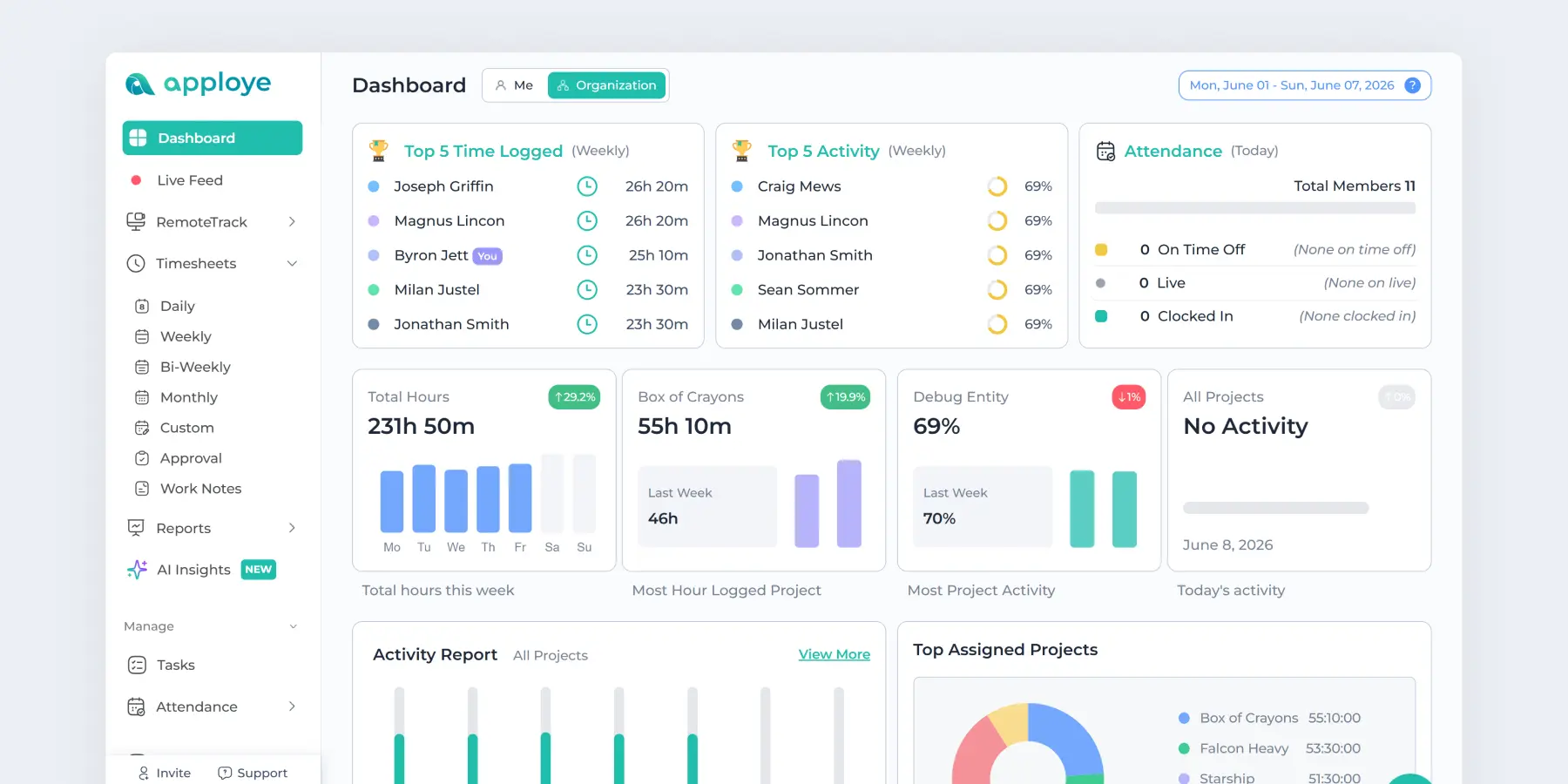
Apploye makes managing remote or hybrid teams simple with features that prioritize privacy. It also delivers real-time monitoring and provides powerful analytics.
Here are the primary reasons to choose Apploye:
Real-time monitoring and productivity data
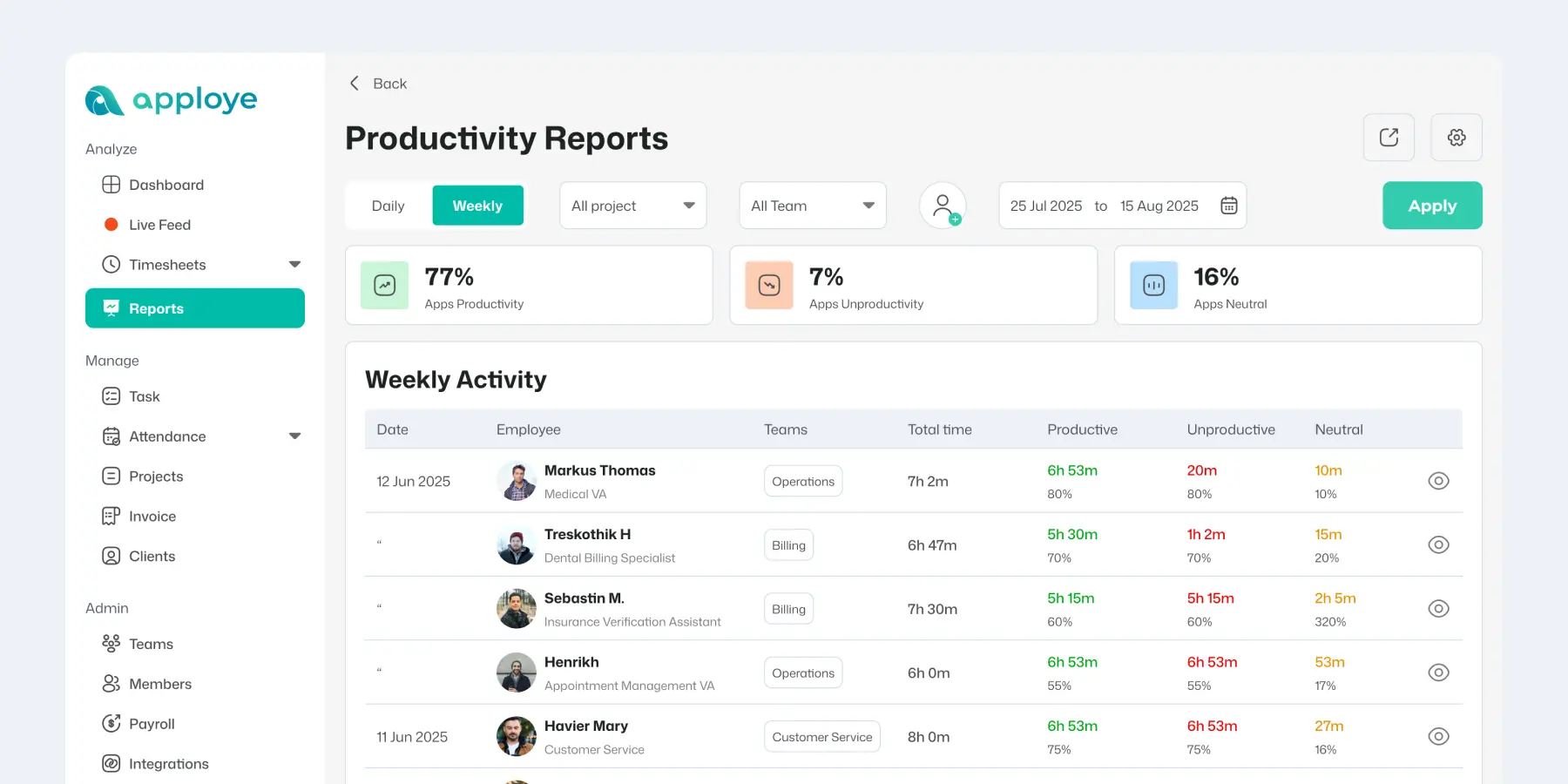
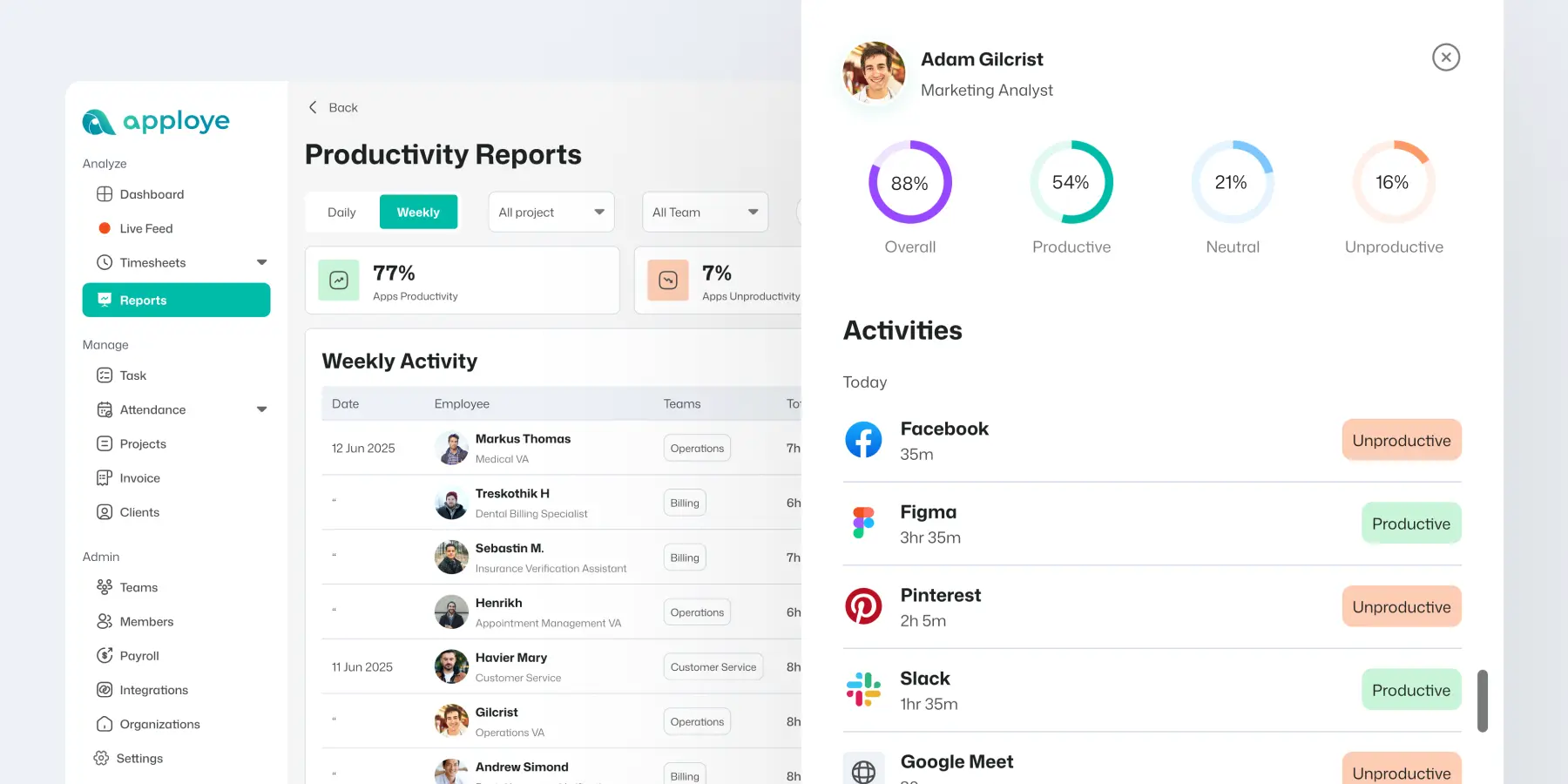
Apploye captures employee activity as it happens, showing detailed employee engagement levels and productivity stats. It gives managers clear, actionable insights to improve performance.
Precise time tracking that works everywhere
Automated time tracking keeps things accurate. Whether it’s on desktop, mobile, or browser apps.
Apploye ensures payroll and project billing are always spot on. With the data from idle time detection and simplified timesheet approvals.
Privacy-friendly features that build trust
Monitoring doesn’t have to be intrusive. Apploye uses randomized screenshot captures. It helps remote employees to explain their tasks and provides adjustable privacy settings.
Insightful analytics for better decisions
Managers get detailed data on team productivity trends and performance comparisons. Spot potential burnout, assess output, and ensure everyone’s efforts are measured correctly.
Smarter task and workload distribution
See exactly how work is divided across your remote team. Apploye helps balance workloads, avoiding burnout or downtime. By linking tasks to tracked hours, project management becomes clear and efficient.
Website and application usage tracking
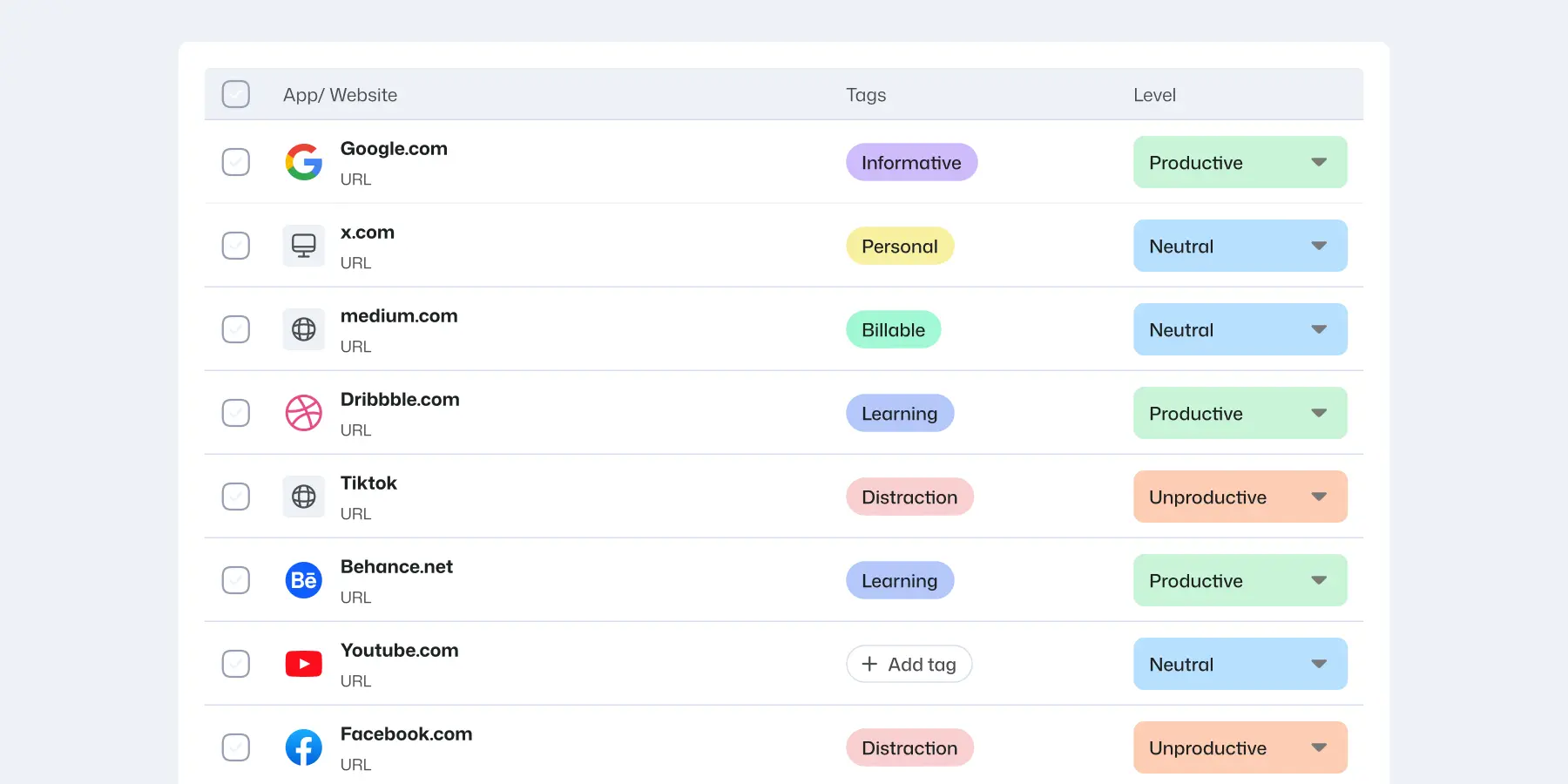
Know how work hours are spent with insider info on website and app usage. Distinguish between productive tools and distractions. This is to make sure every moment is well-used and effective.
Trusted across industries
Businesses everywhere rely on Apploye for its intuitive design and powerful features. Whether it’s improving team output, workflow management, or fostering accountability. Apploye is the tool that helps both in-house and remote teams flourish.
See what your remote team is really doing
You don't need to micromanage to know your team is on track. You need clear data and a fair way to use it.
Start a free 10-day Apploye trial today. No credit card, no setup headache. Get started free.