The Hidden Cost of Call Center Attrition
Key Takeaways
-

Higher attrition drives up hiring, training, overtime, and lost time. This quietly drains a call center’s budget.
-
When skilled agents leave, service quality drops. Longer wait times, more repeat calls, and less trust can hurt the customer experience and brand.
-
Lowering attrition can save money and improve results. Better coaching, fair pay, clear goals, and support help agents stay longer and do better work.
Attrition is not limited to employee turnover and hiring new ones. It’s an expensive process that costs your company money, knowledge, productivity, and time.
The Hidden Costs of Attrition You Should Not Overlook
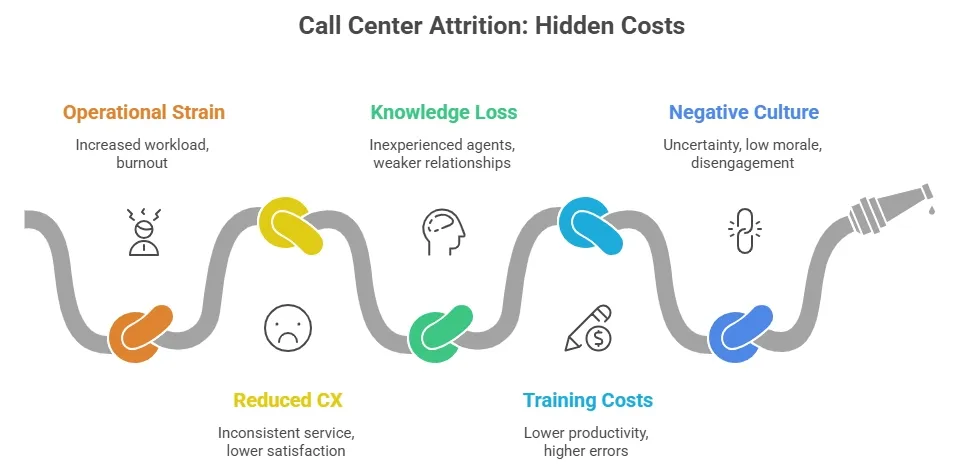
1. Operational Strain & Productivity Loss
Well, what actually happens when an agent leaves your job? In the operation sector, the common thing that happens is that the first moment an agent leaves, their work gets redistributed among the remaining employees.
Then, the remaining team in your support center has to handle more calls, more tickets, and more pressure. Over time, this increased workload may lead to stress and eventually burnout.
That’s where the vicious cycle begins:
- One agent leaves
- Others take on extra work
- Stress increases
- More agents leave.
Even a single vacancy can be costly. In a 100-seat customer service center, a single open position for over 74 days can lead to over $15,000 in lost productivity.
See workload patterns early in Apploye reports
2. Reduced Customer Experience (CX)
When you hire a new agent, it takes time for them to adjust to the company. They spend more time learning the systems, processes, and customer handling skills.
During this learning phase, they go through many costly activities. For instance–
- Calls can take longer
- Customers may be put on hold more often
- Issues may require escalation
This results in inconsistent service across your call center services.
The concerning part is that customers notice the difference. When your wait times increase or resolutions take longer, your satisfaction levels also drop. In a virtual call center, where customer expectations are already high, this can quickly impact your brand reputation.
3. Institutional Knowledge Loss
Experienced employees are among the biggest assets in any profession. For a contact center, they are no less than a treasure.
They understand your complex customer issues, internal systems, and shortcuts, and know the best practices for handling difficult situations
But when those experienced troops leave, they take that knowledge with them.
This loss affects your support center in ways that aren’t always immediately visible. Your new agents may take longer to solve problems, and long-term customer relationships may weaken due to inconsistent service.
Capture workflows with Apploye screen recording
4. Training & “Nesting” Costs
When an employee leaves your help desk, you may think you need to hire a new agent. That’s all you lose between the periods. But hiring a replacement is just the beginning.
After onboarding, new agents go through a “nesting” period. It’s a phase where they handle real interactions but still require guidance and supervision.
During this time in your customer service center, your productivity will be lower. Besides, your supervisors spend more time coaching, and similarly, errors are more likely to happen.
Your call center supervisors need to spend more time on training rather than improving the system.
These hidden costs add up quickly. For example, training a small 7-person team in a help desk can cost over $10,000 before they become fully productive.
Ultimately, the hidden cost of call center attrition piles up even if you can’t notice it.
5. Negative Culture & Morale
High attrition doesn’t just affect numbers. It also affects every person within your support center.
When employees experience constant turnover in their current role, it creates uncertainty. They may start questioning job stability, leadership, or workload expectations.
After a certain period, it will lower their morale, reduce team cohesion, and decrease engagement among the people.
Over time, your contact center culture becomes reactive instead of supportive. This ultimately makes it even harder to retain employees who never felt safe and connected to the company.
Use Apploye for clearer, fairer team visibility
How to Calculate the Hidden Cost of Call Center Attrition (Step-by-Step)
Understanding attrition costs helps you make better decisions. Here’s a simple way to break it down.
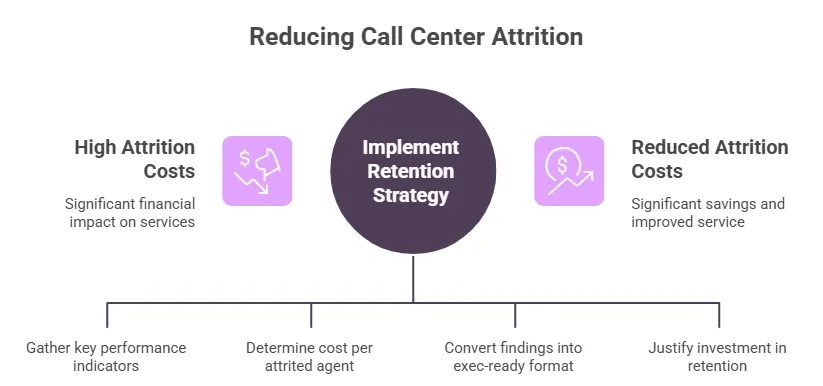
Step 1: Collect the Minimum Viable Inputs
Start with a few key data points from your contact center:
- Monthly number of employees leaving
- Average team size (headcount)
- Recruiting and training cost per hire
- Average ramp time (in weeks) and productivity during that period
- Overtime costs and service level issues
- Quality metrics like AHT, FCR, and CSAT during high attrition periods
These inputs give you a baseline for understanding the real impact on your call center services.
Step 2: Calculate Cost per Attrited Agent
Now combine the different cost components:
- Direct costs → hiring, onboarding, training
- Ramp productivity loss → reduced output during the learning phase
- WFM instability costs → overtime, scheduling inefficiencies
- Quality & compliance overhead → extra QA and coaching time
It’s helpful to calculate a range:
- A conservative estimate (minimum impact)
- An aggressive estimate (full impact, including indirect costs)
This gives a clearer picture of attrition’s impact in your service center.
Measure attrition impact with Apploye reports
Step 3: Translate into an Exec-Ready Number
Raw numbers are useful—but decision-makers need clarity.
Convert your findings into:
- Monthly cost of attrition
- Annualized cost
- Cost per agent (seat)
- Cost per interaction or resolved case
For example:
“If we reduce attrition by 10%, we could save X amount per year.”
This makes the impact of attrition in your customer service center easier to understand and act on.
Step 4: Build the ROI Case for Retention
Once you know the cost, you can justify investing in retention.
Compare:
- The cost of attrition vs. the cost of solutions (better tools, training, pay adjustments, flexible scheduling)
Avoid “vanity ROI.” Instead, tie improvements directly to:
- Service levels
- AHT (Average Handle Time)
- CSAT (Customer Satisfaction)
- Shrinkage
This ensures your retention strategy in the contact center delivers real business value.
Impact on Profitability of Contact Center Attrition Rate
Well, you might be thinking the cost of attrition is having a hampered operations system. Sadly, it directly impacts your profitability too.
According to Robert Half, large contact centers in the U.S. can spend $3.5 million to $5.5 million annually dealing with turnover-related costs.
The good news is that reducing attrition by just 15–20% can generate hundreds of thousands or even millions of dollars in savings for your call center services.
For a virtual call center or growing support center, this can be the difference between scaling efficiently and constantly struggling with operational gaps. So, without ignoring the hidden cost of call center attrition, it’s high time companies should focus on decreasing their attrition rate.
Conclusion
Attrition in a contact center is more than just a hiring challenge. It’s a hidden cost that impacts productivity, customer experience, and long-term growth.
It costs you your help desk’s knowledge, employee morale, and operational costs that ripple across your entire customer service center.
So, to avoid the hidden cost of call center attrition, understand its impact rather than tracking it. The right measurement of attrition will help you build a stronger and more stable support center.
Start reducing attrition with Apploye insights
Frequently Asked Questions
What is the attrition rate for call centers?
Attrition rates in a contact center can vary widely. But, many fall between 30% to 45% annually. However, some high-pressure call center services may also see even higher attrition rates. But whatever rate you have, your goal should be to keep reducing that rate over time rather than comparing with others.
Why do call centers have high turnover?
The few common reasons behind the high attrition rate in call centers are repetitive work and a stressful environment. Besides, if your company combines this with limited growth opportunities or poor management, your employees may start looking somewhere else.
How do you calculate the call center attrition rate?
To calculate a call center’s attrition rate, simply divide the number of employees who left during a period by the average number of employees, then multiply by 100. This gives you a percentage that reflects turnover in your support center.
How much does it cost to replace a call center agent?
Depending on the organization, the cost may vary. But, the unavoidable cost of a replacement includes hiring, training, and the lost productivity and knowledge. In many contact centers, replacing a single agent can cost thousands of dollars when you include the full ramp-up period.
What is a good attrition rate for a contact center?
A “good” attrition rate of a contact center depends on your industry type. But many customer service centers aim for under 20–30% annually. The lower rate you have is always better. It indicates a stable and satisfied workforce.
How can I reduce attrition fast?
Start with quick wins. Improve scheduling, recognize good performance, and fix major pain points like slow systems in your help desk. Even small improvements can make employees feel more supported right away.
What’s the difference between attrition and turnover?
Attrition and turnover are similar but slightly different. When employees leave your company without you having an immediate replacement, it is considered attrition. On the other hand, turnover includes the number of all employee exits and replacements within the company.
How does attrition impact CSAT, AHT, and FCR?
High attrition impacts a company in various ways. For example, if a newly hired agent takes longer to resolve issues, it gives the company a higher AHT. Similarly, if an agent struggles to solve problems on the first try, it lowers the FCR, and if an agent delivers inconsistent service, it will lower CSAT of the company.
What’s time-to-proficiency, and why does it matter?
Time-to-proficiency is how long it takes a new agent to become fully productive. It can be a week or even months for a call center to adjust to a customer service center. But the longer it takes, the higher the hidden cost of attrition will be for the company.
About Author