What is the Difference Between Stealth Monitoring and Regular Surveillance?
Key Takeaways:
-
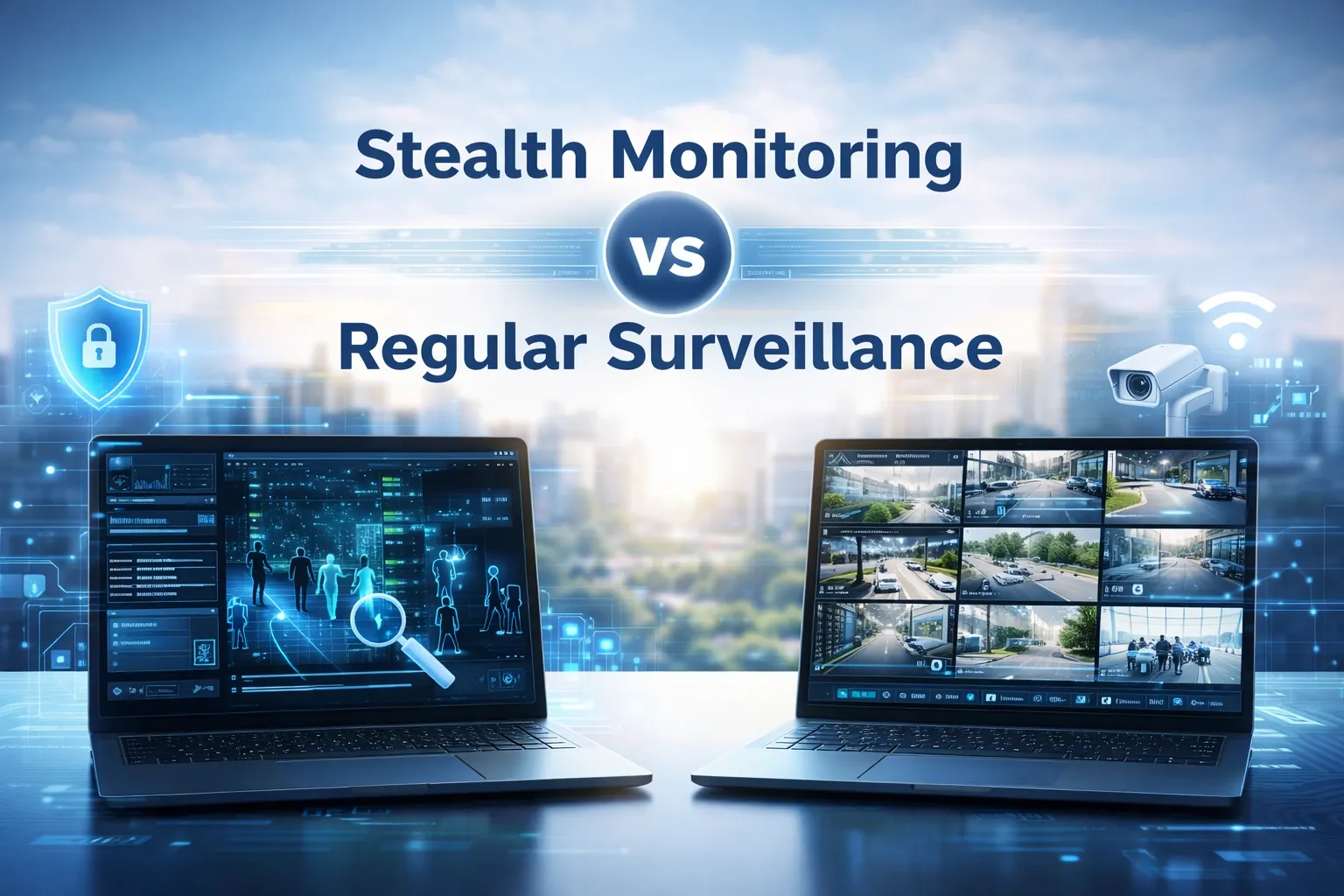
Stealth monitoring software observes employees secretly. So, employees don't know that they are being monitored. On the other hand, regular surveillance is done openly or with notice, so people know they may be watched for safety, rules, or accountability.
Stealth Monitoring vs. Regular Surveillance
Before diving deep, let’s look at the fundamental differences at a glance:
See how invisible tracking works in action
Regular Monitoring
Regular monitoring is the industry standard for agencies, remote teams, and enterprises. It prioritizes transparency and accountability over secrecy.
Usually, employees log into a monitoring tool to track their working hours on an agent.
Apart from activity, monitoring tools can also track tasks, website usage, and application history. All while being fully visible on the employee’s device. It is a participative tool where the employee actually interacts with the software (e.g., starting a timer).
This method is highly conspicuous. The employee can decide when they want to take a break. It’s the comfort of tracking that sets regular tracking apart.
If you haven’t understood it already, regular monitoring is not just about tracking employees. It includes:
- Identifying bottlenecks in workflows and improving employee output.
- Generating timesheets based on actual hours worked, not just committed hours.
- Providing clients with evidence (screenshots/logs) of billable hours.
Research from Harvard Business Review suggests transparent monitoring can improve output due to employee trust.
That’s why remote agencies, startups, and even legacy companies rely on transparent monitoring. A completely safe and secure way of monitoring while boosting employee productivity.
Legal Considerations
In most jurisdictions (including the US and EU), regular monitoring is legal and safe. Because it operates on the principle of "informed consent." By notifying employees and having them acknowledge an Acceptable Use Policy (AUP), companies significantly reduce liability.
So, there’s no issue in monitoring if you keep it transparent from the start.
Start Your GDPR Compliant Tracking with Apploye
Stealth Monitoring
Stealth monitoring shifts the focus from productivity to security and control, acting as an invisible tracking mechanism.
Compared to traditional monitoring, stealth monitoring is different. Generally, employers use an invisible agent installed on company devices. Once the device turns on, the hidden mode automatically shadows the employee. The application runs as a system process that does not appear on the taskbar or system tray. It’s an undercover observation of employees.
At first, the whole idea of invisibility might seem scary. However, from the business standpoint, there’s a clear purpose and sometimes a necessity.
To prevent insider threats, data leaks, and company secrets. Moreover, it offers a credible investigative report for external audits. Finance, healthcare, IT, and defense are some popular industries benefiting from stealth mode.
Let’s take a Google lawsuit for an ex-employee as an example. Google, with its discreet surveillance, found out an employee had stolen secret AI data for Chinese companies. While Google doesn’t explicitly mention stealth monitoring, we can safely assume involvement in secret surveillance.
So, for large corporations, it’s obvious why they choose extreme measures of monitoring.
Legal Considerations
Unfortunately, stealth monitoring is a legal minefield. In most countries, it is prohibited or permitted in exceptional scenarios.
- USA: The ECPA generally allows monitoring on business-owned devices. However, states like California, New York, and Connecticut require employee consent & notification.
- Europe (GDPR): Secret monitoring is strictly regulated and generally prohibited. Unless there is a specific suspicion of a crime. Even then, it must be temporary and targeted.
Protect sensitive data with stealth mode now
Stealth Monitoring vs. EDR/UEBA/SIEM
Agencies often confuse monitoring with cybersecurity tools. While an invisible agent for monitoring tracks productivity, security tools track threats.
Here is how they differ:
Endpoint Detection and Response (EDR)
EDR tools are designed to stop hackers. It’s a monitoring tool, true, but not for employees. EDR is mainly used for preventing cyberthreats.
The only thing common between EDR and stealth surveillance is the on-device agent. Other than that, they differ heavily in function.
- EDR reacts to attacks; monitoring records activity.
- EDR focuses on cyberthreats, and monitoring focuses on productivity.
- EDR is mostly non-invasive; stealth monitoring is not.
However, for large enterprises in risky industries, both are crucial.
User Entity and Behavior Analytics (UEBA)
UEBA is the closest cousin to hidden observation, but it relies on algorithms rather than direct visual surveillance.
UEBA baselines "normal" behavior (e.g., User A logs in at 9 AM from London). If User A suddenly logs in at 3 AM from Moscow and downloads 5GB of data, UEBA flags this anomaly.
So, compared to Stealth monitoring, UEBA focuses on:
- Historical pattern and behaviour analysis.
- Insider threat and risk management.
- Real-time notification about any actions required.
Experience behavioral tracking in real time
Security Information and Event Management (SIEM)
SIEM is the central brain of IT security. It ingests logs from firewalls, servers, and EDRs. From a standard workforce tracking, this is quite different. It doesn't necessarily record screens or track working hours.
Instead, it studies infrastructure-level data for Event correlation, threat detection, and Incident investigation. SIEM and SOAR (Security Orchestration, Automation, and Response) generally work together.
Suppose a stealth monitoring tool detects a keyword like "confidential" being typed in a personal email. The monitoring tool will later send a log to the SIEM. As a result, SOAR will act to block the email.
Conclusion
The choice between stealth monitoring and regular surveillance is simple. If your goal is to catch a spy or stop a data breach, undetectable stealth mode is the way.
However, for 99% cases, the goal is productivity, not surveillance. Transparent monitoring lets employees grow without breaking any trust. It treats employees as partners in productivity. Stealth can be detrimental if your employees feel threatened.
Start invisible oversight with a free trial
Frequently Asked Questions
What is the difference between monitoring and surveillance?
Monitoring tracks work activities for productivity or compliance. Monitoring targets working hours tracking. However, surveillance involves continuous observation to detect misconduct or security threats. Investigators may hide and use surveillance during investigations.
Do employers need consent to monitor employees?
Yes, in most cases, they do. Explicit consent may be needed for personal devices or sensitive information. Signed policies or contracts often function as legal consent. However, the requirements can vary depending on the region or country.
What employee monitoring data should we not collect?
Avoid collecting private communications unrelated to work responsibilities. Do not gather sensitive information like health status or religious beliefs. Biometric data should only be collected when strictly necessary. Tracking employees outside working hours should generally be avoided.
How do we prevent misuse of monitoring data internally?
Restrict access using role-based permissions and least-privilege principles. Keep detailed audit logs of all data access activities. Establish clear policies defining acceptable data use. Conduct regular compliance reviews and disciplinary actions for violations.
Why is stealth monitoring used instead of regular surveillance in certain situations?
Stealth monitoring prevents any performance acting or behaviors. Plus, it is the best method to find out insider threats and data loss. When regular surveillance is used, employees can easily avoid suspicion. Organizations deploy stealth mode only when risks justify covert observation.
Can employers track you in stealth mode?
Yes, employers can track company-owned devices in stealth mode. However, in most cases, companies require legal documents and employee consent. Usually, Company-owned equipment is used for stealth mode.
How is privacy affected by stealth monitoring versus regular surveillance?
Stealth monitoring poses greater privacy risks due to invisibility. Regular surveillance allows people to adjust their behavior knowingly. Lack of transparency can erode trust between employees and employers.
When is it legally permissible to conduct stealth monitoring compared to regular surveillance?
In legal or criminal cases, companies use stealth monitoring. To use it, employers must show necessity and proportionality. Many laws require that no less intrusive alternative exists.
What are the ethical considerations involved in stealth monitoring versus regular surveillance?
Covert monitoring raises concerns about autonomy and informed consent. It can heavily damage organizational culture and employee trust. Even when companies use it for special purposes, employees become anxious.
Which industries benefit most from stealth monitoring and why?
The finance, Healthcare, and Construction industries regularly use stealth. Manufacturing companies also use it to investigate safety violations or theft.
How does stealth monitoring differ from regular surveillance in terms of data security?
Covert systems often collect data without user awareness or safeguards. This increases risk if controls are weak or undocumented. Regular surveillance typically follows established security procedures. Proper encryption and retention policies are essential for stealth operations.
About Author