Employee Monitoring vs Performance Management: Which is More Useful?
Key Takeaways:
-
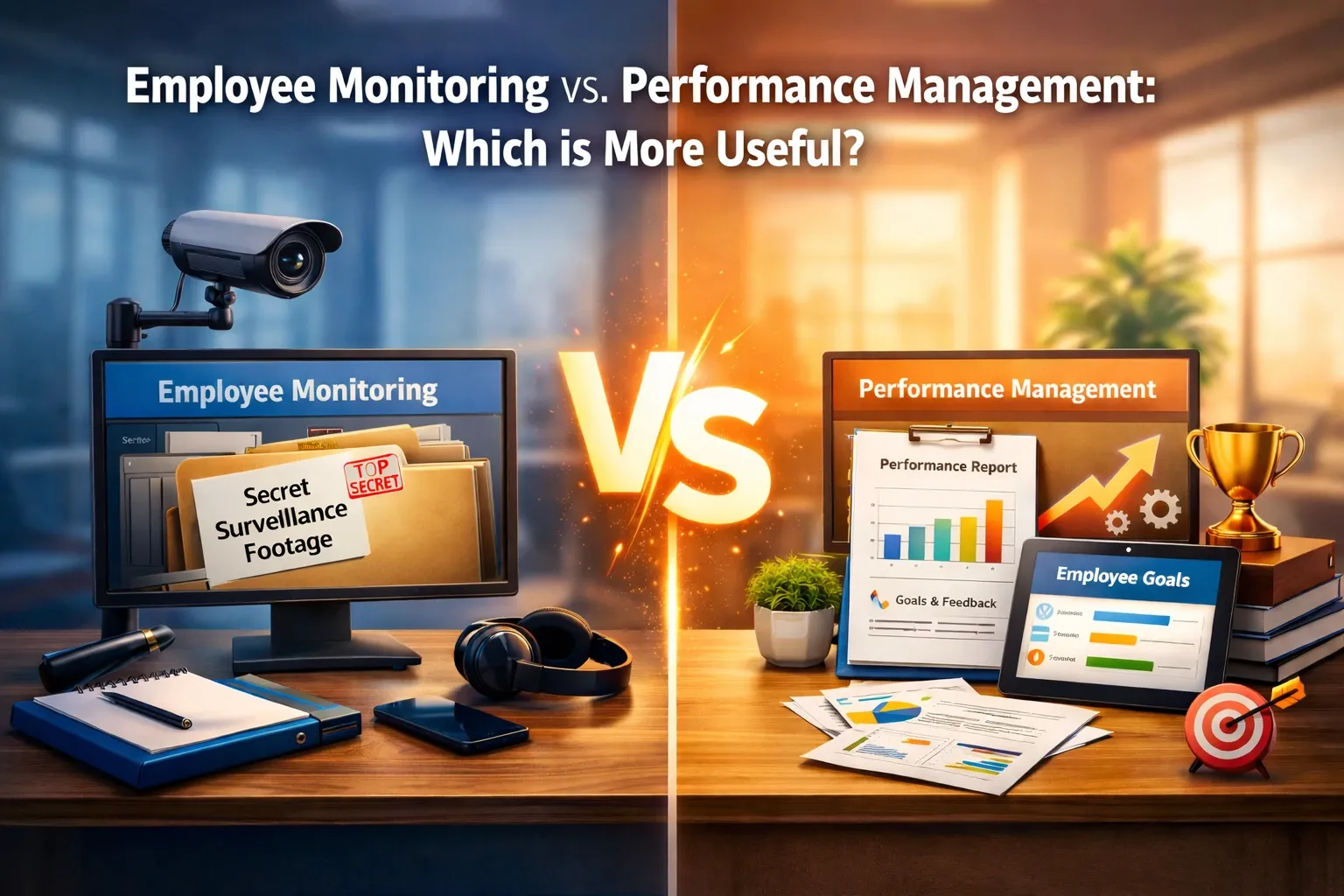
Employee monitoring tracks activity/behavior in real time (logins, apps, screens, location) to ensure compliance and security; performance management sets goals, measures outcomes over time (KPIs, reviews), and develops people through feedback and coaching.
Most companies mismatch employee monitoring with performance management. As a result, it leads them to wrong strategy developments and a conflicted employee management system.
In this blog, we are going to discuss the aspects of these two confusing terms through monitoring vs performance management. So let’s begin–
What is Performance Monitoring?
Employee performance or productivity monitoring is a process. It includes the steps of tracking, observing, and analyzing an employee's performance over a given period. Performance monitoring helps you see if the work is actually getting done and how well it’s being done
It usually includes things like:
- Tracking progress on tasks and projects
- Reviewing productivity and output quality
- Checking if goals, KPIs, or deadlines are met
- Identifying strengths and areas that need improvement
- Offering feedback or support when needed
Track real-time output across your whole team
What is Performance Management?
Performance management is simply the broader and ongoing process of the employee monitoring system. It focuses on developing a continuous process where it will work on how, when, and in what way one’s performance can be redefined and improved.
It focuses on developing and improving employee performance to align with the organization’s goals. It involves planning, coaching, feedback, and goal-setting to help employees grow and succeed.
The key aspects of performance management are–
- Setting clear goals and expectations
- Regularly reviewing performance and providing feedback
- Identifying training and development needs
- Recognizing and rewarding achievements
- Aligning individual performance with team and organizational objectives.
Get full visibility into your team's work
Key Differences: Monitoring vs Performance Management
Here’s how they differ:
- Monitoring focuses on the “what.”
- Performance management focuses on the “why” and “how.”
- Monitoring measures and performance management develop the growth.
One tracks behaviors and outcomes. The other builds skills, encourages growth, and supports better results.
How Employee Monitoring Supports Performance Management
Here’s how monitoring supports performance management:
- Better feedback: You’re giving employees feedback based on real numbers, not assumptions. This makes conversations fair and constructive.
- Spotting problems early: Monitoring helps you notice when someone is struggling, overloaded, or under-engaged before it becomes a bigger performance issue.
- Clearer goals: When you know how long tasks take and what slows teams down, you can set realistic goals that employees can actually reach.
- Balanced workloads: Monitoring highlights who is taking on too much and who has room for more. This keeps performance healthy and avoids burnout.
- Recognizing improvement: You can track progress over weeks and months, making it easier to appreciate effort and reward growth.
Monitoring gives you the visibility you need. Performance management uses that visibility to help people get better.
Turn your monitoring data into real growth
Monitoring vs Performance Management: When Should You Use Them?
Although both monitoring and performance management aim to improve employee output, they should be used in different setups for different goals. You can make your team both supported and feel micromanaged if these two approaches are not used at the right time and in the right way.
So, when should you use monitoring vs performance management? In a company, you can use both in different ways. Here’s how–
Use monitoring when:
- Your company needs real-time visibility: For both in-house and remote teams, real-time data tracking is necessary to help you understand how employees' work hours are getting distributed.
- You need to reduce bottlenecks: Monitoring helps you spot specific details in workflows. You can learn about employee active hours, idle time, and distractions through monitoring.
- You want to store company data: Secured storage of data allows you to detect, analyze, and evaluate employee and company performance whenever you need it. So, monitoring is a helpful regular activity for companies to store their data securely for further use.
- You want to improve productivity: Monitoring allows you to see, understand, and evaluate your company's workflows. It shows patterns that help all adjust their ongoing workflows and enhance productivity accordingly.
Use Performance Management When:
- You want to evaluate a long-term process: performance uses the daily activities data of monitoring to plan and improve the growth over months, quarters, or years.
- You want to set trackable goals: Performance management helps businesses to set key trackable goals like OKRs, KPIs, development plans, and role expectations.
- You need to build a solid work culture: proper performance management provides structured feedback, skill development, and future-focused plans to build a solid work culture.
- You want to evaluate promotions or raises: performance management helps organizations evaluate the actual results, achievements, and long-term contributions of an employee. So, you become more eligible for making fair raises and promotions.
Know exactly when and how your team works
Balance Your Monitoring Data with Developed Performance Management for a Successful Team
Monitoring and performance management are two different systems that complement each other in developing a company’s work culture. Monitoring provides businesses with the clarity of real-time data. Besides, performance management uses that data for impactful improvements, building stronger duties, and driving better results.
So, if you want to develop sustainable employee morale and goals, use both of these. Monitoring will help you understand your employees, while performance management will help you build an evolving work culture within the company.
Build a smarter, more productive team free
Frequently Asked Questions
What is the difference between performance management and performance monitoring?
Employee monitoring tracks what employees are doing, while performance management uses that information to guide improvement and growth.
What's the relationship between executing, monitoring, and controlling in business management?
Executing gets the work done, monitoring checks progress, and controlling fixes issues to keep everything on track.
What are the types of performance management systems?
There are various types of Performance management systems, including goal-based, competency-based, rating-based, and continuous feedback systems.
Which metrics do you use for monitoring project management?
Common project monitoring metrics include time tracking, cost measurement, task progress, workload, quality, and risk indicators.
Is employee monitoring legal?
Employee monitoring is legal in most countries as long as companies follow local employee monitoring laws and clearly inform employees about what is being tracked.
About Author