Pros and Cons of Monitoring Employees in Stealth Mode
Key Takeaways:
-

Stealth monitoring software can reveal real work patterns and speed up investigations, but only when used for clear, legitimate reasons.
-
The highest cost is trust (and legal risk). If it feels secret or unfair, morale and culture can collapse fast.
-
Best practice: Be transparent and minimal. Disclose it, monitor only what’s necessary, protect the data, and use insights to support, not punish.
Stealth monitoring means software runs quietly on computers. True "covert" monitoring happens when workers don't know about it. When done right, it can spot problems like strange file transfers, malware clicks, or broken rules. This helps managers see what happened and when.
Take full command of your team's output now
Good monitoring programs follow a simple plan: Tell employees about it in your policy. Only track work activity. Give access based on job roles and delete data quickly. Always have a person check the data before taking action. Then, use what you learn to improve how work gets done and help employees grow, not to watch every move they make.
Employee Stealth Monitoring Advantages
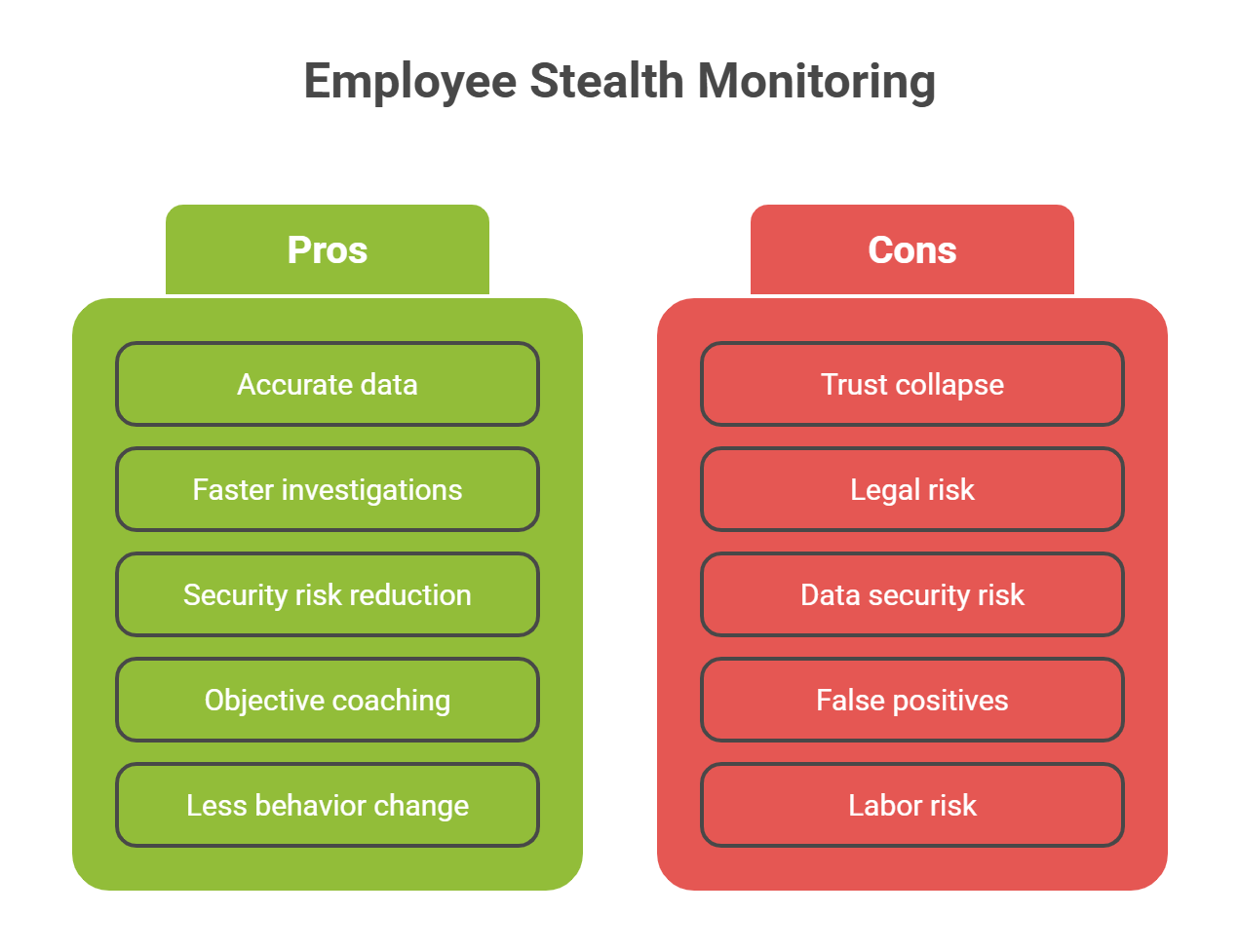
1. More Accurate Baseline Behavior Data
The ultimate goal of monitoring employees using invisible agents is to be able to learn how they naturally work. When you can understand the natural flow of how your individual employee works, you will be more efficient in helping them to grow.
Measure your team's natural workflow today
Here, when stealth monitoring tracks employee productivity in undercover observation, it becomes more capable of tracking the baseline behaviour data. Later, employers can use that accurate baseline data to understand, analyze, and leverage for employee growth.
2. Faster Investigations & Evidence Preservation
When something goes wrong, the first question that comes to our mind is usually, “What actually happened?”
Hidden mode monitoring helps answer that question quickly. Sometimes, even without any guesswork or long back-and-forth discussions.
Instead of asking everyone to explain their side, managers can look at activity records and see a clear timeline. A secret monitoring tool also saves the database on its system. So, you can leverage the same data whenever you need it for emergencies like investigations.
3. Security & Compliance Risk Reduction
One of the most risk modern businesses face is getting insider threats. In this case, a tool working in an undetectable stealth mode works as a silent safety for that business. It flags high risk, like unusual data transfers or visits to malicious sites. So, IT teams get more profound on detecting those risky behaviors before these incidents become more harmful.
4. Objective Coaching Signals
Objective coaching signals are clear, fact-based insights that an invisible tracking tool provides about how someone works.
As a manager, you can see the real work patterns of your employees. For instance, when any of your employees struggles with focus, spends too much time switching between tasks, or consistently works late.
Since these tools provide feedback based on how employees actually work, they help you coach your team in a fair and supportive way. As a manager, you can take action based on real behavior. This is much better than relying on gut feelings or personal bias.
Boost team growth with data-driven coaching
5. Less Behavior Change due to Being Observed
When employees feel they are being watched, it is more likely that they change their behavior than their original behavior. This psychological phenomenon is known as the Hawthorne Effect.
The bad side of that ‘being watched’ effect is that it leads to "productivity theater," where your employees perform busyness rather than actual work. To cut this type of unwanted behavior, employers use stealth surveillance where employees don’t know or feel like they are being watched. So, employees feel more natural while putting their best effort on the table.
6. Validating Specific Allegations
In organizations, you just can’t make decisions from ‘word-of-mouth’ activities. Instead, you would need real data and facts. Specifically, while making a counter-allegation or complaint.
In this case, a secret monitoring tool comes in aid as a fact checker. Its detected logs provide an unbiased, third-party record of events to the authorities. So, it becomes more efficient to validate or disprove specific allegations quickly and fairly. It also helps you protect both the company and the rights of innocent employees.
Get clear activity records for your business
Employee Stealth Monitoring Disadvantages
Let’s learn more about the risks of stealth mode:
1. Trust Collapse and Cultural Damage
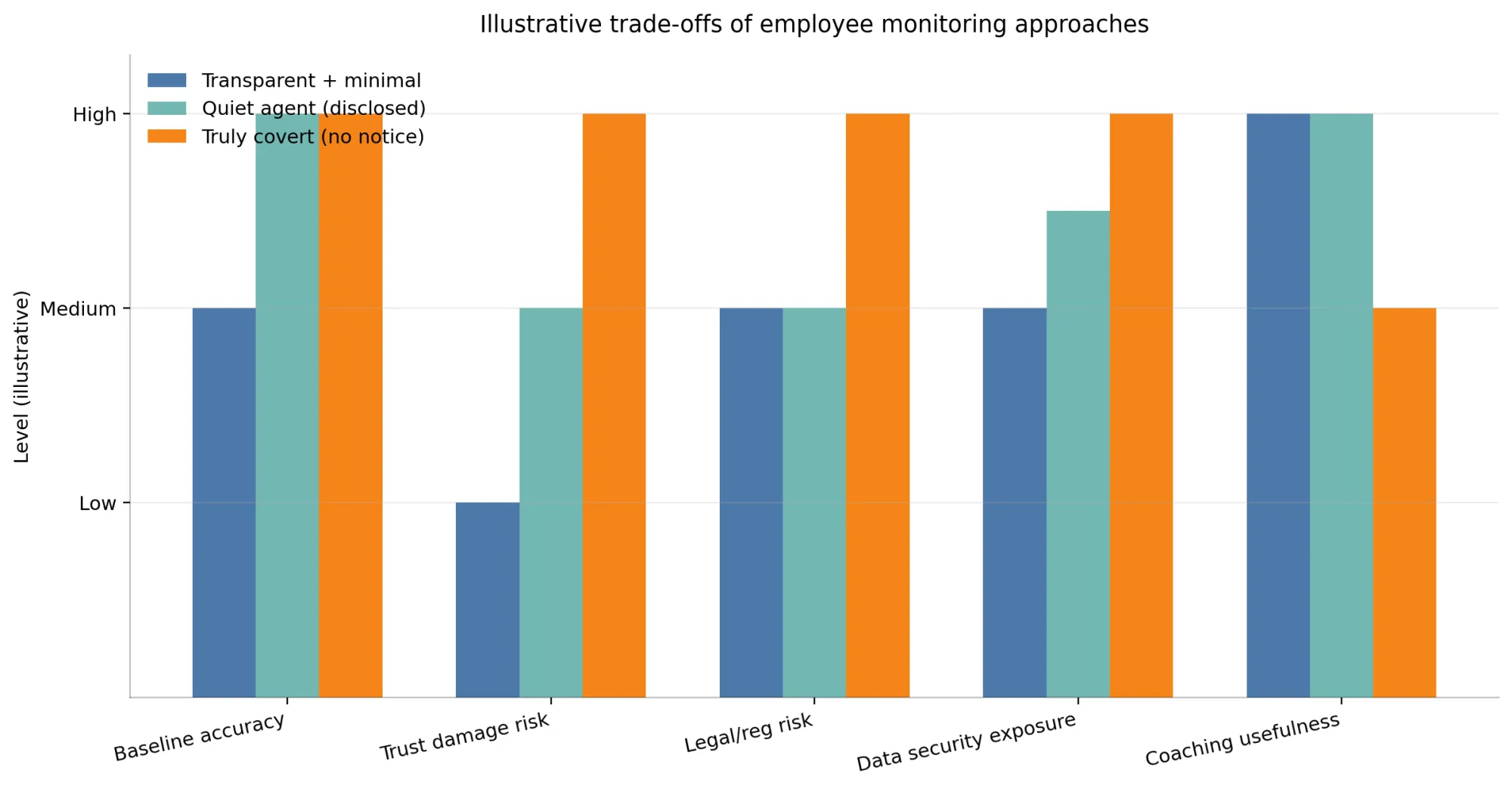
When employees find out they were monitored without knowing, trust can be broken instantly. People may feel watched, judged, or tricked. Over time, this creates fear instead of teamwork. A workplace without trust often sees lower morale, less honesty, and more stress.
2. Legal/Regulatory Risk
Do you know that countries like Japan, South Africa, and others have privacy laws that restrict stealth mode monitoring?
Yes, it is considered awful in some countries and regions if you track employers without informing them. Monitoring without proper notice or consent can lead to legal trouble, fines, or lawsuits. Even if the tool is legal, using it the wrong way can still cause problems for the company.
3. Data Security Risk
The data your hidden monitoring tools collect is highly sensitive. It belongs to your company and must be kept private and secure. In that case, if this data is not stored or protected properly, it can be leaked, hacked, or misused.
Thus, using an invisible agent puts both employees and the company at risk. Especially when personal or confidential data is involved.
Lock down your company assets immediately
4. False Positives Leading to Unfair Discipline
Silent monitoring tools do not always understand the context behind certain behavior. For instance, its system may flag normal behavior as suspicious or unproductive. And, naturally, machines make mistakes.
However, if the company uses that raw data as the final source of their decision, it may lead to unfair employee treatment. Even your employees may feel frustrated, end up resigning, or even take legal action against the company.
5. Worker Relations and Labor Risk
Hidden monitoring can damage relationships with employees, unions, or worker groups. It may be seen as control rather than support. This can result in complaints, resistance, or public criticism, which hurts the company’s reputation and long-term stability.
How does Stealth Monitoring Impact Workplace Productivity?
Here are a few ways stealth mode monitoring helps organizations increase productivity:
- Allows managers to understand how work actually gets done without only showing how busy people look.
- Highlights distractions and workflow issues that slow productivity for managers and employees to review.
- Allows you to support employees with better workload balance and coaching.
- Saves time by reducing guesswork and manual performance checks
- Improves work focus if the insights are used to support the employees without controlling them.
Eliminate productivity leaks with one tool
How Can Companies Balance Stealth Monitoring with Employee Privacy Rights?
Before starting to monitor employees’ data in quiet mode, it is better that you inform them about what you are going to track. Getting employees’ consent is the best way a company can protect its employees' rights and privacy.
To balance monitoring with privacy, companies also remain clear about purpose and limits. Even if monitoring runs quietly, they tell employees what is being monitored and why. Companies protect employee rights by only tracking work activity. By doing so, they avoid collecting any personal data.
Moreover, if you are going to start silent surveillance, try to utilize strong data protection. You should also limit who can access monitoring data, store it securely, and keep it only as long as necessary.
Most importantly, you should use the data to support and coach employees. not to punish them.
It becomes easier to handle privacy concerns when your people understand that it exists to support the system, not for surveillance or judging one’s ability.
Enforce high standards with total clarity
Conclusion
We all know, technology always comes with benefits and drawbacks, too. But when we can understand the right way to use it, this is when we bring something exceptional to the world.
Similarly, employee stealth monitoring also comes with drawbacks. But if you understand what’s good and what’s not ethical, that’s when you can enhance your business performance with the right technology.
So, understand what causes the backdrops of secret monitoring, avoid them, and let your business grow with proper surveillance.
Start your free trial for better productivity
Frequently Asked Questions
Is it legal to monitor employees in stealth mode (without telling them)?
Yes, but with strict conditions in many regions. In the U.S., federal laws (like the ECPA) generally allow it on company-owned devices for "legitimate business reasons." However, in the UK, EU, and parts of Canada (like Ontario), transparency is often a legal requirement. Covert monitoring is usually only permitted in extreme, limited cases. Such as investigating suspected criminal activity.
Do employers have to tell employees they are being monitored?
Yes, even if the software runs in "stealth mode," employers should disclose the matter in an employee handbook or contract. This protects the company legally and helps maintain a culture of trust.
Can my employer monitor my emails or chats at work?
Yes, if you are using company-owned tools, your company can monitor those emails and chats. However, your company does not have the right to monitor your personal accounts (like your private Gmail). It is a much murkier legal area and is generally avoided by ethical employers.
Can employers monitor personal devices (BYOD)?
No. An employer can typically monitor work-related apps. But it is illegal to monitor an employee’s personal data, such as photos, texts, or private social media.
Can employee monitoring be used as evidence for discipline or termination?
If monitoring is conducted legally and follows stated policies, it can be used as evidence for discipline. For example, if logs show a clear violation of security protocols or "time theft," that data can be used as evidence in disciplinary hearings.
What should an employee monitoring policy include?
An employee monitoring policy should answer what, why, how, and where. For instance, what is being tracked (apps, time, screenshots), why it is being tracked (security, productivity), who has access to the data, and how the data is protected and how long it is kept.
What are alternatives to stealth monitoring?
The alternatives to stealth monitoring or discreet surveillance are visible monitoring, result-based employee management, and self-reporting by employees.
Why do employers choose to monitor employees without their knowledge?
When people know they are being watched, they often perform "theatrically". Which means it starts to work harder than natural or appears to be better. Thus, employers use stealth monitoring to get a true "baseline" of how work happens, to prevent people from "gaming" the system. It helps them to gather untampered evidence during sensitive investigations like data theft or harassment.
How does employee monitoring affect workplace trust and morale?
If monitoring is used as a tool for support, it can actually improve morale. However, if it feels like someone is looking over your shoulder to catch mistakes, it can lead to high stress, feel untrusted, and increased employee turnover.
What are the Ethical Concerns Related to Covert Employee Monitoring?
Covert employee monitoring raises several ethical concerns. It can hurt privacy, trust, and transparency within a team. Problems usually happen when companies monitor staff without clear communication. Issues also arise if personal activities are tracked or if the data is misused. To stay ethical, companies should only track work-related activity. They must also explain why the monitoring is necessary and keep all collected data safe.
About Author