The Role of AI and Automation in Call Center Trends
Key Takeaways
-

AI tools now handle simple calls, route people faster, and give agents live help, so teams save time, and customers get answers with less waiting.
-
Automation does not replace every agent. It works best for repeat tasks, while people still solve hard issues, show care, and build customer trust.
-
The big trend is blended service: smart bots plus trained agents. Call centers that use both well can cut costs, boost speed, and improve service.
Call centers have never been pressured. Customers expect quicker responses, and agents feel more burned out. Similarly, U.S. companies still lose an estimated $75 billion annually from poor service.
That’s why most businesses can’t help but adopt AI and automation in call centers. The global call center AI market is projected to reach $101.77 billion by 2034 at a CAGR of 17.76%. And 78% of organizations are already using AI in at least one business function.
But adoption and operationalization are different things. Only 25% of call centers have successfully integrated AI into daily workflows. This blog breaks down what's actually working, what the risks are, and where the industry is heading.
Core AI Technologies Powering Modern Call Center Automation
Natural Language Processing (NLP)
NLP is the foundation that makes conversational AI possible. It allows machines to read, interpret, and respond to human language. It works on both typed and spoken formats. In a support center, this powers chatbots, voice assistants, and automated ticket classification.
NLP also enables applications like sentiment analysis, automated transcription, and context-aware responses. To date, NLP remains the single largest driver of innovation in call center services today.
Machine Learning (ML)
ML gives AI the ability to learn from every interaction. Rather than following fixed rules, ML models analyze call history, customer behavior, and resolution patterns. This allows ML to improve routing accuracy, response relevance, and issue prediction. As ML is trained more on data, a virtual call center becomes more capable.
Speech Recognition
Automatic Speech Recognition (ASR) converts spoken language into text in real time. It enables live routing decisions, quality monitoring, and post-call analysis without a human reviewer.
AI-powered speech recognition enables analysis of 100% of interactions. It directly impacts how quality assurance works on a large scale.
Robotic Process Automation (RPA)
RPA handles the repetitive, rules-based back-office work that drains agent time. These works include updating customer records, generating reports, processing refunds, etc.
By automating these tasks, service centers reduce human error and free agents for higher-value interactions. RPA bots execute defined workflows at scale and speed. They are ideal for structured, predictable tasks in high-volume environments.
Predictive Analytics
Predictive analytics uses historical data to forecast future call volumes. Similarly, it can also statistically predict customer behavior and staffing needs. Instead of reacting to a surge, a contact center using AI can anticipate it. AI-powered agent assistance tools are projected to boost productivity by 25% in the US by 2040 through smarter forecasting and scheduling alone.
Sentiment Analysis
Sentiment analysis reads the emotional tone of a conversation in real time. By flagging frustration or escalation risk, it guides agents to self-improve. Supervisors can intervene before a call deteriorates. It also feeds long-term analytics, surfacing which issue types or agent behaviors consistently drive negative experiences.
How AI Is Reshaping Customer Service Automation in Practice
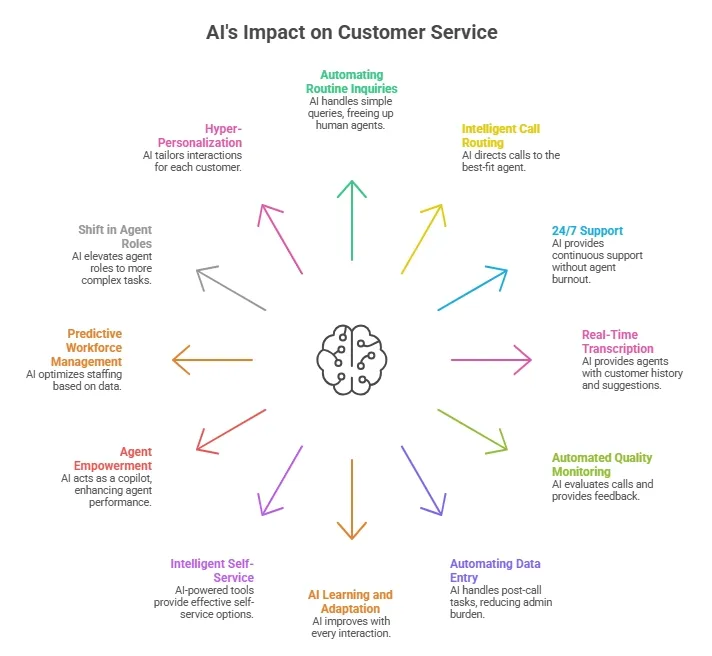
Automating Routine Inquiries
AI chatbots and voicebots handle the high-volume, low-complexity queries easily. Not only that, it can track orders, reset passwords, and answer billing questions. Currently, 75% of customer inquiries can be resolved by AI tools without any human intervention.
Due to that, human agents could provide effort where judgment and empathy are required.
Intelligent Call Routing
With smart call routing, customers get the best-fit agent based on their history. It doesn’t follow a static menu-style waiting period. Instead, it uses ML to analyze the issue, language, and sentiment, then assigns the best agent. This cuts wait times and improves first-call resolution rates significantly.
A real-world example showed that AI-powered routing contributed to a 42% improvement in first-call resolution.
24/7 Support Without Burning Out Your Team
Virtual call center technology lets businesses extend their support hours without adding headcount. AI-powered assistants and VAs handle after-hours requests, high-volume periods, and weekend queues.
69% of consumers now prefer AI-powered self-service tools for quick issue resolution. This makes it easy for virtual assistants to run 24/7, without affecting your human agents.
Real-Time Transcription and Agent Assist
During a live call, AI tools display relevant customer history, past interactions, and suggested responses on the agent's screen. The agent, because of that, doesn't need to put the customer on hold. All the information the agent needs becomes available before the customer asks the first question.
This is one of the most significant benefits of AI in customer service. A contact center survey found 87% confirmed that conversational AI has reduced agent effort and costs.
Automated Quality Monitoring
AI doesn't just help during the call; it evaluates and shares feedback instantly, after the call. Speech analytics tools score and call center monitoring software calls on tone, pace, resolution, compliance keywords, and sentiment. Supervisors get direct dashboards to see who’s doing well and who needs help. And agents get structured coaching based on actual patterns.
Automating Data Entry and Record Keeping
After every call, agents typically spend 5 to 10 minutes on post-call wrap-up. That includes updating CRM records, logging outcomes, and tagging issue categories. AI handles this automatically through real-time transcription and structured data extraction. By doing that, it reduces the admin burden, provides accurate data logs, and allows more time for productive work.
AI That Learns and Adapts Over Time
Unlike rule-based systems, modern AI models improve with every interaction they process. The more calls a model analyzes, the better it becomes at understanding how to respond. This self-improvement loop is what separates today's AI from the clunky IVR systems of the past decade.
Intelligent Self-Service That Actually Works
The self-service tools of five years ago were frustrating dead ends. Today's AI-powered systems are genuinely capable. AI now enables agents to learn without the help of supervisors. That is a massive shift in how contact volumes have increased after AI and automation came into existence.
High-performing organizations are already acting on this. 80% of top-tier service centers deploy self-service solutions.
Agent Empowerment: AI as a Copilot
The most effective way to use AI is to integrate it alongside agents, not replace them. Real-time prompts, sentiment alerts, automatic call summaries, and suggested next-best actions give agents context they didn't have before. Because of AI, they can now use more energy on each call rather than thinking about documentation and recalls.
McKinsey found that Gen AI-enabled agents achieved a 14% increase in issue resolution per hour. These are real, measurable gains — not projections.
Operational Efficiency Through Predictive Workforce Management
Predictive analytics takes workforce scheduling from guesswork to science. AI models analyze multiple metrics to understand the staffing needs. The metrics involve: historical call volume data, seasonal patterns, campaign schedules, and external triggers. With AI in call center WFM tools, businesses can avoid overstaffing and understaffing problems at scale.
The Shift in Agent Roles
As AI takes over tier-one inquiries and entry-level roles, agent roles are evolving to senior and manager-level roles automatically. Agents with AI need to manage time and effort to achieve higher productivity. AI helps with the basic documentation, feedback, and analysis, while agents make sure the complex, multi-step judgment is done flawlessly.
This shift doesn't necessarily mean fewer jobs. A Gartner survey found that only 1 in 5 customer service leaders had cut agent headcount despite aggressive AI adoption. More than half (55%) reported steady headcount while serving an increasing number of customers.
Hyper-Personalization at Scale
71% of consumers now expect personalized interactions, and 76% become frustrated if they don’t receive them. AI makes sure it happens 100% of the time. By analyzing purchase history, past interactions, preferences, and real-time intent, AI can tailor every touchpoint. It’s not just for VIP customers, but for everyone.
Agentic AI, where multiple specialized AI agents work together, is definitely the next frontier. Industry analysts predict AI automation rates in contact centers will increase fivefold by 2026.
The Disadvantages of AI in Customer Service: What to Watch Out For
The benefits of AI in customer service are real. But so are the risks, and too many businesses rush adoption without accounting for them.
Loss of Human Empathy
AI can recognize emotional keywords, but it cannot genuinely empathize. Harvard Business School found that 30 to 50% of customers are willing to wait for a human response rather than receive an instant AI response. Another survey pointed out that 60%+ customers would prefer no AI assistance at all. So, you should definitely think of your customers before adopting AI in scale.
Hallucinations and Misinformation
In 2024, Air Canada was ordered to compensate a passenger who received incorrect refund information. The source was Air Canada’s AI chatbot. The legal ruling was simple: companies are liable for what their AI says. Without proper knowledge management and guardrails, AI systems are confident enough to share misinformation.
Data Privacy and Security
AI systems in service centers process enormous amounts of sensitive customer data. 81% of consumers worry about how AI companies use their information. And another 63% fear data breaches. Businesses can’t blindly trust an AI’s security level without protecting the sensitive data.
In 2025, Lenovo's chatbot was manipulated into revealing live agent session cookies. It’s a clear reminder that even well-funded deployments can have serious vulnerabilities.
Cybersecurity Exposure
85% of business leaders say AI will significantly increase the chances of cybersecurity threats. AI can mimic almost every voice, every note imaginable. So, phishing, deepfakes, and social engineering attacks will get more sophisticated, targeting both the contact center and its customers.
That’s why AI should augment human judgment, not replace it entirely. The hybrid model, where AI handles volume and humans handle complexity, is balanced.
Conclusion
AI and automation are no longer emerging trends in call centers; they are the operating standard. From intelligent routing to 24/7 virtual support, AI is fundamentally changing what a call center can do.
However, just deploying AI agents is not enough. Most businesses don’t train, optimize, and regulate it thoroughly. The organizations winning with AI are the ones treating it as a system change, not a tool purchase. So, if you’re considering the AI shift, then do it carefully.
Frequently Asked Questions
What are the call center automation trends?
The leading call center automation trends in 2025 include generative AI for agent assist and response drafting, agentic AI for autonomous task handling, intelligent call routing powered by ML, real-time sentiment analysis, and predictive workforce scheduling. Self-service tools that don’t require human intervention are also rapidly becoming standard.
What are the future call center trends?
The future of call centers is moving toward hyper-personalized, AI-augmented service. In such a scenario, human agents will focus on complex and emotionally charged interactions while AI handles volume. Agentic AI is also emerging as the next major shift.
How is AI used in the BPO industry?
In BPO, AI is deployed across the full call center services stack. It automates tier-one customer inquiries, transcribes and analyzes calls for QA, and routes customers to the most suitable agents. It can also provide summarized call recordings. AI also helps BPO providers meet SLAs more consistently through predictive staffing.
Will AI Replace Call Center Jobs or Just Enhance Human Agents?
The evidence strongly favors enhancement over replacement. Surveys found that only 1 in 5 customer service leaders had cut agent headcount despite heavy AI adoption. The World Economic Forum projects AI will displace 92 million roles globally while creating 170 million new ones. Obviously, the new jobs will require reskilling and quick adoption.
Will call center jobs disappear due to automation and/or artificial intelligence?
Total disappearance is unlikely in the near or medium term. AI reduces the need for agents handling simple, high-volume queries, but creates demand for new roles. AI supervisors, quality reviewers, prompt engineers, escalation specialists, and customer success partners. The industry's job profile is shifting, not disappearing.
What is Agent Assist, and how does it work?
Agent Assist is an AI tool that provides real-time, on-screen guidance to human agents during live customer interactions. It listens to the conversation and surfaces relevant knowledge base, suggested responses, customer history, sentiment signals, and compliance alerts. It removes the manual searching and auto-generates summaries and CRM inputs after the call ends.
What's the difference between a chatbot and a voicebot?
A chatbot handles text-based conversations through a web chat widget, mobile app, or messaging platform. A voicebot handles voice-based interactions, either over the phone or through a smart speaker. It uses speech recognition to convert speech to text and text-to-speech to respond. Both use NLP to understand intent and generate relevant responses.
How does RAG improve contact center AI accuracy?
Retrieval-Augmented Generation (RAG) improves AI accuracy by having the model retrieve relevant, up-to-date documents before generating a response. Rather than using the training data, it gathers the data from the company's own knowledge base. This is critical in a service center context, where company-specific policies, product details, and pricing change frequently.
What are the biggest risks of using AI and automation in call centers?
The biggest risks include AI hallucinations, data privacy breaches, cybersecurity threats, etc. Some customers prefer companies not to use AI, and it impacts the overall customer retention. Moreover, implementing and adopting AI requires a significant amount of money and time.
Which KPIs improve most with AI and automation?
First Contact Resolution (FCR) and Average Handle Time (AHT) improve the most with AI and automation. In most businesses, Customer Satisfaction (CSAT) improves significantly with gen-AI chatbots. Agent utilization, cost per contact, and QA coverage rates also improve, particularly when AI enables 100% call monitoring.
About Author