Call Center Quality Assurance vs. Workforce Management Tools
Key Takeaways
-

Call center QA tools focus on interaction quality. They score agent calls, identify coaching gaps, and ensure compliance across every customer conversation.
-
Call center WFM tools focus on staffing capacity. They forecast demand, build optimized schedules, and track real-time adherence.
-
High-performing contact centers use both. Because precise scheduling and strong QA scores mean you have the right amount of staff to solve your customers’ issues perfectly.
Running a call center is like juggling. On one hand is quality - are agents handling calls well? On the other hand, is capacity - are there enough agents available to handle those calls at all? One wrong move and your customer experience suffers.
That is the core tension behind the debate over call center Quality Assurance (QA) tools versus Workforce Management (WFM) tools. Both are essential. But they solve very different problems. Confusion about what they do can be a costly error for your call center.
In this guide, we break down exactly what QA tools and WFM tools do, and where they differ. And by the end, you’ll understand why contact centers, help desks, support centers, and virtual call centers need both.
QA Tools vs. WFM Tools: At a Glance
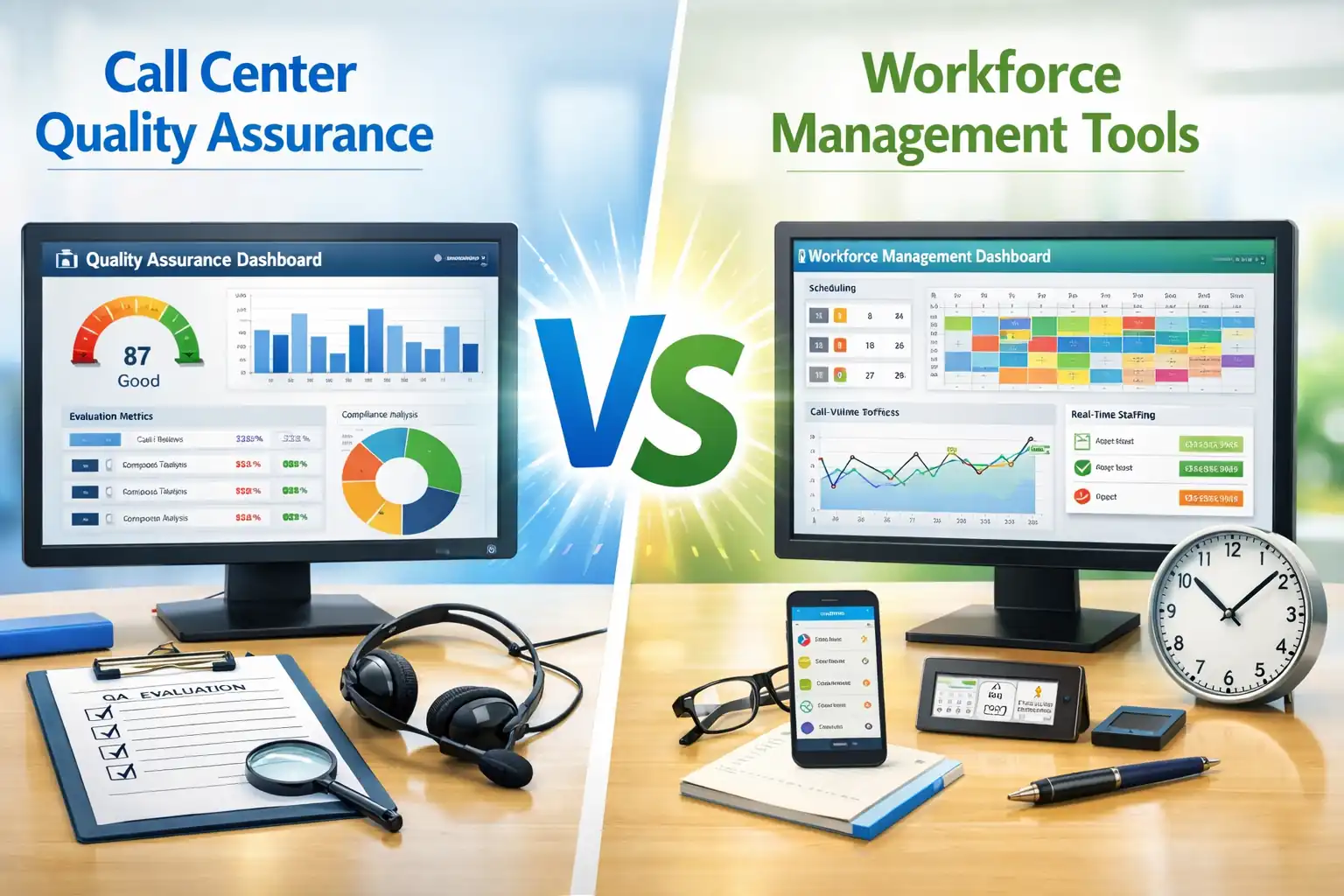
Before we go deep, here is a quick side-by-side. Both tools have different purposes, yet they meet at the same destination: customer experience.
Both tools are used in modern contact centers, support centers, and virtual call center environments. While they are different, most businesses and companies prefer using both to ensure a holistic view.
What is Call Center Quality Assurance (QA)?
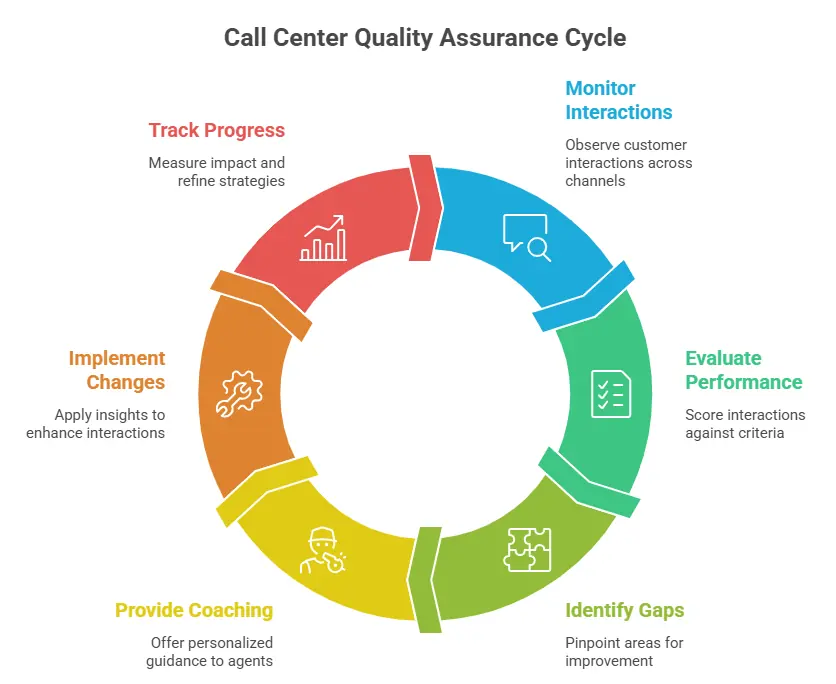
Call center Quality Assurance (QA) is the process of monitoring, evaluating, and improving the quality of customer interactions. It covers every channel a contact center or support center uses - voice calls, live chat, email, and SMS.
Previously, QA meant that supervisors manually listened to a random 1–2% of calls and scored them on a checklist. This was mostly effective, but assessing only 1-2% calls didn’t reflect the actual performance. However, modern AI-powered QA tools now automatically evaluate 100% of interactions - scoring them against custom criteria the moment a call ends. It’s a complete QA solution that call centers have been waiting for.
It is important to distinguish QA from related but distinct concepts, especially Quality Management. Quality Assurance evaluates interactions after they happen using scorecards and AI scoring.
Quality Management (QM) governs the QA process itself. It calibrates scorecards, manages evaluation workflows, and links QA data to coaching. Quality Monitoring watches calls in real time for compliance or live intervention. So, these are completely different functions that differentiate QM from QA.
Purpose of Call Center QA
The purpose of call center QA is to evaluate the quality of customer interactions. Here are all the major purposes a QA tool serves in a call center:
- Improves CSAT: Almost 95% of customers report that a great service experience encourages them to be a repeat customer. QA finds the gaps that hurt satisfaction before they become patterns.
- Protects compliance: For healthcare, finance, and insurance, QA provides documented proof for each conversation to maintain consistency.
- Reduces churn from bad service: One in three customers will leave after a single bad experience. QA catches the behaviors that drive customers away.
- Creates coaching opportunities: QA reveals improvement areas for coaching that can positively impact agents’ performance.
- Scales consistency: In virtual call center and remote support center environments, QA ensures consistency regardless of the location.
Key Functions of Call Center QA Tools
QA tools in a modern call center or help desk environment perform several interconnected functions:
Scorecards are the backbone of any QA program. They define how you measure the metrics to be “good”. It can be a compliance script, showing empathy, resolving the issue on the first call, or using the correct greeting. Teams can customize scorecards for different call types, channels, and agent roles.
Call monitoring enables QA analysts and supervisors to review actual conversations. AI-powered tools now transcribe and score these conversations at scale. Agent coaching flows directly from QA findings. The best QA tools automatically route performance gaps to coaching sessions, rather than waiting for a quarterly review.
Lastly, interaction analytics support contact centers with a detailed view of crucial patterns. Common complaints, frequent escalation triggers, or script adherence trends. These can now be easily analysed at scale with AI-powered QA tools.
What Call Center QA Focuses On
Call center QA focuses on evaluating how effectively each agent performs their job during customer interactions. It doesn’t care about agent scheduling, leaves, or any similar functions. It is purely about performance quality per interaction.
Specifically, QA evaluates:
- Did the agent follow the correct script or process?
- Did the agent show empathy and professionalism?
- Was the customer's issue resolved on the first call (FCR)?
- Did the agent comply with regulatory requirements?
- Did the customer leave the interaction satisfied?
What is Call Center Workforce Management (WFM)?
WFM refers to the process and applications to match the right number of agents who are available at the right moment. Obviously, it assumes the agents are skilled and efficient so that the tools can optimise for both performance and cost.
While QA asks "How well are agents performing?", WFM asks "Are there enough of the right agents available right now?"
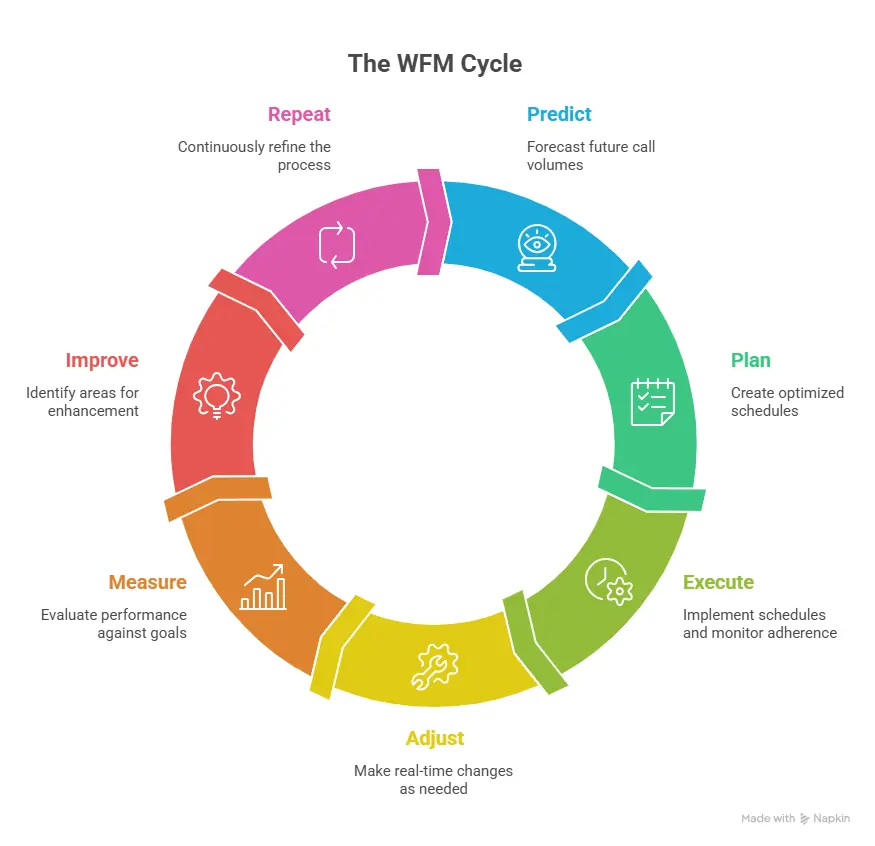
WFM covers the entire staffing lifecycle. That includes forecasting call volumes weeks in advance, building optimized schedules, monitoring real-time adherence during shifts, and adjusting on the fly when volume spikes or an agent calls in sick.
WFM is not just a scheduling tool. It is a strategic capacity management system. Without it, contact centers are either overstaffed or understaffed. Both outcomes damage the business.
Purpose of Call Center WFM
The purpose of WFM is simple — make sure all agents are working, and some are available in case of emergency.
A well-run WFM function delivers:
- Service level achievement: The industry standard is to answer 80% of calls within 20 seconds. WFM is what makes hitting that benchmark possible without overstaffing.
- Cost control: With 60–70% of a contact center budget going to human resources, precise scheduling directly reduces the single biggest cost driver.
- Agent satisfaction: Flexibility is often the biggest factor in agent satisfaction, according to Calabrio's WFM research. WFM tools that offer self-service scheduling and shift swapping can reduce attrition.
- Compliance with labor laws: WFM tracks overtime, break requirements, and PTO entitlements automatically. It reduces the legal risk for call center services and BPO operations.
- Real-time adaptability: AI-powered WFM tools go beyond forecasting to assist with intelligent scheduling, intraday adjustments, and real-time adherence monitoring.
Key Functions of WFM Tools
Workforce management tools in a contact center or support center environment handle the full staffing lifecycle:
Demand forecasting is the foundation. WFM tools analyze historical call volume patterns, seasonal trends, planned marketing campaigns, and product launch calendars to predict future volume.
Automated scheduling converts those forecasts into agent schedules. It factors in agent skills & capabilities, shift preferences, and labor law requirements to prepare a roster within minutes. Over time, it understands the spikes in agent demand to suggest scheduling insights proactively.
Real-time adherence monitoring tracks whether agents are following their schedule during the shift. If an agent is late returning from break or not logged into the correct queue, the system flags it. So, supervisors can intervene before service levels are affected.
Lastly, payroll integration connects time and attendance data directly to HR and payroll systems. No need for manual entries and wasted time, reducing errors in agent compensation.
What Call Center WFM Focuses On
WFM focuses on understanding when and how many agents are needed. It is a capacity and operational efficiency tool, not a performance quality tool.
Specifically, WFM manages:
- How many agents are needed per 30-minute interval, per day, per week
- Which agents have the right skills for each queue or channel
- Whether agents are following their assigned schedules in real time
- How to adjust staffing instantly when demand spikes or drops
- How to plan headcount for the next quarter without overspending on labor
Conclusion
QA tools and WFM tools address distinct challenges in any call center, contact center, or support center. QA tells you how well agents perform. WFM tells you if the right agents are scheduled. However, both are essential for a call center to grow.
The most effective customer service centers use them together. Because great schedules without quality produce busy but ineffective agents. On the other hand, great quality scores with chronic understaffing still break service levels.
Frequently Asked Questions
What does quality assurance do in a call center?
Call center QA monitors and evaluates every customer interaction for quality. It uses scorecards, call recordings, and AI scoring to find performance gaps. QA findings feed directly into agent coaching and training programs. The goal is to improve CSAT, FCR, and compliance outcomes consistently.
What are the key performance indicators for call center QA?
The core QA KPIs are CSAT, FCR, AHT, and compliance score. QA programs also track agent quality scores and script adherence rates. The industry FCR average sits at 69%, according to SQM Group. World-class contact centers aim for an FCR rate of 80% or higher.
What is quality management in a contact center?
Quality management (QM) governs how QA programs operate inside a contact center. It covers calibrating scorecards, managing evaluation workflows, and linking QA data to coaching. QM is the operational layer that sits above individual QA evaluations. Unlike QA, QM focuses on the system that makes quality work.
Why is interaction recording important?
Interaction recording is the foundation of any strong call center QA program. Without recordings, quality evaluation relies on limited and biased supervisor recollection. Recordings allow AI transcription tools to review 100% of interactions at scale. They also serve as documented evidence during compliance audits and regulatory examinations.
How can automated scoring work in a contact center?
Automated scoring uses AI and NLP to evaluate every interaction the moment it ends. The AI reviews transcripts for script adherence, empathy signals, and compliance language. It assigns a quality score without any human reviewer involvement. This removes sampling bias and scales QA across thousands of daily calls.
What is the workforce management process in a call center?
The WFM process follows a recurring cycle: forecast, plan, schedule, execute, monitor, and adjust. WFM tools analyze historical data to predict demand at the interval level. Schedules are then built to match demand with available, skilled agents. Intraday management handles unexpected changes like absences or sudden call spikes.
What are some challenges of contact center quality management?
Traditional QA reviews only 1–2% of calls, leaving massive performance blind spots. Subjectivity between evaluators creates scoring inconsistency across teams and shifts. Integrating QA tools with WFM, CRM, and telephony platforms adds technical complexity. Delayed feedback also significantly reduces the coaching impact on agent behavior.
How often should quality assessments be conducted?
Manual QA programs typically assess a sample of calls weekly or monthly per agent. AI-powered QA systems assess 100% of interactions continuously in real time. For regulated industries like finance or healthcare, continuous monitoring is a compliance requirement. Feedback loops should also be continuous — monthly reviews reduce behavior change significantly.
What's the difference between WFM and WFO?
WFM covers scheduling, forecasting, and real-time agent adherence monitoring. WFO is a broader umbrella that includes WFM, plus QA and performance management. It also includes learning management systems and advanced analytics capabilities. Think of WFM as one core component inside a larger WFO or WEM suite.
Which CRM is best for call centers?
There is no single best CRM for every call center environment. Salesforce Service Cloud and Zendesk dominate enterprise contact centers with deep integrations. HubSpot suits small-to-mid-sized support centers with tighter budgets. The right choice depends on your volume, channel mix, and team size.
What does a WFM do in a call center?
WFM ensures the right agents are available at the right time. It forecasts inbound volume, builds optimized schedules, and tracks real-time adherence. WFM also manages shift swaps and adjusts staffing intraday as conditions change. It balances two risks: understaffing that breaches SLAs and overstaffing that wastes budget.
What's the best workforce management solution for call centers?
The best WFM solution depends on your call center's size, complexity, and channels. NICE WFM and Verint lead the enterprise market with deep forecasting accuracy. Calabrio ONE and Genesys Cloud WFM are strong mid-market options with solid AI. For SMBs, Apploye offers lightweight workforce tracking at a fraction of enterprise cost.
How are call centers using AI for agent call audits?
AI tools now review and score 100% of interactions instantly after each one ends. This replaces the old model of supervisors sampling just 1–2% of calls. AI detects sentiment, flags compliance risks, and identifies coaching opportunities at scale. It applies consistent scoring criteria without human bias or reviewer fatigue.
About Author