How to Prevent Call Center Agent Burnout
Key Takeaways
-

To prevent call center agent burnout, give agents fair shifts, enough breaks, and real time off. Short rest times between hard calls lower stress, improve focus, and help stop burnout early.
-
Call center monitoring software allows managers to set clear goals and provide feedback. This makes contact center agents feel safer, stronger, and less worn out.
-
Use smart routing and simple scripts to cut repeat work. Better systems and proper staffing help customer service center agents solve calls with less stress each day.
Call center agents go through a fluctuating schedule every hour. Every call is different from the other and needs intense care from agents to manage each customer.
As a result, call center agents feel burned out even knowing it on their own. But, as a manager, you can prevent it through an organized process. You can turn the best result, ensure the highest productivity, and still save employees from getting burned out.
How?
Let’s discover the effect of strategies on how to prevent call center agent burnout—
Key Prevention Strategies for Contact Center Agent Burnout
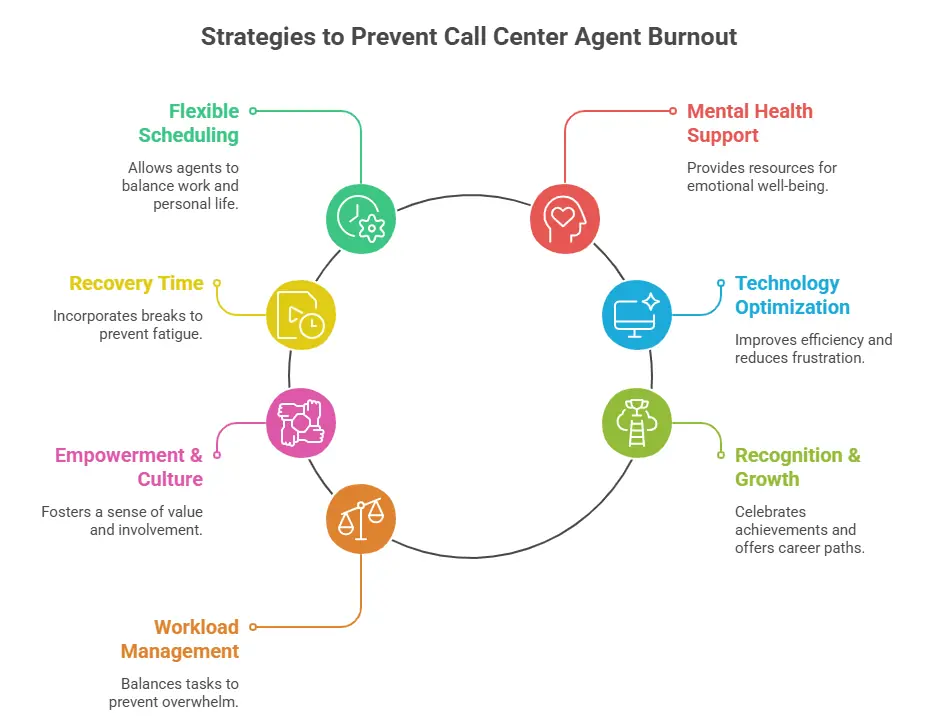
1. Flexible Scheduling & Work-Life Balance
Employees feel chronic stress at work due to an unmanaged work culture.
When you manage work schedules poorly and overload employees with back-to-back calls, it causes them fatigue. Over time, sticking to an unbreathable schedule like this leads to continuous mismatched work-life balance.
So, try to allow your agents to customize their working hours around their personal responsibilities. Flexible scheduling will help them manage family commitments, health needs, and personal time without constant stress.
Track hours fairly with weekly time limits
2. Actionable Mental Health Support
Working in a help desk or support center often means dealing with difficult conversations throughout the day. That emotional load can build up quickly.
To prevent your call center agent burnout, you can offer wellness initiatives like—
- Access to counseling or mental health resources
- Stress management workshops
- Encouragement to take short, regular breaks
3. Build Recovery into the Schedule
Do you know that many employers offer phased returns to let employees recover to start a nonconstructive hour efficiently?
And trust me, this is one of the most effective ways to prevent employee burnout in a hectic job contact center. Your agents get a call that drains their energy, and just juggling between calls can make them burn out.
Here, breaks gave that space to survive the busy queue periods. So try to plan schedules realistically so agents can still step away even when call volume increases.
You can also offer microbreaks in your service center, such as–
- A 2–3 minute pause after a difficult call.
- A quick walk or stretch between interactions.
- A short decompression period after handling an abusive customer.
These small recovery moments can help agents reset mentally and perform better throughout the day.
Use Pomodoro breaks to reduce call fatigue
4. Technology & Tools Optimization
Well, it’s not always your customer queries that cause employee burnout. Sometimes, it can be the bad tools. In many customer service centers, employees struggle with slow systems. They need to juggle between tasks and switch from dashboard to dashboard in order to handle a single query.
Here, you can reduce that frustration by investing in:
- AI-assisted scheduling tools
- CRM integrations
- Faster internal systems
There are many profound solutions available that can help speed up your employee performance as well as prevent burnout.
Spot slow tools with app and URL tracking
5. Empowerment & Culture
When employees feel that their opinion matters, it boosts their morale and makes them more committed to work. So, instead of micromanaging, try to build a work culture that makes employees feel valued.
You can also involve your agents in improving your processes. For example, you can ask for their input on workflows, scripts, or customer handling strategies. Since they interact with customers every day, they often have valuable insights that can improve your help desk operations.
Coach with live productivity data instead of micromanaging
6. Recognition & Growth
Well, you might be thinking, how can recognition help prevent employee burnout? Even if the effect is not direct, recognition goes a long way in preventing burnout.
How? As a manager, we only offer feedback when something goes wrong. Which can over time make the employee demotivated and discourage their effort.
Instead, you can make recognition a regular part of your culture. It will naturally build their strength, make them feel valued, and show them how their activities affect the company.
There are many ways you can celebrate achievements, such as:
- Appreciating high customer satisfaction scores
- Recognising successful problem resolutions
- Cheering consistent performance improvements
Employees also feel secure in working in jobs that offer career opportunities. So, try to provide clear career development opportunities along with recognition. When your agents see a future beyond their current role, it will make them stay motivated and committed.
Reward progress with performance rankings
7. Workload Management
As call center agents experience fluctuating call volumes, it is necessary to offer them a balanced schedule. With proper workforce management, it will help you ensure the right.
Workforce Management (WFM) is critical in call centers to balance agent scheduling with fluctuating call volumes, ensuring the right staff is available at the right time. It optimizes operational efficiency by reducing overstaffing costs, minimizes wait times for improved customer experience, manages agent performance, and ensures consistent service levels.
Poor workload distribution is another major cause of burnout.
Using Workforce Management (WFM) software helps managers balance occupancy levels and avoid scheduling agents for nonstop interactions.
These tools help ensure that agents in your virtual call center have enough productive work to stay engaged without becoming overwhelmed.
Balanced workloads protect both employee well-being and customer experience.
Use timesheets to rebalance heavy workloads
How to Identify and Manage Call Center Services Agent Burnout Symptoms
You can just avoid burnout by using prevention strategies. It can still appear, and as a manager, you should always keep an eye out for signs to detect earlier.
Here’s how you can manage burnout–
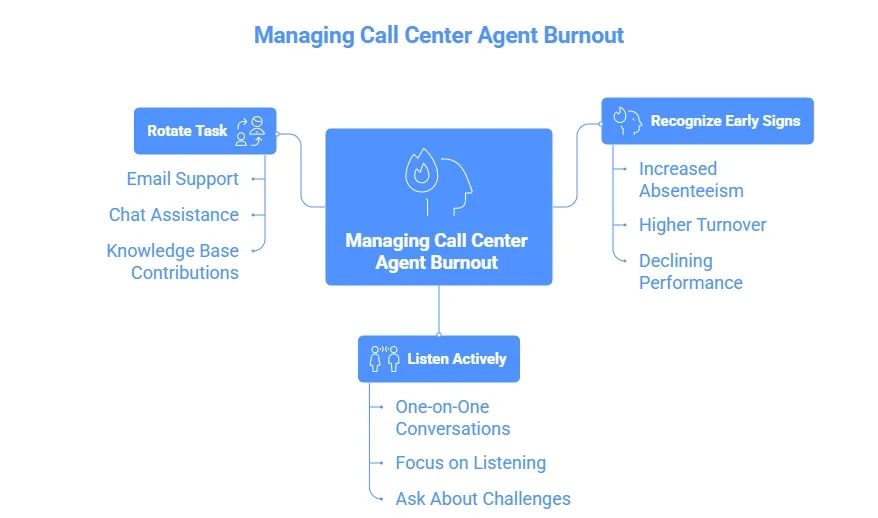
1. Recognize Early Signs
Any issues can be solved earlier if the signs are detected at the right time. Burnout in a service center often shows up through patterns such as:
- Increased absenteeism
- Higher employee turnover
- Declining performance metrics
If agents who previously performed well suddenly struggle with productivity or engagement, it may be a signal that stress levels are rising in your support center. Try to look for those signs, and work on solving them before they turn into massive burnout.
Spot stress signals early with live dashboards
2. Listen Actively
Active listening is one of the most needed attributes a contact center manager should have. If you regularly check in with agents through one-on-one conversations, it will help you look for signs you usually avoid.
Here, these discussions can focus on listening rather than evaluating. Ask your agents about their challenges, frustrations, and suggestions so you can bring improvement.
It will make them feel heard and share things without hesitation.
3. Rotate Task
It can become mentally exhausting for your agents to handle the same type of calls every day. Here, you can rotate tasks on different types of interactions, such as—
- Email support
- Chat assistance
- Knowledge base contributions
The variation in task assigning will help you prevent monotony and keep your employees engaged.
Rotate work using task and project tracking
Conclusion
Burnout is a serious issue in modern contact centers, but it doesn’t have to be unavoidable.
By focusing on flexible scheduling, supportive technology, balanced workloads, and a positive culture, organizations can create healthier environments for agents working in customer service centers, help desks, and virtual call centers.
When agents feel supported and valued, they perform better, stay longer, and deliver higher-quality call center services to customers.
Preventing burnout isn’t just good for employees; it’s essential for building a strong and sustainable support center.
Frequently Asked Questions
What is the 42% rule for burnout?
The 42% rule is basically a guideline. It suggests that employees shouldn’t spend more than about 42% of their time under high stress or intense cognitive demand. So, employees should balance heavy call handling with recovery time and lower-pressure tasks.
What is the 80/20 rule in call centers?
The 80/20 rule in call centers is also known as the Pareto Principle. It suggests that 80% of a call center’s results come from 20% of the agents’ efforts. Or that 80% of your customer complaints come from just 20% of common issues
What are the signs of call center agent burnout?
The first thing you will notice is changes in their behavior. For instance, your agents may become disengaged, call in sick more often, or struggle to maintain performance levels. You may also see behavior such as frustration, lower patience with customers, or declining CSAT scores, which are a strong sign of call center agent burnout.
What’s the difference between burnout and fatigue?
Fatigue is usually short-term physical and mental tiredness that goes away after rest. However, burnout is long-term emotional and mental exhaustion caused by continuous stress. In a support center, burnout often develops when agents feel overwhelmed for weeks or months without proper recovery time.
What causes burnout in call centers?
Things like constant call volume, difficult customers, strict productivity metrics, and poor scheduling can cause burnout in a call center. Even technology frustrations and a lack of career growth are also common factors in this. When stress from multiple sources piles up, agents feel stuck or exhausted, which results in serious burnout if not resolved earlier.
How can WFM reduce burnout?
Workforce Management (WFM) tools help distribute work more evenly across agents. Managers forecast demand and create schedules so they can prevent agents from handling nonstop calls all day. In a virtual call center, WFM also ensures the agents get proper breaks and balanced workloads.
How do you deal with abusive customers in a call center?
As a manager, you should provide agents with clear policies on how to handle abusive situations. They should know when it’s acceptable to warn the customer, escalate the call, or disconnect if necessary. In a healthy service center, managers also provide emotional support and recovery time after difficult interactions.
How can we reduce after-call work (ACW) without hurting quality?
Automation is an effective solution for reducing ACW in a help desk. These tools offer call transcription and automated summaries, which makes interaction documentation faster.
How can technology or AI reduce agent stress?
AI tools can handle repetitive questions, provide real-time suggestions during calls, and automate documentation. This reduces cognitive load for agents in the support center. When used correctly, technology helps agents focus on solving problems rather than fighting with systems.
How do you motivate and retain call center agents?
Recognition and growth opportunities make a big difference. Agents who feel valued and see a career path are more likely to stay engaged. In successful customer service centers, managers regularly celebrate achievements and provide training that helps agents advance professionally.
About Author