How Employee Engagement Impacts Call Center Productivity: A Manager's Guide
Key Takeaways
-

Disengaged agents take three times longer to resolve issues and generate nearly double the customer defection rate of engaged ones.
-
The earliest signs of disengagement show up in focus hours, AHT, and peer interaction.
-
Fixing engagement starts with goal clarity, consistent feedback, and recognition.
Have you been noticing that your call center numbers are slipping? Average Handle Time (AHT) is climbing, and First Contact Resolution (FCR) is dropping. But you can’t pinpoint why.
Well, don’t mistake thinking that it’s a process or technology issue. Instead, it’s the engagement. To get more clarity, you must understand how employee engagement impacts call center productivity.
Up next, I’ll explain what engagement means in a call center and the impact on productivity. There will also be a discussion on how you can improve the engagement. So, keep reading.
How Does Employee Engagement Impact Call Center Productivity?
Agent engagement affects every measurable productivity output in contact centers.
Engaged Agents Resolve More Calls, Faster
Engaged agents take ownership of every call. They ask the right questions, stay on the line, and close issues in one interaction. That directly improves FCR and brings average handle time down.
Plus, the gap is hard to ignore. Gartner reports that disengaged reps take roughly 3X longer to resolve issues. Also, higher FCR means fewer repeat calls. So the whole team carries a lighter load over time.
Turnover Drops When Agents Feel Connected
Engaged agents stay longer. That matters because tenure directly affects call quality. During long periods of service, agents carry institutional knowledge. It includes product context, escalation shortcuts, and customer service patterns that new hires take months to build.
FCR Rates Climb with Agent Empowerment
Empowered agents don’t wait for permission to solve a problem. They —
- Make decisions
- Skip unnecessary transfers
- Close calls with confidence.
That behavior is a direct factor of higher FCR. SQM Group's research shows the bottom 15% of CSRs produce customer defection rates double those of the top 15%.
Errors and Rework Fall with Higher Engagement
Engaged agents get it right the first time. Hence, the team spends less time fixing what should not have broken.
Loyal Agents Refer Better Hires
Focused agents talk about their workplace positively. Trust me, it directly affects who applies for open roles.
On top of that, referred hires tend to ramp faster, stay longer, and already understand the culture before their first day.
A study by McKinsey on contact centers shows that engaged employees are 16 times more likely to tell others to work at their company. This flow of good referrals lowers the cost of hiring.
At the same time, it helps keep the team’s average skill level high.
How Can Call Center Managers Improve Engagement to Increase Productivity?
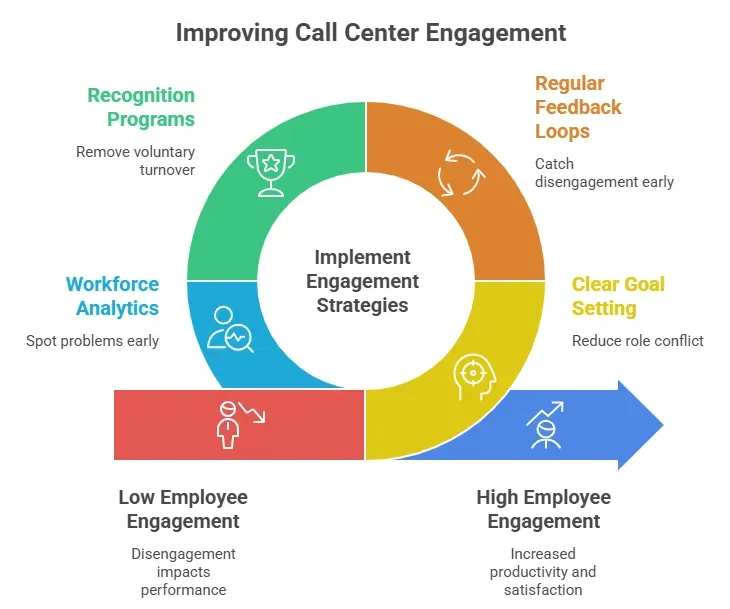
Here’s how call centers can improve the engagement of employees —
Assign Clear Goals to Reduce Role Conflict
Set clear goals so agents know exactly what good performance looks like. Also, avoid conflicting targets, like quality versus handle time, as it creates role conflict.
Run Feedback Loops to Catch Disengagement Early
Build regular feedback loops so you can spot disengagement before it hits performance metrics. Without them, agents have no criteria to self-evaluate.
Supervisor availability matters here. McKinsey research found that 57% of agents who could reach their supervisor within two minutes were extremely satisfied. When wait times exceeded 15 minutes, that figure dropped to 14%.
Use Recognition Programs to Remove Voluntary Turnover
Recognize performance consistently. Without it, even high performers start questioning whether staying is worth it.
SHRM research found that companies with recognition programs see 23.4% lower turnover. I implement —
- Peer shoutouts
- Performance bonuses
- Sometimes, a simple manager acknowledgment
The method matters less than the consistency.
Use Workforce Analytics to Spot Problems
Track engagement signals early so disengagement never reaches the point of resignation. Standard KPI dashboards show what has already gone wrong. But call center monitoring software shows what is about to.
I focus on hours, idle patterns, and utilization rates to understand which agents are overloaded, underutilized, or quietly disengaging.
Apploye's activity monitoring and workforce analytics give call center managers exactly that visibility. You see productivity shifts in real time, across every agent, before they become attrition.
Sign up for Apploye to catch disengagement before it costs you
Wrapping Up
How does employee engagement impact call center productivity? It impacts in ways most managers only notice after the damage is done. Most of the time, turnover spikes and FCR drops.
The fix starts with visibility. Apploye's workforce analytics and activity monitoring show you exactly where engagement is slipping. It lets you track focus hours, utilization rates, and productivity patterns in real time.
Frequently Asked Questions
What is the link between employee engagement and first call resolution?
Engaged agents are 3.3x more likely to feel empowered to resolve issues on the first call. They take ownership, stay on the line, and avoid unnecessary transfers. It directly improves FCR rates and reduces repeat contact volume.
How much does a disengaged call center employee cost the business?
Replacing one disengaged agent costs $10,000 to $20,000 in recruiting and training. Bottom-15% CSRs also generate nearly $1.4M in annual revenue loss from customer defections. That’s nearly double the impact of top-performing agents.
What are the early signs of disengagement in call center agents?
Early signs of disengagement in call center agents include rising AHT, declining FCR, lower quality scores, and reduced peer interaction. Managers should also watch for conflicting KPI frustration and dropping focus hours.
How do I balance occupancy and service level without burnout?
To balance occupancy and service level without burnout, keep occupancy rates between 80–85%. Above that, agents have no recovery time between calls. Also, schedule buffer time, rotate high-volume shifts, and monitor utilization data weekly.
What KPIs prove productivity improvements?
Track FCR, AHT, CSAT, voluntary turnover rate, and absenteeism. These five metrics move directly with engagement levels. Moreover, FCR and AHT shift first, usually within 30 to 60 days of an engagement intervention.
How does an employee's performance impact service quality?
High-performing agents resolve issues faster and generate fewer repeat contacts. They also keep customer defection rates low. In contrast, low-performing agents do the opposite. They have slower resolutions, more follow-up calls, and higher customer churn.
How quickly can engagement improvements show up in metrics?
FCR and AHT respond fastest, often within 4 to 8 weeks. Meanwhile, CSAT and retention metrics take longer, typically 3 to 6 months. Absenteeism rates usually improve within 60 days of consistent recognition and feedback programs.
What’s the best engagement strategy for remote/hybrid agents?
Prioritize structured check-ins, clear goal visibility, and digital recognition tools. Remember, remote agents disengage faster without regular feedback loops. So, implement daily async updates and weekly one-on-ones to maintain the supervisor's availability. It drives satisfaction in on-site teams.
About Author