Top 10 Call Center Training Best Practices for New Managers
Key Takeaways
-

Set clear targets early. Agents need defined KPIs like FCR, AHT, and CSAT, as clarity improves focus and faster improvement.
-
Coach with data from call center monitoring software and feedback. Track performance, run role-play drills, and give same-day, specific feedback.
-
Use a structured training flow with a call center workforce management tool. Start with onboarding, move to shadowing, then nesting.
New managers often step into call centers and rush training to fix staffing gaps. I did the same. My agents struggled with call control, missed KPIs, and lost confidence within weeks.
Then I shifted to structured coaching, clear metrics, and real-time feedback loops. Well, performance stabilized fast. Here, on call center training best practices for new managers, I’ll show you the exact system that builds high-performing agents from day one.
Top 10 Call Center Training Best Practices for New Managers
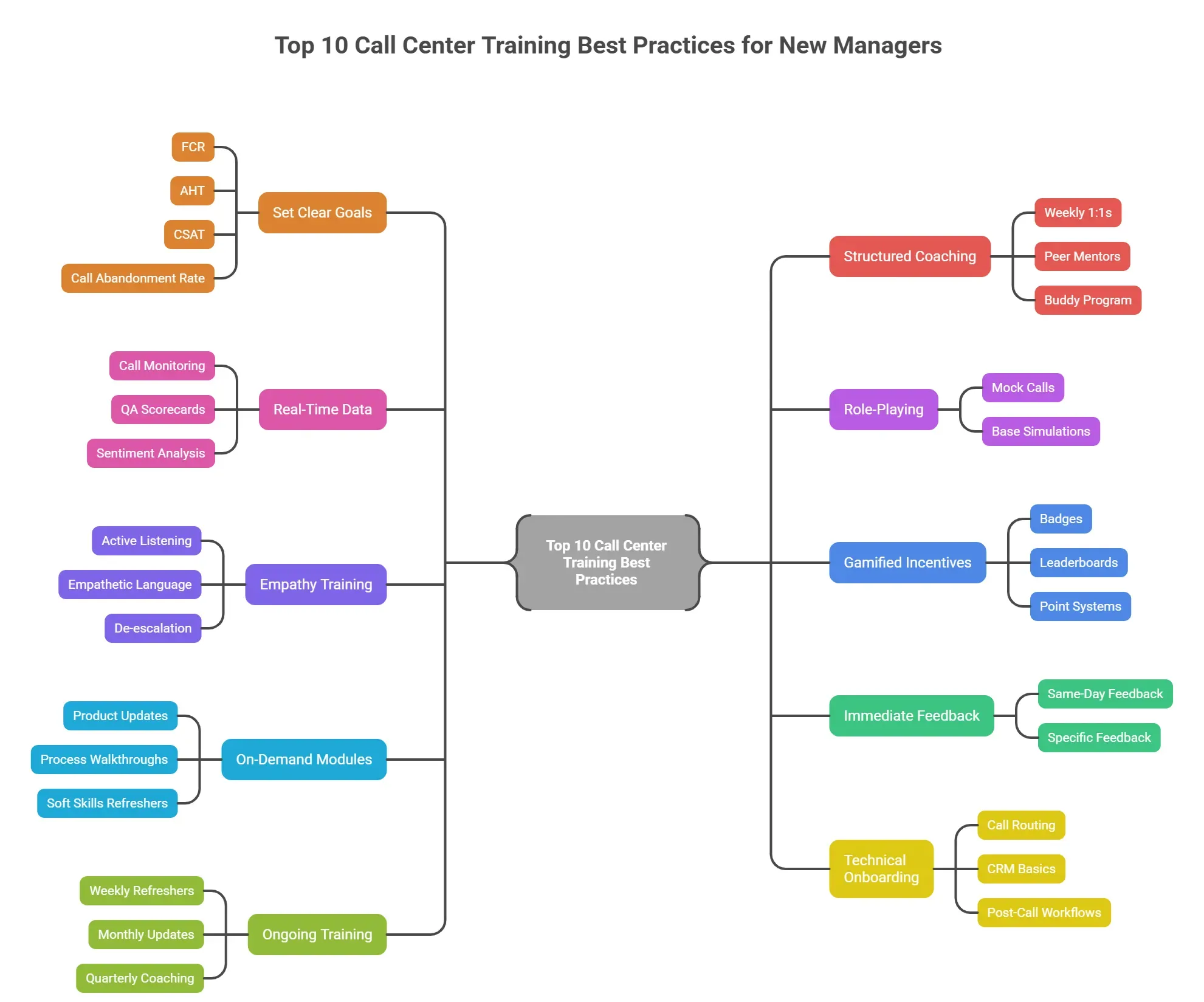
Set clear KPI targets early, use structured coaching with mentors and 1:1s. Also, track performance data to find gaps, run role-play drills, and train soft skills like empathy. Moreover, add gamified incentives, provide on-demand modules, and give quick yet specific feedback.
Let’s get to know each of them in detail —
1. Set Clear, Metric-Based Goals From Day One
Set clear goals before contact center training starts. Agents perform better when they know the customer service target. I start with these core KPIs —
- First Call Resolution (FCR): 70 to 80% industry benchmark
- Average Handle Time (AHT): 5 to 8 minutes per call
- Customer Satisfaction Score (CSAT): 80 to 90% is strong
- Call Abandonment Rate: Keep it under 5%
Revisit these customer interaction metrics weekly in your first 90 days.
2. Build a Structured Coaching and Mentoring System
Structure your contact center coaching before agents take their first call.
You can implement a fixed system like mine. That’s weekly 1:1s, assigned peer mentors, and a buddy program for new hires.
Agents who feel supported are nearly 70% less likely to experience burnout. So, pair each new hire with a tenured agent in week one. Also, set a recurring 10-minute 1:1 cadence for the first 30 days.
3. Use Real-Time Data and Analytics to Spot Skill Gaps
Use call center monitoring software to collect data before coaching. In my case, I do —
- Call monitoring
- QA scorecards
- Sentiment analysis
It shows exactly which agents struggle and on which call types.
Here, Apploye gives new managers a direct view of agent activity. It comes with productivity scoring, app and URL tracking, and workforce analytics. Thus, you can see where time goes and which agents show patterns worth resolving.
Try Apploye free to close agent training gaps
4. Run Role-Playing and Simulation Exercises
Give your agents to run mock calls before handling real ones. It helps them to make fewer mistakes and recover faster under pressure.
I also put my new hires into role-playing in controlled situations. At that time, they know that the errors are learning moments.
On top of that, apply base simulations to your most frequent call types. Assign one agent as the customer and give them a realistic customer experience scenario.
5. Train Agents on Empathy and Soft Skills
Teach your call agents soft skills with the same structure you use for product knowledge. You can start with three core behaviors during training —
- Active listening: Repeat back what the customer said before responding
- Empathetic language: Use phrases like "I understand how frustrating that is"
- De-escalation: Lower your tone, slow your pace, acknowledge the emotion first
Run short role-play drills around each behavior.
6. Incentivize Training to Increase Employee Engagement
Gamification makes agent training competitive without burning out call center agents. To do that, you can offer —
- Badges
- Leaderboards
- Point systems
- Weekly challenges
It gives agents a reason to engage beyond the requirement to complete modules. In this case, I set up simple mechanics from week one —
- Points for completing training modules on time
- Badges for hitting KPI milestones in the first 30 days
- Leaderboards for FCR or CSAT scores are updated weekly
- Challenges linked to specific skills like call opening or de-escalation
7. Offer On-Demand Training Modules for Flexible Access
I’ve seen that the on-demand training process removes the scheduling problem. Therefore, build a library of short, focused modules agents can access anytime —
- Product knowledge updates when offerings change
- Process walkthroughs for new workflows
- Soft skills refreshers between coaching sessions
- Tool and software guides for new hires
Also, record every live training session. Plus, store everything in one searchable knowledge base. This way, agents who miss a session catch up on their own schedule.
8. Provide Immediate and Specific Feedback After Every Interaction
You must offer immediate feedback to correct mistakes before they become habits. I aim for same-day feedback.
I also keep feedback specific, not general —
- Weak: "Your tone needs work"
- Strong: "On that third call, your pace slowed down when the customer pushed back; that worked well. Hold that."
9. Keep Training Ongoing Beyond Onboarding
Offer ongoing training even after onboarding as products change and processes update.
Here, you can build a simple ongoing training rhythm —
- Weekly: Short skill refreshers linked to recent call trends
- Monthly: Process or product updates as they roll out
- Quarterly: Deeper coaching sessions focused on individual growth areas
10. Include Technical Onboarding on Call Center Tools
When your agents have enough tool knowledge, it gives them confidence. Most importantly, it directly affects call quality. So, make technical onboarding mandatory.
Cover these systems before agents take their first live call —
- Call routing and transfer procedures
- QA platforms and scorecard navigation
- CRM basics, like logging calls, accessing customer profiles
- Post-call workflows, such as summaries, dispositions, follow-up tasks
Conclusion
Call center training best practices for new managers come down to clarity, structure, and consistency. Set clear KPIs early, use data to find gaps fast, and practice through role-play. Moreover, train soft skills with intent. Avoid one-size coaching and script dependence.
Apploye can help you see real work patterns with data, so you fix issues that actually affect performance.
Frequently Asked Questions
How long should call center training last for new agents?
Call center training for new agents should last for 3 to 6 weeks. It covers onboarding, shadowing, and nesting.
What is the difference between call center coaching and training?
Call center coaching improves specific behaviors after calls happen. On the other hand, training builds foundational knowledge before agents take calls. Training is a one-time phase. Again, coaching is an ongoing habit.
What KPIs matter most in the first 90 days of call center management?
The KPIs that matter most in the first 90 days of call center management are FCR, AHT, CSAT, and agent attrition rate. While FCR shows whether training is working, the AHT flags process gaps. Meanwhile, CSAT reflects customer impact. Finally, attrition rate tells you if agents feel supported enough to stay past the first 90 days.
How do you train remote call center agents effectively?
To train remote call center agents, use on-demand modules that are easily accessible. Also, record every live session and build a searchable knowledge base for quick reference during calls. On top of that, you can pair remote agents with virtual mentors for regular video check-ins.
About Author