Tips to Make Call Center Agents More Productive

Key Takeaways
-

Give agents clear scripts, quick training, and regular coaching so they can solve customer problems faster and make fewer mistakes on every call.
-
Use simple tools like call routing, call center monitoring, knowledge bases, and time tracking to cut wasted time, speed up tasks, and help agents stay focused all day.
-
Set fair goals, track key metrics, and support agents with breaks and feedback so they stay motivated, improve performance, and avoid burnout.
Unlike other jobs, call center work is more relentless. Here, a service center agent has to work between back-to-back calls, solve complex customer issues, and go through constant pressure.
By working in that roller coaster work culture, it’s easy for virtual call center agents to feel burnt. So, in this blog, we are going to discuss effective tips that will help you make your agents more productive.
How to Boost Call Center Agent Productivity
Method-01: Technology & Automation Tools
i) Leverage AI and Automation
As technology arises, there are many AI tools evolving that can help organisations automate their daily tasks. Call center agents can automate their repetitive tasks with the help of AI and Automation tools.
Here are the tasks that call center agents can leverage AI and automations–
- For preparing a live transcript and translations.
- Routing calls to suitable agents.
- Automatically verifying identity.
- Summarizing calls after the call ends.
- Predictive smart dialing.
- Preparing 100% call review without sampling 1-2% of the calls and preparing scoring.
ii) Implement a Unified Agent Workspace
In case you don’t notice yet, when you instantly switch between tools, it is one of the biggest reasons our productivity drains. And for call center agents, it happens rapidly, in every call. You need to jump between CRM systems, email, chat dashboards, and knowledge bases, which wastes seconds on every interaction.
To get rid of this constant loop of time wastage, using a unified agent workspace is most effective. It allows you to see the necessary context from one platform without searching for it in different systems.
So, over time, it gives you access to respond faster, make fewer errors, and maintain smoother conversations. It also reduces mental fatigue caused by constant switching.
iii) Optimize Routing with Intelligent IVR
Proper call routing is one of the most important activities that defines how your call center is going to earn customer satisfaction. Call routing is a method through which incoming calls are
Smart routing ensures customers reach the right agent the first time.
Intelligent IVR systems use customer input, history, and data to direct calls to the most appropriate department or agent. This reduces unnecessary transfers and shortens resolution time.
When calls are routed correctly from the start, first-call resolution (FCR) improves, hold time decreases, and agents spend less time correcting misrouted issues. Better routing means fewer interruptions and more efficient workflows.
iv) Utilize Knowledge Management Systems
In call center services, information management is the key to performance boosting. Even the best agents lose time if information is hard to find.
Here, you can use a centralized, searchable knowledge management system. It will give your agents quick access to updated policies, troubleshooting steps, and standard responses. Instead of asking colleagues or placing customers on long holds, your agents can retrieve answers within seconds.
Method-02: Agent Empowerment & Development
Once you provide your team with the right possible solutions, you can focus on your call center agent development. Here are a few ways you can support center agents–
i) Provide Targeted Training
Training allows an unqualified employee to achieve more and reach the best of their potential. Not all employees you have in your help desk will have all the qualifications from the very beginning.
Some will need training before onboarding, and some might need development over time.
In our traditional employee management, training often happens only during onboarding. But real learning should continue while agents are actively working. By using coaching sessions and speech analytics, managers can identify common mistakes, knowledge gaps, or missed opportunities during calls. This allows supervisors to provide “just-in-time” training, quick, focused coaching that addresses specific issues immediately.
As a result, agents learn faster, improve call handling skills, and apply feedback directly in their next interactions.
ii) Clear KPIs and Performance Metrics
When you have measurable perimeters to measure productivity, it helps employees see through real-time data. They understand more, will not judge your evaluation analysis, and improve productivity automatically.
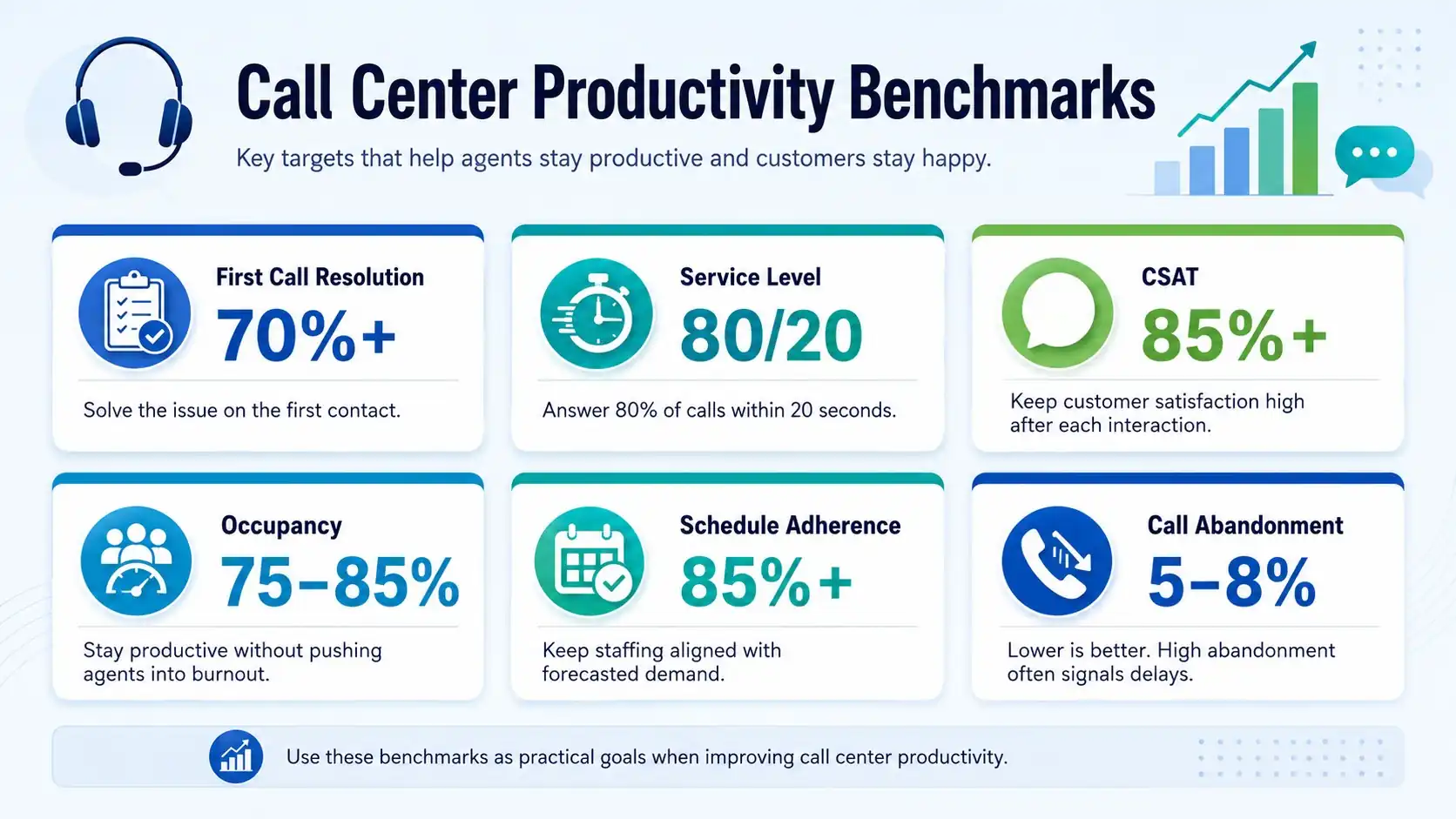
In your contact center, you can utilize effective performance indicators such as Average Handle Time (AHT), Customer Satisfaction (CSAT), First Call Resolution (FCR), and Schedule Adherence.
Before you implement these metrics, try to communicate the KPIs clearly with your team. It will help them prioritize the company goal better and align with the team’s expectations.
iii) Empowerment
Being able to make decisions on their own gives them greater confidence to handle queries. They become proficient in taking actions without seeking seniors' approval on every step. Ultimately, it leads to faster problem-solving and increased productivity.
To help your team make informed decisions on their own, you can provide them with clear guidelines, decision boundaries, and access to the right tools.
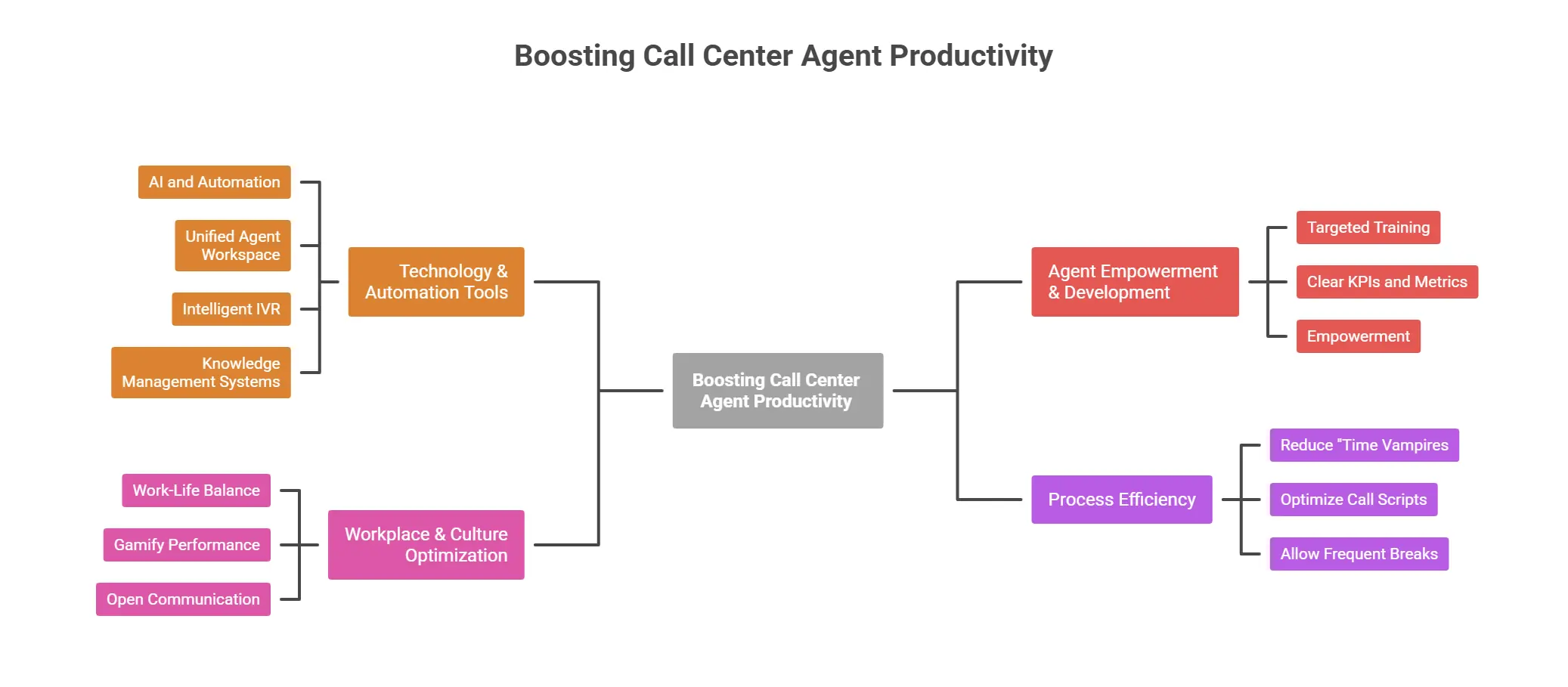
Method-03: Workplace & Culture Optimization
i) Promote Work-Life Balance
Unlike other high-frequency jobs, virtual support center work can also be demanding. In these cases, if your employees can not balance their personal life and work life together, this will lead to employee dissatisfaction.
But when employees feel rested and supported, they are less likely to experience burnout. This directly improves your team’s productivity, engagement, and service quality.
To help them with balancing work and life, you can provide flexible schedules, distribute shifts fairly, and provide adequate break times. It will help agents maintain their energy and focus throughout the day.
ii) Gamify Performance
Gamifying performance is the strategic application of game-like elements for performance improvement. Such as points, leaderboards, badges, and challenges for workplace tasks to boost employee engagement, motivation, and productivity.
This way, employers can transform traditional, static performance management into an interactive experience, promoting continuous feedback, skill development, and goal achievement.
iii) Encourage Open Communication
Strong communication between managers and agents builds trust and helps resolve problems early.
Regular one-on-one meetings allow supervisors to provide constructive feedback, discuss challenges, and recognize achievements. Encouraging agents to share suggestions or concerns also helps improve processes and creates a work environment where employees feel valued and heard.
Method-04: Process Efficiency
i) Reduce "Time Vampires"
You might be thinking that more time at the desk means more work has been done. However, your employees can sit for an extra hour and still work similarly to the other employee who left the desk hours earlier.
Even in your virtual call center to-do list, there can be tasks that cause more time waste. They can quietly drain time without adding real value. These are often called time vampires.
As a manager, you should regularly review workflows to identify these inefficiencies and remove unnecessary steps. You can streamline the work processes, automate repetitive tasks, and make use of tools that can free up sufficient time for agents.
ii) Optimize Call Scripts
Whether we’re working as a virtual call center agent or a help desk agent, we all use call scripts. They’re supposed to help you, right?
But if a script is too rigid, it can actually slow you down. You end up trying to follow every single line instead of focusing on what the customer actually needs.
A better approach for this is to treat the script like a guide, not a rulebook. It should give you the key checkpoints. Once you know those steps, you can have a more natural conversation instead of sounding robotic.
When scripts are designed this way, they help you stay organized without interrupting the flow of the call. That means you can get to the root of the issue faster and reduce Average Handle Time (AHT) without making the customer feel rushed.
iii) Allow Frequent Breaks
Can you imagine taking calls nonstop for hours? One call ends, another begins, and before you know it, your energy will start to drop. And it’s completely normal. That’s exactly why short breaks are so important.
Small breaks actually improve performance over time. Instead of feeling exhausted halfway through your shift, you can maintain steady energy, communicate more clearly, and handle calls more efficiently. Sometimes the best way to stay productive is simply giving yourself a moment to recharge.
Conclusion
At the end of the day, a productive call center is built on a mix of smart technology and a supportive culture.
So if you want to improve, take a look at your current workflow and see where the biggest "time-sinks" are. These are the most effective tips to make call center agents productive. Even a few small changes to your tech stack or coaching style can make a massive difference in your team's daily output.
Frequently Asked Questions
What tools help agents be more productive?
Standard tools like CRM software (to see customer history), Knowledge Bases (for quick answers), and Noise-Canceling Headsets are essential. However, many high-performing teams now use Employee Monitoring and Productivity Software to take things a step further.
What is the 80/20 rule in call centers?
The 80/20 rule is known as the Pareto Principle, which suggests that 80% of your results come from 20% of your efforts. In a call center, it often means 80% of calls are handled within 20 seconds, or that 80% of your customer complaints come from just 20% of common issues.
How to improve as a call center agent?
To improve as a call center agent, focus on active listening and taking notes during the call. It will help you avoid asking the customer to repeat themselves. You can also regularly review your own call recordings to identify habits like using "filler words" or long silences that you can tighten up.
How to create a productive team in a call center environment?
Build a culture of transparency where agents can see their own real-time stats and understand how they contribute to team goals. Providing regular, positive feedback and gamifying targets can also boost morale and output.
How to stay positive and optimistic while working in a call center job?
The key to staying positive in a call center job is not to take angry callers personally. You can take a full break from the desk to reset and celebrate your small wins in order to stay motivated in your contact center job.
How do you measure call center productivity?
Call center productivity usually gets measured following a few metrics, including AHT, FCR, utilization, and occupancy. Average Handling Time measurement is measuring the total time spent on a call, plus follow-up work. Besides, First Call Resolution indicates the percentage of issues solved in a single interaction, and the Utilization metric measures the total time spent on work-related tasks vs. total shift time.
How can I reduce AHT without hurting CSAT?
Focus on the "middle" of the call by improving your system navigation speed rather than rushing the customer. Using pre-written templates for common solutions allows you to provide the answer faster while still sounding thorough and helpful.
What are the best call center KPIs to track?
The "Big Three" call center KPIs are Customer Satisfaction (CSAT), First Call Resolution (FCR), and Service Level. The regular tracking of these metrics can ensure you are balancing speed with quality and meeting customer expectations.
How do you improve first call resolution (FCR)?
To improve your customer service center agents’ FCR, try to empower their decision-making skills without seniors’ help. Provide them with a fast, up-to-date, and searchable knowledge base so they can always get the right information at the right time.
How does AI improve agent productivity?
AI can listen to calls in real-time to suggest the right knowledge base articles or automatically summarize the conversation once the call ends.
About Author