Time Management Tips for Call Center Agents
Key Takeaways
-

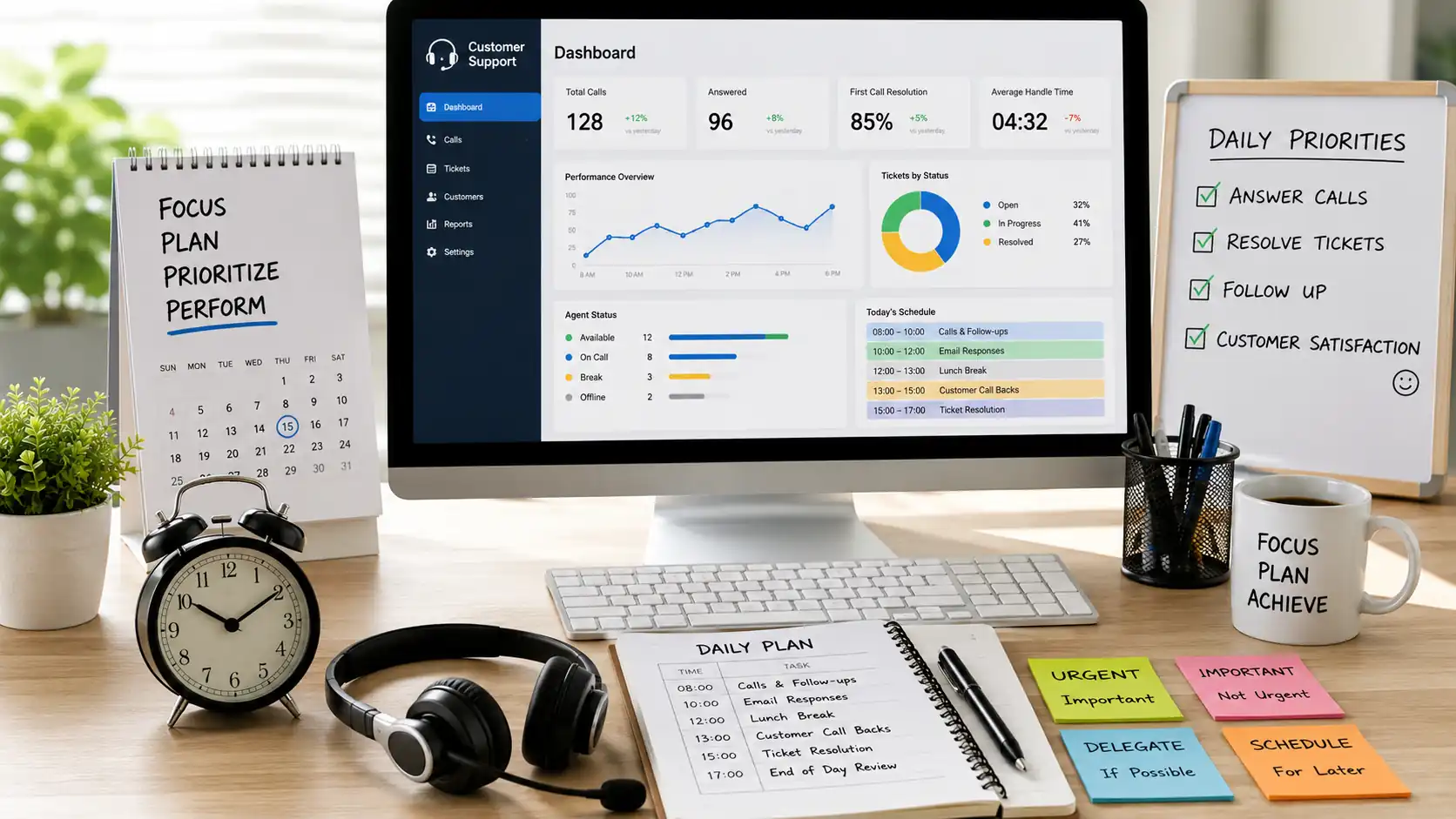
Call center agents save time when they plan each shift in blocks for calls, after-call work, and breaks. A simple plan helps lower rush, missed notes, and idle time.
-
Use call scripts, shortcuts, and ready-made replies to handle common questions faster. This cuts talk time, keeps answers clear, and helps agents stay on task.
-
Track where minutes are lost, like long wrap-up time or extra hold time, then fix one problem at a time.
No matter what hectic job you are in, time management is the key to better results. The better you can manage time and handle issues, the more efficiently you can achieve your goals.
In call center customer service, time management is your weapon. Call centers need to master their time management skills in order to maintain service quality and reach daily goals.
In this blog, we are going to share the ultimate proven time management tips for call center agents. So, let’s dive in—
Top Time Management Techniques for Call Center Agents
1. Prioritize Tasks (Eisenhower Matrix)
To prioritize tasks based on their urgency, Eisenhower metrics work best. In this metric, it has 4 quadrants where it says to solve–
- Quadrant 1: Urgent & Important (Do Now): Crises, deadlines, and problems that need immediate action (e.g., a client deadline today).
- Quadrant 2: Important but Not Urgent (Schedule): High-value activities that build long-term success (e.g., skill-building or strategic planning). This is where you should spend most of your time.
- Quadrant 3: Urgent but Not Important (Delegate): Interruptions like non-essential emails or minor requests that feel pressing but don't move the needle.
- Quadrant 4: Neither Urgent nor Important (Eliminate): Time-wasters like mindless scrolling or unnecessary meetings.
As a support center agent, when you focus on these 4 quadrants, it becomes efficient for you to manage time better.
2. Single-Tasking
Multitasking is not a blessing, especially when you are struggling with focus. Even when you are handling high-stress work, it is better to handle each task at a time. It gives you more space to think clearly and dedicate your focus to a particular problem.
To focus on one call at a time, you can–
- Give your full attention to one customer at a time.
- Organize your desk and set small goals before you start.
- Use noise-canceling headsets to block out distractions.
- Schedule specific times for your tasks and your breaks.
3. Use Templates and Automation
As a customer service center agent, using time tracking templates can significantly reduce after-call work (ACW) and ticket handling time. Instead of rewriting the same responses repeatedly, rely on canned responses, pre-written email templates, and structured note formats.
You can also use your CRM’s built-in features like auto-fill fields, dropdown selections, and tagging systems to speed up documentation. For example, you can create a simple note structure, such as Issue → Action Taken → Outcome, to keep updates clear and quick. For repetitive cases, prepare ready-made responses that can be slightly customized instead of being written from scratch.
4. Time-Blocking & Breaks
The most effective time management technique is to be able to know when to work and when to take a break.
Yes, it may sound unrealistic, but trust me, the break you take to recharge yourself is the main performance booster. Even in a fast-paced call center, scheduled breaks between heavy call periods help you reset mentally and avoid fatigue.
Similarly, without breaks, the focus of work drops, and the chances of mistakes increase.
You can use micro-breaks of 2–5 minutes to stretch, breathe, or rest your eyes. During longer scheduled breaks, step away from your workstation completely. This will help you maintain energy levels throughout the shift and prevent burnout.
This way, when you use a structured recovery method, it will improve your performance level in the long run.
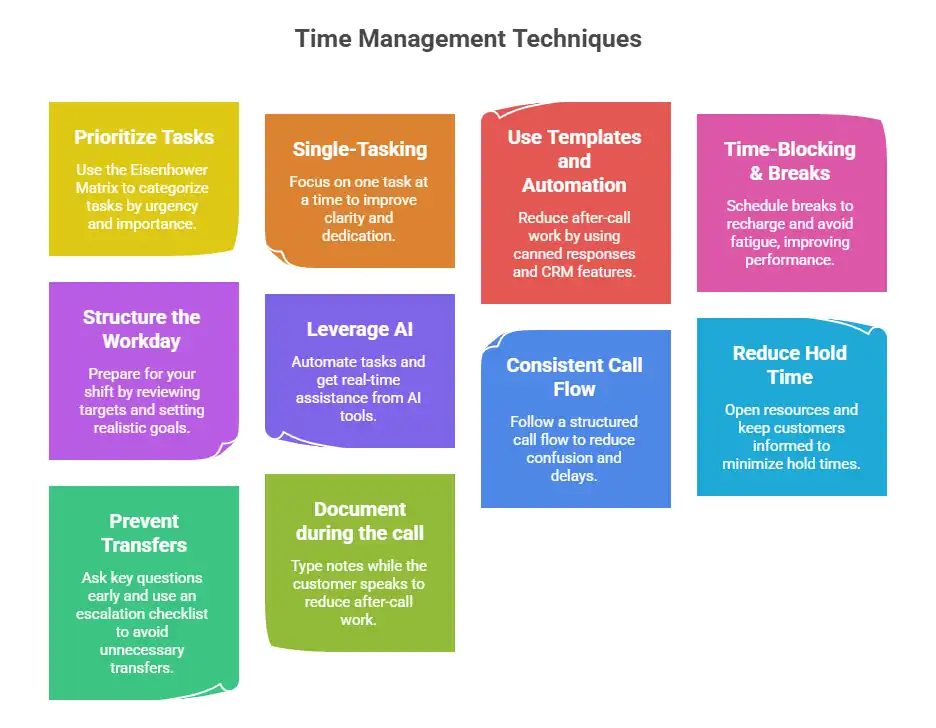
5. Structure the Workday
Well, let’s be honest!
When you start a day knowing what you need to do, won’t your day feel lighter? Even if you have a packed schedule, you can still complete all these without messing up.
Similarly, in all center services, you may not control the call volume, but you can control how you prepare for it. So, before your shift begins, take a few minutes to review your targets. You should also check yesterday’s performance. Try to find out if you are working on improving AHT or reducing ACW.
Then, set one or two realistic goals for the day. Not ten. Just one or two clear focus points. These structured improvements will help you manage your time better and
6. Leverage AI
A large part of the online world is busy nowadays, saying AI did this, AI did that.
But, honestly?
Is this era to waste your time behind the screen when you can automate tasks? When technology advanced so fast that it’s giving you the opportunity to get the best sales rate with minimal effort?
Many modern systems now provide real-time assistance, including call summaries, suggested responses, knowledge base recommendations, and error checking. So you can use AI to auto-generate call notes, highlight key points, or suggest next steps.
7. Use a Consistent Call Flow
What do we do when we host a meeting? We prepare a meeting agenda, we go through this, and host the meeting accordingly. It gives us the ultimate scenario plan for how the meeting should be conducted and what results the entire flow will bring.
Similarly, having a structured call flow reduces confusion and unnecessary delays in your virtual call center. It keeps your conversations focused and efficient through following the same clear pattern for every interaction keeps conversations focused and efficient.
So, what could this flow look like? A simple communication flow of a support center may look like this:
Opening → Verify or Authenticate → Diagnose the issue → Confirm the goal → Provide the solution → Recap → Outline next steps.
This type of structured flow can help you prevent missed steps, reduce repeated explanations, and improve overall AHT and customer satisfaction
8. Reduce Hold Time with “Search Rules”
Hold time is one of the most common call center issues the agents face. While facing complex queries, most agents struggle with maintaining a fair hold time. However, when it’s not completely possible to determine what queries are coming your way and prepare for them, service center agents can still reduce them in various ways.
For instance—
- Before your shift, open the most-used resources, FAQs, and tools. So, you will not need to start from zero during a call.
- Keep the customer informed with simple lines like, “Let me quickly check that for you,” instead of going silent. This keeps the interaction smooth and professional.
- Try to create and maintain a cheat sheet with common issues, steps, or links. It will help you find answers in seconds instead of searching across multiple tabs.
9. Prevent Transfers with a Smarter First 90 Seconds
There is nothing more frustrating for a customer than being transferred three times. To prevent call transfer, you need to own the first 90 seconds. The first minute of the call often decides whether the issue gets resolved or transferred.
- Ask 2–3 key questions early: Identify the problem type quickly so you can route or resolve without delay.
- Use an escalation checklist: Know exactly when a case needs to be escalated instead of guessing mid-call. This reduces unnecessary transfers.
10. Document during the Call (Not After)
Many customer service center agents record calls and document them after the conversation finishes. It simply does nothing but create a huge backlog of "After-Call Work" (ACW). But if you type as you go, you can hang up and be ready for the next call almost instantly.
Here, you can follow a few active techniques like-
- Writing short bullet notes while the customer speaks (in-call documentation)
- Setting up faster and wrapping up later (ACW reduction tactic echoed by ACW-focused resources)
Conclusion
Time management is not rocket science when you have the proven tips in your hand. Neither does it mean you have to isolate yourself from everything and keep working continuously without taking breaks.
Instead, when you use the effective time management tips, you will make your own workday less stressful. By implementing the techniques, you can transition yourself from a reactive agent to a proactive professional.
Frequently Asked Questions
What does good time management for a call center agent involve?
Good time management for a call center agent includes staying on schedule, minimizing after-call work (ACW), documenting accurately but quickly, managing hold time properly, and balancing speed with customer satisfaction. One should handle calls efficiently without dropping quality.
What is the 80/20 rule in call centers?
The 80/20 rule (Pareto Principle) means that roughly 80% of results come from 20% of causes. In call centers, this often shows up as: 20% of call types generating 80% of volume. If you identify and optimize that critical 20% (scripts, workflows, FAQs), you can dramatically improve performance and reduce handling time.
How do I reduce after-call work (ACW) time?
To reduce after-call work, you can automate repetitive tasks, use AI-made transcripts, and even use trained agents. These will complete half of your work while you are on the call. Then you can implement templates and CRM workflows to minimize manual data entries.
How do I improve schedule adherence in a call center?
You can log in a few minutes early to prepare, stick to break times strictly, avoid extending ACW unnecessarily, track your own patterns (where you lose time), and treat your schedule like an appointment you can’t miss.
How can I manage time when calls are back-to-back?
To manage time for back-to-back calls, you can reset yourself mentally in 5–10 seconds between calls, use structured call flow to avoid rambling, keep simple and consistent notes, and focus on one customer at a time without worrying about the next call.
How do I reduce hold time without sounding rushed?
To reduce time, you can prepare your answer while your customer explains the issue. If you don’t have the solution right at hand, use confident transitions like “Let me quickly check that for you.” Don’t forget to keep them updated if it takes longer than expected. You must also avoid silent holds. Check back every 30–60 seconds.
How do I reduce AHT without hurting CSAT/QA?
To reduce your average handle time without hurting the CSAT/QA, follow a clear call structure. For instance, greetings → diagnose → resolve → confirm → close. Without asking random questions, ask fruitful ones to gather information. You can also avoid unnecessary small talk when you have a heavy queue.
What tools help call center agents manage time better?
Call center agents use various tools to better time management, including CRM systems with automation, call center monitoring software, call scripting tools, knowledge base software, auto-text/canned response tools, time tracking, and performance dashboards.
How do I write faster call notes/ticket updates?
The best way to write faster call notes is to use a pre-made structured format for all calls. You can also prepare templates for repetitive cases. On the other hand, having a personal shorthand and keeping sentences necessarily short helps a lot.
How can call center agents improve their productivity through better time management?
By prioritizing high-impact tasks, minimizing distractions during live calls, using structured call handling, and reducing unnecessary ACW. Small improvements in each call compound over a shift.
Why is time management important for call center agents?
Call center agents' jobs require high emotional labor, multitasking, and also need to maintain strict KPIs. In this case, they need to be careful about time management for handling back-to-back calls better.
What challenges do call center agents face related to time management?
High emotional labor, multitasking, and system slowdowns are the most common challenges a call center agent faces.
What are common time-wasting activities for call center agents?
Small habits like over-documenting notes, multitasking, extending small talks, and spending a long time on ACW, etc., are common time-wasting activities that call center agents do.
How does effective time management benefit call center operations overall?
Time management helps call center agents reduce their average handle time (AHT) and minimize customer waiting periods. On a larger scale, better time management reduces employee burnout, enhances service delivery, and supports overall team productivity.
How can call center agents prioritize tasks to optimize time usage?
Call center agents can prioritize tasks in various ways for optimized time usage. For instance, they can resolve urgent customer issues first, complete required documentation immediately after the call, and batch lower-priority admin tasks during quieter periods.
What tools or software can help call center agents with time management?
Tools like CRM systems, knowledge platforms, call scripting software, performance dashboards, time tracking, and workforce management can help call center agents manage their time better.
What are the best practices for balancing call time and after-call work to enhance efficiency?
The key is structure and consistency. Agents should take brief notes during the call instead of starting from scratch afterward. Using templates for documentation saves time and ensures completeness. Avoid overwriting. Focus on essential details only. Close the interaction cleanly before moving into ACW to avoid rework.
About Author