Micromanagement is Hurting Call Center Agent Morale: Here is What to Do
Key Takeaways
-

Micromanagement in a call center happens when managers control how agents work instead of what they deliver.
-
It breaks trust, accelerates call center agent burnout, and increases employee turnover costs.
-
Instead of micromanaging, set outcome goals, reduce unnecessary approvals, and coach from performance data patterns.
What is Micromanagement in a Call Center?
Common instances include —
- Asking agents to justify a bathroom break mid-shift
- Requiring sign-off before offering a standard refund or workaround
- Flagging idle time without checking workload balancing or the queue load first
- Scoring calls low for going off-script, even when the issue was resolved
These happen daily, and wear your team down faster than any difficult call ever could.
What is the Impact of Micromanagement in a Call Center?
Micromanagement damages agent morale, accelerates burnout, and pushes your best performers out. The effects spread throughout the floor and show up in your customer satisfaction score.
Agents Lose Trust
When every decision needs approval, your agents stop trusting their own judgment. They default to —
- Caution
- Rigid scripts
- Defensive documentation
Customers feel it, too. Customer interactions get slower, and the quality of customer service drops. Plus, once trust breaks between an agent and a manager, it rarely rebuilds. As a result, you get a floor full of people doing the minimum to stay out of trouble instead of doing maximum to help a customer.
Burnout Starts to Build Up
Call center work is already demanding. Your agents rather —
- Absorb frustration
- Work through complex issues
- Hit performance metrics back-to-back across every shift
And add constant scrutiny on top, and fatigue arrives faster.
Most importantly, they're not just managing difficult calls. They're managing the anxiety of being watched. As a result, that mental burden builds up over time.
Turnover Costs More
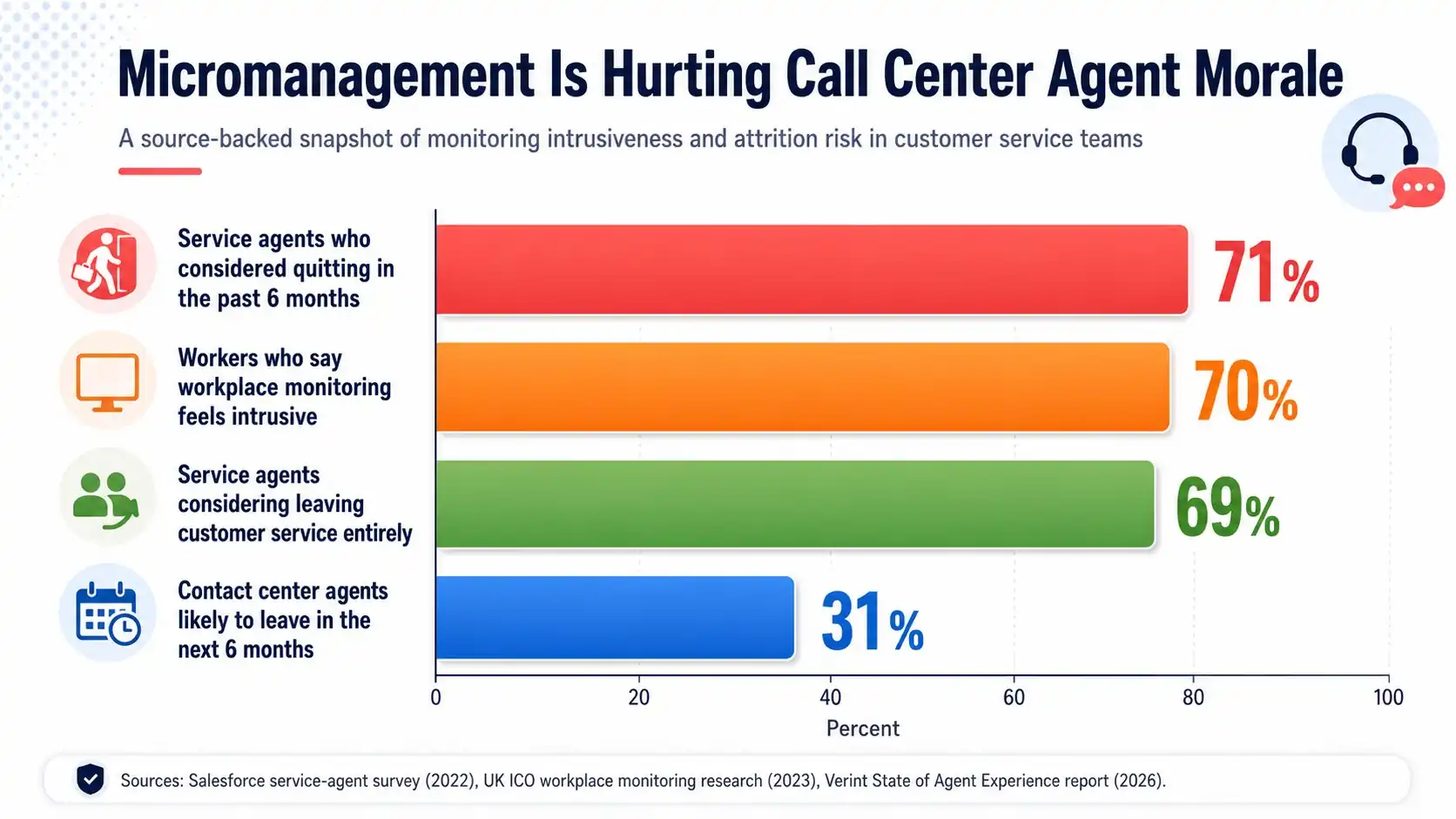
High employee turnover is the most expensive outcome of micromanagement. But most contact centers treat it as inevitable.
Besides, new recruitment, onboarding, and training and development time stack up fast.
The agents who leave first are usually your strongest ones. They have options. So you're left training replacements while your remaining team absorbs the extra load.
How to Fix Micromanagement Without Losing Oversight
Here are some simple yet effective methods you can follow to fix micromanagement —
1. Set Goals, Not Checklists
Define good customer interaction with your agents clearly before they pick up the phone. It means —
- Reach first-call resolution
- Show empathy and meet customer satisfaction standards
- Meet regulatory standards and compliance requirements
When agents know the performance goals upfront, they choose the path. Hence, you can stop managing steps and start managing results.
2. Reduce the Approval Loops
I see the reason for most approval requirements is that no one has defined clear decision rules. So agents wait for sign-offs. Eventually, your managers drown in them. So, fix that first —
- List every action that currently needs approval
- Decide which ones agents can handle independently
- Keep escalation for genuine edge cases only
I mean, standard refunds and basic call transfers shouldn't need a manager.
3. Coach From Data, Not Assumptions
Trust me when I say that gut-feel coaching is the root of micromanagement in the first place. Instead, pull patterns from actual performance data —
- QA (Quality Assurance) scores
- Handle time data
- Productivity trends
When you sit down with an agent, you're reviewing evidence. This way, your agents get specific and fair feedback. Hence, they act less defensively and are more likely to act on it.
4. Set Limit Between Monitoring and Surveillance
Monitoring and spying aren’t the same thing, period. If I put it simply, here’s the difference —
- Employee monitoring tracks patterns to understand workload and find coaching needs
- Surveillance watches individuals to catch them doing something wrong
Guess what, your agents know which one they're experiencing. Yes, productivity data and activity logs are useful tools. Yet the moment you use them to interrogate rather than support, you've crossed into micromanagement.
5. Let Agents Challenge Their Scores
A QA process agent can't question what they won't trust. That’s why build a simple escalation path —
- The agent flags a score they disagree with
- A second evaluator reviews the call
- The outcome comes back to the agent within a set window
It exposes evaluator blind spots. Plus, it signals that the system is fair.
How Apploye Supports Call Center Monitoring Without the Micromanagement
Managers tend to micromanage when they can't see what's happening on the floor. Apploye gives you that visibility without putting agents under a microscope.
You can use —
- Live Feed to see which agents are active. Plus, what your agents are working on right now
- Idle time detection to flag inactivity automatically, without questioning every break
- App and URL tracking to see how agents spend time across shifts
- Activity reports to spot workload imbalances before they become a morale problem
As a result, you can monitor call center agents and coach them based on actual patterns. On top of that, Apploye is GDPR and HIPAA compliant for regulated call center environments.
Try Apploye for free and coach without micromanaging
Conclusion
Micromanagement is hurting call center agent morale one small friction point at a time. If turnover is rising, start with your approval loops. When trust is gone, rebuild it by focusing on results, fair QA, and coaching based on facts.
Apploye changes the focus from spying to actual monitoring. Its Live Feed, idle detection, and activity reports reveal how agents work each shift. So managers rely on proof, not just instinct.
Frequently Asked Questions
What counts as micromanagement in a call center?
Micromanagement in a call center means controlling the process instead of the outcomes. It includes requiring approval for routine decisions and enforcing scripts over judgment. It also means questioning bathroom breaks and using activity data to punish rather than coach.
How does micromanagement affect call center agent performance?
Micromanagement lowers output quality and slows resolution time. Agents under constant scrutiny focus on proving they're working rather than solving customer problems. Hence, trust breaks down and performance drops before managers spot the cause.
What is the difference between quality assurance and micromanagement?
QA (Quality Assurance) measures outcomes to coach improvement. On the other hand, micromanagement controls every step of the process. One uses data to develop agents.
How can call center managers reduce agent turnover caused by micromanagement?
Call center managers can reduce turnover with outcome-based goals, fewer approval loops, and data-driven coaching. A clear path for agents to challenge QA scores also helps. These steps rebuild trust and give strong performers a reason to stay.
About Author