Top 10 Strategies for Handling High Call Volumes Without Burning Out Your Team

Key Takeaways
-

Call volume spikes from seasonal demand, service outages, poor self-service options, and reactive workforce management.
-
Forecast contact center demand early, stagger shifts, cross-train agents, and protect ACW buffers before the next spike hits.
-
Offer callback options, use smart call routing, and give agents scripts and knowledge tools to minimize handle time.
When call volume spikes, your team slows down. It exhausts your strongest call center agents and increases the abandonment rates. Also, it pushes your top performers toward the exit.
I've seen managers react by loading even more calls into the queue. Well, that only makes the damage worse.
See, handling high call volumes without burning out your team starts with knowing what causes the spike. Today, you'll learn exactly that and the strategies that keep your team stable when demand surges.
What Causes High Call Volumes in a Call Center?
Call spikes don't appear randomly. Most have a clear source. And if you know that source, you can manage them without damaging your team and customer satisfaction.
- Seasonal Peaks and Promotional Campaigns: During holidays, product launches, and limited-time offers, customers do months of activity in a few days. That surge causes high call volumes.
- Service Disruptions and Product Issues: When an outage happens, call volume jumps with complaints. So, the team gets more inbound calls than it is staffed to manage.
- Knowledge Base Gaps and Missing FAQ Content: Without self-service deflection options like IVR menus or an FAQ hub, customers default to calling for answers they could have found online.
- Reactive Workforce Management: When staffing models ignore historical data, schedule adherence collapses. It’s especially true during high-demand periods.
Best 10 Ways for Handling High Call Volumes Without Burning Out Your Team
Forecast demand, stagger shifts, and add self-service to cut call load. Also use smart routing, callbacks, and agent tools to speed resolution. On top of that, protect breaks, cross-train staff, track workload data, and recognize effort to prevent burnout.
1. Forecast Peak Periods With Historical Call Data
Analyze historical call data to predict call volume spikes before they hit. It shows repeating customer service patterns, like billing cycles, seasonal surges, or campaign windows. Thus, you can make a staffing model based on what's coming.
2. Use Staggered Shifts to Reduce Occupancy Rate Pressure
Plan shift coverage for high-demand windows. By staggering schedules, you place agents evenly during busy times. As a result, the daily occupancy rate stays under control. Plus, it stops agents from working long, back-to-back stretches that cause fatigue.
3. Build Self-Service Options That Deflect Routine Calls
Set up self-service deflection before the next spike happens. You can easily handle routine questions through self-service resources, like —
- Well-organized knowledge base
- FAQ hub
- IVR system
In return, your team stays safe from the call queue. Besides, for simple issues, self-service is the top choice for 61% of customers.
4. Implement Smart Call Routing and Escalation Protocols
Route every call to the right contact center agent from the start. I apply skill-based routing and ACD systems to match callers to agents based on the issue type. It helps to increase the first call resolution (FCR) rates, and the handle time comes down.
Meanwhile, clear escalation protocols remove the speculation when a call exceeds an agent's scope.
Relevant Read: The Role of AI and Automation in Call Center Trends.
5. Offer Callback Options Instead of Hold Queues
Replace hold queues with callback technology to protect both your CSAT score and your agents. Long hold times drive call abandonment rates up and customer patience down. In fact, 63% of customers prefer a callback over waiting on hold.
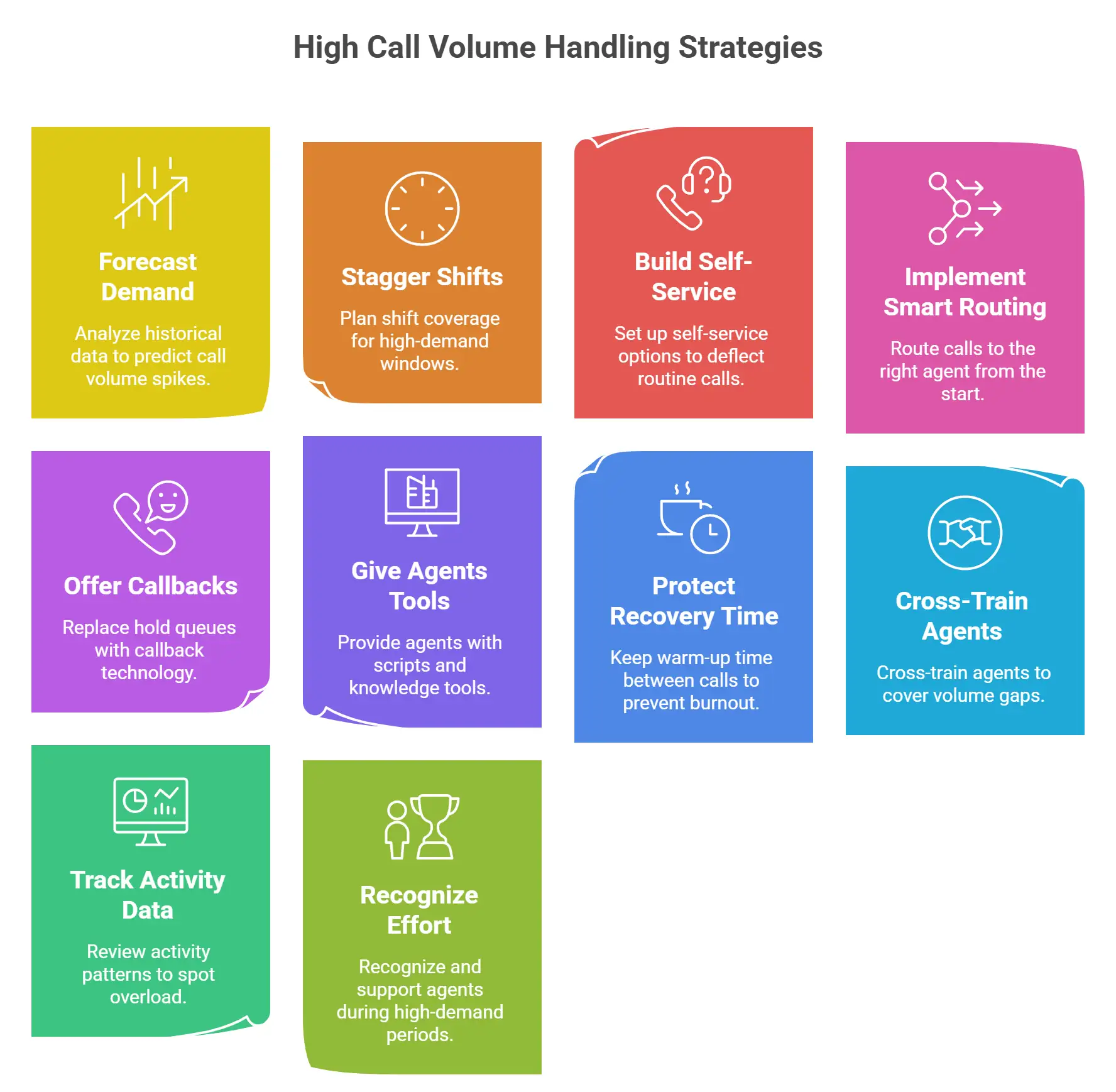
6. Give Agents Scripts and Knowledge Tools
Before high call volume periods hit, I provide my agents with —
- Call scripts
- Agent assist tools
- CRM shortcuts
These resources help to give the right answer quickly. Thus, my agents spend less time searching and more time resolving. Besides, shorter average handle time (AHT) means fewer calls stack in the queue.
7. Protect Recovery Time Between Calls
You must keep warm-up time in the schedule. It’s non-negotiable. When agents move call to call with no ACW buffer, it builds cognitive load. Here, I can vouch for even short micro-breaks between calls. It restores the psychological safety agents require to stay functional throughout a full shift.
8. Cross-Train Agents to Cover Volume Gaps
Cross-training makes your coverage more flexible when customer inquiries suddenly spike. Agents who know several issue types can fill in the gaps without disrupting the skill-based call routing system.
At the same time, escalation protocols remain intact. That’s because cross-trained agents understand their limits
9. Track Activity Data to Spot Overload
Review activity patterns across your team regularly. I mostly focus on —
- Who is handling the most volume
- Where wrap-up time is spiking
- Which agents have idle capacity that others don't
That data tells me where to redistribute workload before any agent hits a breaking point.
Apploye makes that visibility possible! It offers real-time activity monitoring, idle time analysis, screenshots, and app/URL tracking. Thus, managers like me get a clear picture of team capacity.
Start your free Apploye trial and protect your team today
10. Recognize and Support Agents During High-Demand Periods
During busy times, pay attention to your agents’ workload right away. Also, praise those who perform well under pressure openly. It encourages the rest of the team to perform similarly.
Most importantly, offer targeted coaching and feedback in high-demand moments. It shows that you care about progress, not just metrics.
Final Words
Handling high call volumes without burning out your team comes down to visibility and preparation. So, forecast demand before it hits. Also, distribute the workload before it piles up on your best agents.
Frequently Asked Questions
What is considered a high call volume for a support team?
A steady 10% rise above your normal call volume tells your support team that demand is high. And once inbound call management begins to break down, for example, wait times grow, calls get missed, and abandonment rates climb.
How do you keep agents calm and focused during call volume spikes?
To keep agents calm and focused, make call scripts and escalation steps easy to follow, as it reduces cognitive load. Also, listen carefully to stay in control, even when things get tense. Allow short recovery windows between calls to protect psychological safety.
What metrics should managers track to prevent agent burnout?
To prevent agent burnout, managers should track AHT, FCR, occupancy rate, ACW time, idle time, and CSAT score consistently. If you notice rising AHT and ACW time, they're the early burnout indicators. In the meantime, idle time imbalance signals uneven workload distribution.
How can I reduce hold time in a call center?
To reduce hold time in a call center, use skill-based routing to connect callers to the right agent immediately. Also, offer callback options instead of hold queues, and expand self-service tools.
Do callbacks / virtual hold reduce abandonment? How do they work?
Yes. Callback technology lets callers keep their place in the queue without staying on hold. When an agent is available, the system calls them back. It reduces call abandonment rate and keeps CSAT scores stable during peak periods.
What is call abandonment rate and how do I reduce it?
Call abandonment rate is the percentage of callers who hang up before reaching an agent. You can reduce it with callback options, accurate wait time messaging, IVR self-service, and staffing adjustments during predictable high-volume windows.
What is real-time adherence (RTA) and intraday management?
Real-time adherence measures how closely agents follow their scheduled activity at any given moment. On the other hand, intraday management uses live data to adjust staffing, breaks, and routing mid-shift. So service levels hold even when call volume spikes unexpectedly.
How do I reduce call center volume without hiring more agents?
To reduce call center volume without hiring more agents, build a comprehensive self-service hub. You should also expand FAQ content, fix IVR gaps, and send proactive outreach before customers need to call.
How do you deal with a “high volume caller” (one person calling constantly)?
Flag repeat callers in your CRM and route them to a dedicated agent with full context. Meanwhile, identify the unresolved root issue that’s leading to repeated contact. Then, address it directly, and set clear follow-up expectations so the caller has no reason to call back.
What is the most effective way to manage high contact volumes during peak periods?
Combine predictive scheduling, self-service deflection, smart call routing, and real-time activity monitoring. You can’t rely on a single tactic to hold under peak pressure alone. In fact, the teams that manage it best use data to distribute workload before any agent reaches a breaking point.
How do you handle high call volumes with a small dispatch team?
Cross-train every agent to handle multiple call types and use skill-based routing to maximize coverage. Along with that, implement callback technology to flatten demand spikes. If you’re running a small team, use workforce analytics to identify idle capacity and redistribute load.
About Author