The Impact of Outdated Quality Assurance Tools in Call Centers
Key Takeaways
-

Old call center QA tools often review too few calls, so managers miss repeat mistakes, weak coaching needs, and service risks that hurt customer trust and team performance.
-
When QA is slow, scorecards come late, and agents get vague feedback. That makes it harder to fix errors fast, improve scripts, and raise first-call resolution.
-
Modern quality assurance tools can check more calls, spot trends fast, and guide better training. This helps call centers cut errors, boost quality, and improve the customer experience.
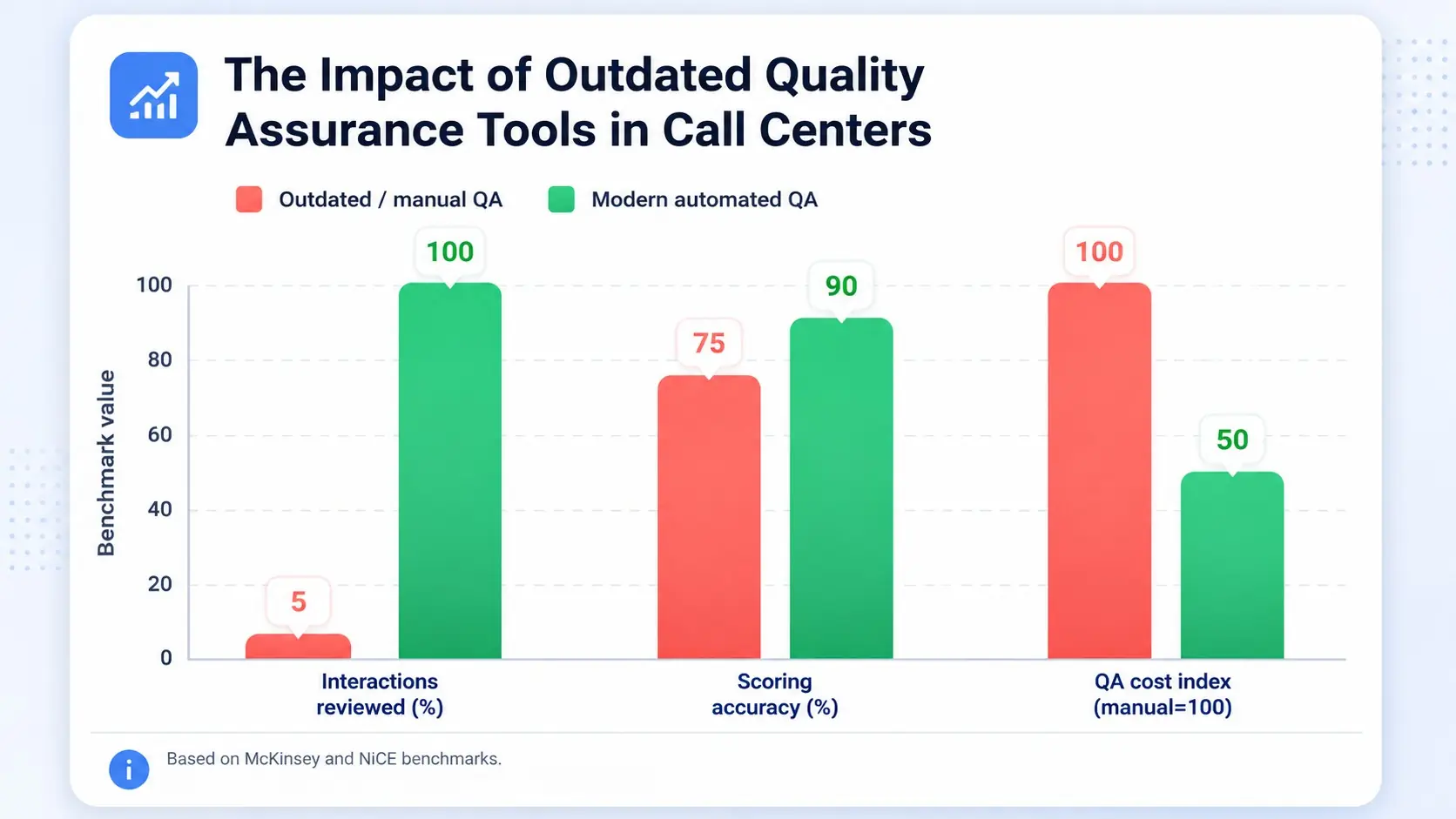
Every contact center operates for one purpose: great customer service. But when your QA is still manual, you are already losing ground at this point. Outdated tools leave 95%+ of interactions unanalyzed, create biased scoring, and push your best agents toward burnout.
The result? Lower CSAT, higher turnover, and mounting compliance risk. Traditional QA tools are not enough anymore when modern solutions are available.
This article breaks down exactly where legacy QA tools fail and what modern call center services are doing instead to stay competitive.
Key Impacts of Outdated QA Tools in Call Centers
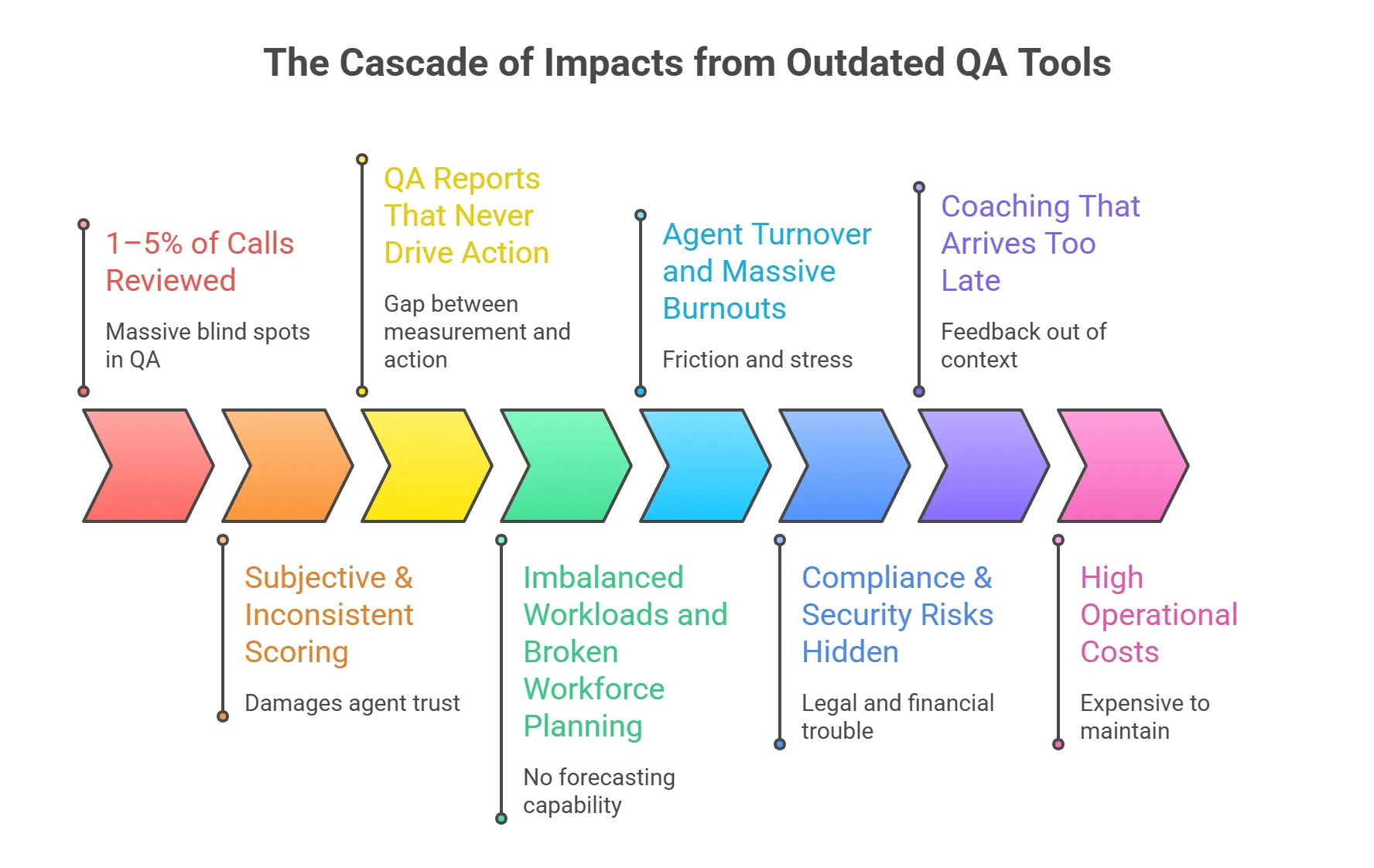
Outdated QA processes are not just slow. They create a chain reaction across every part of your support center or help desk. Growing blind spots, inconsistent scoring, and coaching arriving too late. The costs, both financial and human, compound quietly until they reach the point of no return.
1. Massive Blind Spots: Only 1–5% of Calls Ever Get Reviewed
Manual auditing in most contact centers reviews a maximum of 5% of total interactions. That’s 95% of customer conversations left unanalyzed and non-reviewed.
According to Scorebuddy, this figure sits between 1–3% for most manual QA processes. What does it mean for your call center? You have processes that have tons of blind spots, unchecked.
This sampling bias has serious downstream effects. Agents feel unfairly judged on a tiny, unrepresentative slice of their work. Managers miss systemic trends. Most importantly, critical issues like compliance failures or customer friction points stay hidden until they directly affect the bottom line.
2. Subjective & Inconsistent Scoring Damages Agent Trust
When human evaluators score calls using manual spreadsheets and personal judgment, subjectivity is inevitable. Two evaluators listening to the same call can arrive at meaningfully different scores based on multitudes of variables. Even when the scorecard or SOP is there, evaluators can’t always follow them fairly.
This inconsistency has a direct impact on morale. Agents who receive different scores for similar performance lose trust in the QA process altogether. Rather than seeing evaluations as useful development feedback, they start viewing QA as arbitrary. Or worse, as a "gotcha" tool designed to catch mistakes rather than support growth.
88% service leaders acknowledge their QA processes do not match customer expectations. Plus, their inconsistent, manual scoring is a leading reason for that. When QA data is not reliable, it cannot drive meaningful coaching conversations, let alone a fair evaluation.
3. QA Reports That Never Drive Action
Many call center services generate extensive QA data. The problem is that this data sits in reports and dashboards without ever translating into real change. Evaluations happen, scores get logged, and then nothing moves.
This gap between measurement and action is one of the most underappreciated costs of legacy QA. Supervisors in a busy support center simply can’t find the time to manually dig through that data. So, identifying coaching priorities and scheduling follow-up sessions happens without properly assessing what the QA reporting tells. Actions happen, but without any meaningful purpose.
The result is what you see. Agents keep repeating the same mistakes, managers keep flagging the same patterns. And the process keeps getting updates without any data-backed precedence.
4. Imbalanced Workloads and Broken Workforce Planning
Outdated QA tools have no forecasting capability. They tell you what went wrong in the past without preparing you for what’s to come next.
This leaves service center managers flying blind when planning staffing levels, especially during peak periods. Without insight into call volume trends or agent utilization rates, scheduling decisions are guesswork.
The outcome, however, can be easily forecast. Understaffed during peak hours, underutilized resources, and decreased CSAT score.
Deloitte's research found that 3 in 4 respondents said agents are overwhelmed by too many systems. This is a direct burden that results in longer call times and weaker responses. Without smarter planning tools embedded into QA, this imbalance is almost impossible to fix.
5. Agent Turnover and Massive Burnouts
When QA functions as a surveillance system, it creates friction, and that breeds agent burnout. Research shows that 87% of contact center agents report their job causes significant stress. Annual turnover rates across the call center industry range from 30–75%. And replacing a single agent costs between $10,000 and $15,000 in recruitment and training expenses alone.
Much of this churn connects directly to how QA is positioned. Agents who feel they are being watched for errors disengage quickly. When agents see growth and actual helpful feedback, they feel more motivated to work.
A virtual call center or remote help desk with a poor QA culture will amplify this problem further. Without a face-to-face connection, a punitive QA system feels even more impersonal and demoralizing.
6. Compliance & Security Risks Hidden in the 95%
Regulatory environments for contact centers are tightening. TCPA, HIPAA, PCI DSS, GDPR — these frameworks govern how customer data and communications must be handled. If your QA tools don’t account for that, you’ll be in legal trouble.
When manual processes review only 1–3% of calls, the compliance risks hiding in the other 97% are enormous. A missed disclosure or an improperly handled data request can go undetected for weeks. Then you’ll get an official complaint, which will damage your whole business.
The financial stakes are also significant. IBM's 2024 Report put the global average cost of a data breach at $4.88 million. HIPAA civil violations also carry a heavy toll per incident. FTC fined Dish Network $280 million for DNC violations, reminding us how costly compliance gaps can become.
Slow, manual QA simply cannot identify these violations in real time. By the time they surface through traditional review, the damage is often already done.
7. Coaching That Arrives Too Late to Help
In most manual QA setups, feedback reaches agents days (even weeks) after the interaction. By that point, agents handle hundreds of calls. For them, the feedback is nothing if they cannot implement it the next day. Once the learning mentality passes, it’s hard to bring them into that mindset with a few notes.
Delayed coaching is one of the clearest operational failures of legacy QA. Behavior only improves when feedback is timely and specific. Arriving late and out of context creates confusion rather than clarity. Agents feel doubtful that sessions are just to point out their mistakes.
8. High Operational Costs That Scale the Wrong Way
Legacy QA tools are not just ineffective — they are expensive to maintain at scale. As call volume grows in a contact center, the manual labor requirements increase significantly. You need more QA analysts, more supervisor hours, and more administrative overhead. And it’s just maintaining current demand, not future surges.
Legacy QA tools also tend to carry their own licensing and maintenance costs. Some can be quite inflexible when you’re trying to efficiently scale for remote teams or omnichannel environments. So, you end up incurring costs that could’ve been used for something better.
The Shift to Modern QA in Contact Centers
To move past these limitations, high-performing call center services and virtual call centers are adopting a new generation of QA tools built around AI, automation, and conversation intelligence.
AI-Powered Quality Assurance
Modern AI-powered QA platforms analyze 100% of interactions with fairness. Every call, chat, and email handled by your contact center is scored automatically. They can even flag risks and trends surfaced in real time. This eliminates the sampling bias of manual review and gives managers the full picture every time.
Auto QA Scorecards
Automated scorecards apply consistent evaluation criteria across every interaction. By removing the subjectivity bias, it ensures a uniform review process for every agent. Agents can see exactly where they stand against compliance requirements and script adherence standards. Some modern tools can even gamify scoring, encouraging agents to be more productive and compliant.
Conversation Intelligence
Modern tools go beyond form-filling. Conversation intelligence platforms analyze the full context of customer conversations. It can analyse sentiments, tones, and real-time script adherence to detect whether the conversations are successful or not. This is fundamentally different from checking whether an agent said the right words in the right order.
Binary Scoring and Automation
Yes/No question formats on QA scorecards dramatically reduce evaluator subjectivity. Combined with AI automation, this approach removes the most tedious manual tasks from QA workflows. Opening more time for supervisors to focus on what matters: actual coaching conversations with their agents.
AI-Enhanced Workforce Management
Modern remote workforce management tools integrated with QA systems close the planning gap entirely. By analyzing historical call volume trends, live queue activity, and agent utilization data, these platforms predict workload spikes almost perfectly. Managers at a service center can schedule proactively, prevent burnout, and maintain service levels. Even during peak periods, call centers can maintain the same level of performance.
Final Thoughts
Outdated QA tools are not just a technology problem. They are a people problem, a compliance problem, and a growth problem, all-in-one. Every interaction that goes unreviewed is a missed opportunity to coach an agent, catch a compliance risk, or understand customers’ needs.
Modern contact centers and customer service centers are recognizing this. The transition from manual sampling to AI-powered, 100% coverage QA is not a trend. It is the new baseline for any operation serious about service quality.
Frequently Asked Questions
What is QA in a call center?
QA in a call center is the process of monitoring, evaluating, and improving agent interactions to ensure quality and compliance standards. It typically involves reviewing calls, scoring performance against scorecards, and delivering feedback. Modern QA systems use AI to cover 100% interactions. The goal is consistent, high-quality service across every customer touchpoint.
How many calls should be monitored for QA?
Ideally, 100% of interactions should be monitored, and with AI-powered tools, this is now achievable. Traditional manual processes only manage to review 1–5% of calls. Most quality experts recommend a minimum of 5–10 calls per agent per month for manual review. However, AI-based systems remove this limitation entirely.
How do you reduce evaluator bias in QA scoring?
The most effective approach is to use structured, binary (Yes/No) scoring criteria that limit subjective interpretation. Calibration sessions, where multiple evaluators score the same call and compare results, also help align standards. Introducing AI auto-scoring provides a consistent baseline that human evaluators can reference. Clear rubrics and regular training for QA analysts reduce bias further over time.
Can AI remove evaluator bias completely?
AI significantly reduces evaluator bias by applying the same criteria consistently across every interaction. However, it does not eliminate bias — the criteria and training data used to build the AI model can reflect existing biases if not carefully designed. The best approach combines AI consistency with periodic human review to catch edge cases. Transparent scoring criteria and regular model audits are essential.
What role does technology play in QA?
Technology enables contact centers to move from reactive, sample-based QA to proactive, comprehensive quality management. AI tools can analyze sentiment, flag compliance risks, score interactions, and surface coaching insights in real time. Modern platforms also integrate QA with call center workforce management, creating a unified view of performance and planning. Without the right technology, QA remains limited in scope and impact.
Why is quality assurance important in call centers?
QA ensures that every customer interaction meets the service, compliance, and brand standards your organization sets. It directly affects customer satisfaction, agent development, and regulatory standing. Poor QA leads to inconsistent service, unresolved compliance risks, and high agent turnover. Strong QA, by contrast, builds customer trust and gives agents the feedback they need to improve.
How to improve QA in a call center?
Start by increasing interaction coverage. Use AI-powered QA tools to spot-check all calls. Standardize your scoring criteria to reduce subjectivity and increase agent trust. Deliver feedback faster, ideally within 24–48 hours of the interaction. Then, integrate QA insights with coaching workflows so evaluations lead directly to agent development.
What are the quality assurance tools for a customer service agent?
Common QA tools for customer service agents include auto-scoring platforms, call recording and speech analytics software, conversation intelligence tools, and AI-enhanced scorecards. WFM platforms that integrate QA data help with scheduling and workload planning. Many modern contact centers combine these into a unified quality management suite.
About Author