Is Stealth Monitoring Legal? US Laws & Risks Guide (2026)
Key Takeaways:
-

Using stealth monitoring software is legal on company assets for business reasons, but "live" eavesdropping is a federal crime.
-
New York, Connecticut, and Delaware require employers to provide prior written notice or face thousands in civil fines.
-
You must follow the strictest state's laws in multi-state calls, often requiring everyone's consent.
-
The NLRB views "always-on" monitoring as illegal if it stops employees from discussing work conditions.
Stealth monitoring doesn’t mean just hidden observation anymore. It can have serious legal and financial repercussions. The penalty doesn’t end at monetary fines and can go up to jail time.
So, if you want an undetectable stealth mode to be in the system, you need to know about its legality. And our goal is to deliver exactly that – a proper documentation of whether Stealth monitoring is legal in the US or not!
Reduce legal risk with smarter oversight
Stealth Employee Monitoring Laws in the United States
Federal laws provide the ground for privacy protections across all 50 states. Most states have serious legal protections in favor of employees.
Federal Baseline Laws
The ECPA is the primary federal law governing electronic monitoring. It is split into two important parts:
Wiretap Act (ECPA Title I)
The Wiretap Act is a federal law that makes it a crime to secretly listen to or record a "live" conversation. Think of it as a rule against digital eavesdropping.
It protects your private calls & messages while you’re unaware. It is illegal to intercept these communications unless you have permission or a special court order.
Stored Communications Act
This protects communications that are "at rest" or stored on a server. It can be any old emails or archived Slack messages.
Consent + “Ordinary Course of Business”
Consent and business purpose appear everywhere in employer-monitoring law. Courts often ask whether it’s done by informing employees or not.
Here, a written notice, verbal agreement, or official notice serves as consent. If that’s not the case, it most likely will fall into undercover observation.
On the other hand, Ordinary Course of Business is a specific rule within the Wiretap Act. It allows an employer to use employee monitoring software if they have a legitimate cause. Generally, it applies to a company-provided device, not personal ones.
- The Framing: To use this exception, the employer must show that the monitoring was necessary.
- The Limit: Employers have to stop if monitoring captures personal data. If they continue to monitor after realising, it can go very wrong for a business.
Let’s take the famous case of City of Ontario v. Quon (2010) for an example.
In this famous Supreme Court case, a SWAT officer sued his department. Why? Because the city read his explicit text messages on an official pager. The Supreme Court ruled against the officer due to a legitimate observation.
Deploy monitoring with clear legal safeguards
Labor Law Angle
NLRB GC Memo 23-02
The National Labor Relations Act (NLRA) is crucial for silent monitoring. A 2022 memo (GC Memo 23-02) from the NLRB GC warns that constant or "omnipresent" monitoring can be illegal. Keyloggers, GPS tracking, or camera surveillance can fall into that. Additionally, it can interfere with Section 7 rights.
Section 7 rights are very simple. They protect employees from joining together, talking about their pay, and working as a group. These all fall under the Labor Law Act.
The memo argues in favor of employees. When employees feel they are being watched, it makes them afraid to discuss workplace issues.
Under this framework, monitoring is considered illegal if it interferes with these rights. However, if businesses can prove the necessity of tracking, then it can be legal.
Consumer protection / “stalkerware” enforcement
Beyond the Wiretap Act, the Federal Trade Commission (FTC) protects people from "stalkerware." Stalkware is considered a malicious tool for stalking or secret monitoring. The FTC views these apps as "unfair" because they encourage illegal spying.
Use legitimate tools—not risky spyware
Let’s take a real-life example: SpyFone.
In a major 2021 case, the FTC followed a company named SpyFone. This company sold apps that tracked and stored private data without any consent.
The FTC gave a heavy penalty. The company and its owner were forever banned from the surveillance business. The case demonstrated that the use of any tracking tool without consent can be considered illegal.
State Laws: Why “Stealth Monitoring” is Especially Dangerous
In some states, stealth monitoring is completely illegal without consent. These states prevent employers from tracking private data with silent trackers. So, tracking without notice is almost impossible.
States with Explicit Monitoring Notice Requirements
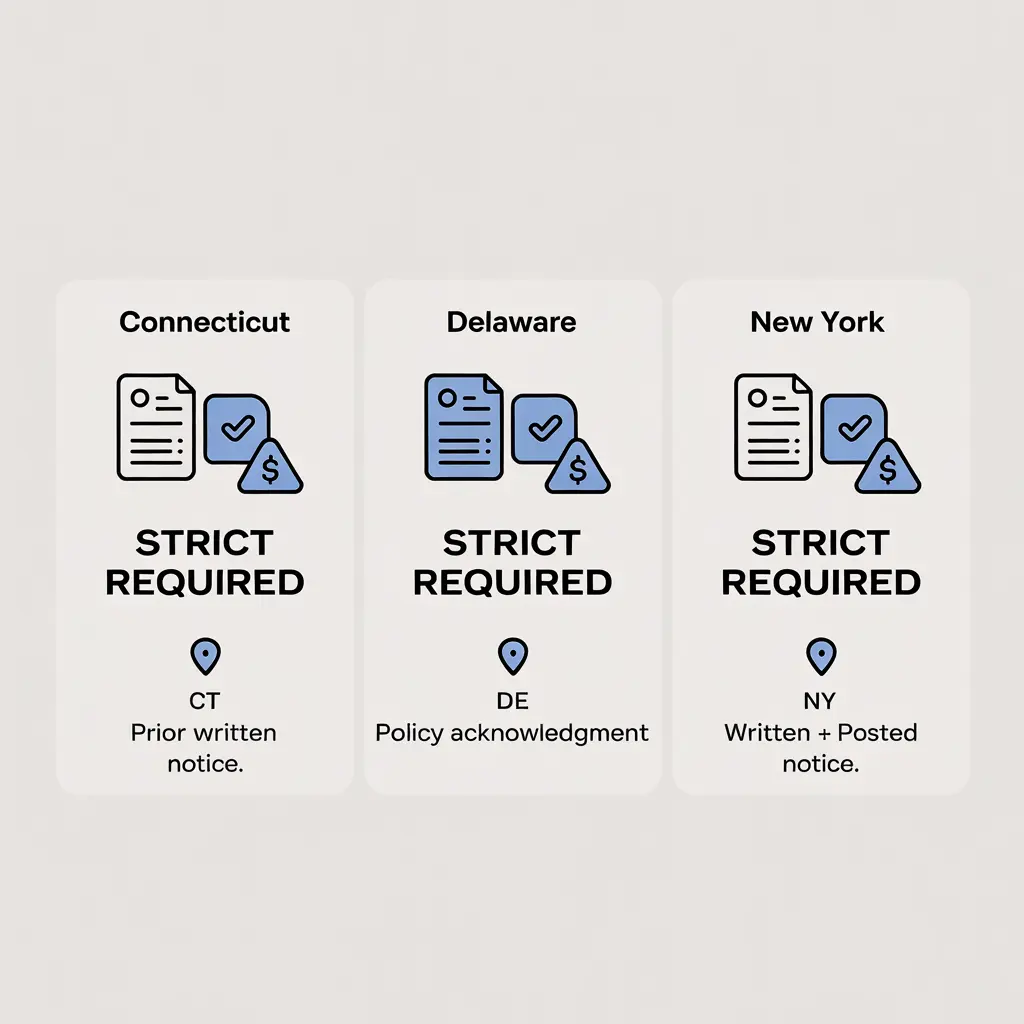
As of 2026, Connecticut, Delaware, and New York have the strictest requirements for electronic monitoring.
Connecticut: § 31-48d (Prior Notice; Exceptions; Civil Penalty)
Employers must give prior written notice before monitoring. Failure to do so can result in civil & financial penalties. There are very narrow exceptions for investigations into illegal activity.
Delaware: 19 Del. C. § 705 (Notice/Acknowledgment Mechanisms)
Employers cannot monitor emails or internet usage unless they provide a daily electronic notice. Or, at least, they have a one-time signed acknowledgement from the employee.
New York: Civil Rights Law § 52-c (Prior Notice Required)
As of 2022, all private employers must provide written notice upon hiring. Failing to do so can result in a financial penalty that can go up to $3,000.
One-party vs Two-party Consent for Recordings
Monitoring employees is very important when it comes to voice or video recording. States are generally divided into two categories:
- One-Party Consent: You can record a conversation when one person in the conversation provides consent. If you’re in the conversation or a participant, your consent will make it legal. Federal law and the majority of states follow this rule.
- Two-Party (All-Party) Consent: Every person involved in the communication must consent to the recording. Even if one person is unaware, the recording becomes illegal.
In the current situation, teams collaborate remotely. So, you, as an employer, might be in Texas (one-party), and your employee can be in California (two-party). So, that makes multi-state calling complex. Most legal experts advise following the strictest law involved in the call.
So, it’s best to follow the all-party rulings to avoid any criminal charges. Let’s take California to understand this scenario better.
Under Penal Code § 632, it is a crime to record a "confidential communication" without the consent of all parties. This applies to phone calls and in-person conversations. Obviously, the expectation of privacy has to be there. No party can record or store private data without having everyone’s consent.
Get a monitoring toolkit with built-in guardrails
When Stealth Monitoring is Legal vs Illegal
Stealth monitoring is most likely to be legal when: 1) the use is completely for a technical and legitimate purpose, 2) it’s on a company asset.
And it becomes illegal when it captures private data, bypassing consent requirements. However, specific rules may vary depending on states.
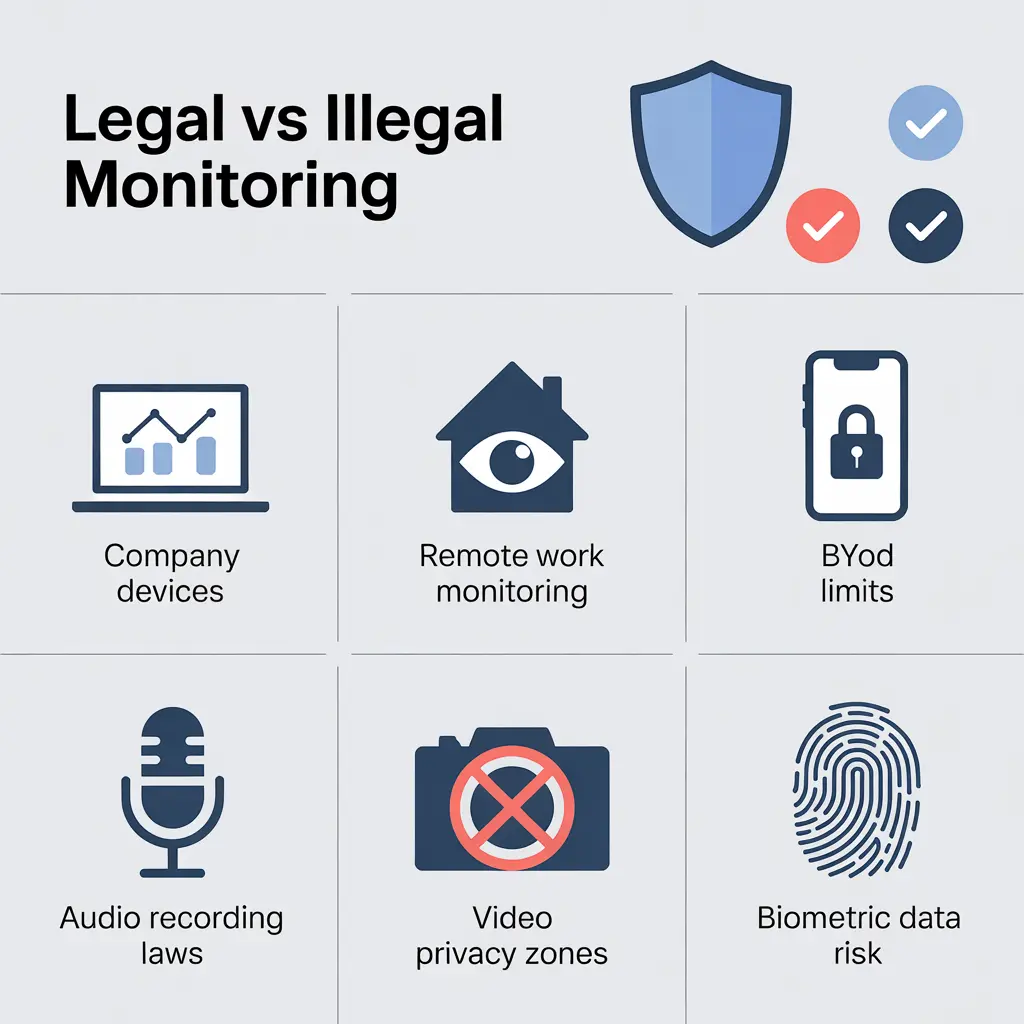
Monitoring on Company-owned Laptops/Phones
There are limits to what employers can actually track on company devices. For example, Email traffic, URL history, application usage, and endpoint telemetry (EDR/DLP) are safe to track. They don’t contain personal or confidential data.
However, tools that capture screenshots and keystrokes can fall into a risky area. And most tools don’t offer hidden mode or quiet mode. They may violate the "reasonable expectation of privacy" even on a work device.
Remote Work & “Always-on” Monitoring
The shift to home offices has increased the use of "tattleware." However, the NLRB (via GC Memo 23-02) has increased scrutiny of intrusive monitoring. The Labor Relations Board check:
- Proportionality: Monitoring must be narrowly tailored. Capturing data off-hours or requiring always-on webcams is often viewed as excessive. It can even be a violation of labor rights.
- Legality Tip: Monitoring should focus on outcomes. It should not just blindly track anything and everything.
Measure outcomes with clean productivity reports
BYOD (personal phone used for work)
This is a tricky thing to navigate for employers. Employees can use personal devices for work. However, a signed consent doesn’t give employers the right to track personal files or messages.
BYOD policies often grant the right to "remote wipe" a device if lost. If an employer wipes a personal phone and deletes an employee's non-work photos/data, they could face a lawsuit.
Audio Recording (Calls, Meetings, Zoom/Teams)
We already covered this in the one-party/two-party section. Audio capture can be easy, but in modern remote settings, it can be tricky. Recording a Zoom call where a participant is in an all-party state can be a thing to worry about.
Video Surveillance & Hidden Cameras
In any place where there’s "Expectation of Privacy", video capture is illegal. It can be a bathroom, a prayer room, or a lactation room. In most states, this is a criminal offense.
Biometric and Sensitive Data Monitoring
Biometrics (fingerprints, facial scans) carry the highest legal penalties. In no capacity should an employer store this data without an absolute necessity. The Biometric Information Privacy Act (BIPA) is the strictest in the U.S.
The severity is quite visible as Illinois set an example in 2024. The Illinois legislature passed SB 2979. It clarifies that a company is liable for only one violation per person. While it became easier for companies to avoid billions in fines, it still upholds the privacy of employees.
What Makes “Stealth” Legally Risky
The danger of stealth monitoring lies in the removal of informed consent. When employees aren't told they are being watched, they maintain a "reasonable expectation of privacy." Breaking that expectation can lead to criminal charges, massive civil fines, and federal labor complaints.
No Notice/Acknowledgment Where Required
As mentioned before of the 3 strictest states, no notice means a sure legal penalty. CT, DE, and NY don’t mess around with stealth monitoring. It’s a direct statutory violation. So, just having a policy handbook isn’t enough; your employees need to see it too.
Recording Audio without Proper Consent
Under the California Penal Code (§ 632), recording a "confidential communication" without the consent of all parties is a "wobbler" offense. It can be charged as a felony punishable by up to three years in prison.
So, you need to be extra careful about the all-party consent laws. Just because you’re sitting in New York doesn’t mean the court will rule in your favor. Victims can sue for $5,000 per violation or three times the actual damages. And that’s when there’s no financial harm.
Monitoring Personal Devices/Accounts without Clear Authorization
Stealthily monitoring a personal device used for work is a privacy killer. You can’t justify tracking, monitoring, or storing data from personal devices. It should always be limited to work devices and apps.
And the most harmful part of stealth monitoring is no authorization. The monitoring tools don’t show any indicator or sign. So, employees have no clear understanding if they’re being monitored. That clearly violates the Stored Communications Act.
Monitoring that Chills Protected Activity
The NLRB (GC Memo 23-02) gave laborers and workers a clean way to avoid monitoring. Section 7 rights. It’s the right to join together and talk about pay, benefits, or working conditions.
Additionally, if employees feel anxious/afraid about their employers, then it can be considered illegal to monitor them. Unless the employer can provide a vital business need for discreet surveillance.
Overcollection + Weak Access Controls
Invisible agents often collect more data than needed. And it’s tough to separate work emails and personal screenshots. This creates a massive security liability.
In 2025, the average cost of a data breach involving employee PII rose to $168 per record. This clearly shows that stealth surveillance without proper security is earth-shattering for employees.
Conclusion
Stealth monitoring is rarely worth the risk. The legal trend is moving toward ethical transparency.
To stay safe, employers should move away from invisible tracking and toward a framework of Notice + Consent + Business Purpose. And Apploye can be the perfect companion for that!
Adopt transparent monitoring that stands up in court
Frequently Asked Questions
Is electronic monitoring of employees illegal in the US?
No, it is usually legal. Federal law lets employers monitor work devices for business reasons. However, some states have extra rules that require employers to tell you first.
Can employers track you in stealth mode?
Yes, in most states, they can track you secretly on company equipment. They often use hidden software to watch your emails or location. A few states, like New York and Connecticut, make this illegal by requiring a warning.
How do you know if your employer is monitoring your screen?
It is hard to tell because monitoring software is often invisible. You might notice your computer runs slowly or your webcam light blinks for no reason. Some people check their network traffic for strange data being sent out.
What are the risks of stealth mode?
Stealth monitoring can lead to lawsuits if it breaks state privacy or wiretap laws. It can also hurt employee morale and destroy trust in the office. The NLRB may also see it as an illegal way to stop workers from talking about their rights.
Can my employer monitor my computer without telling me?
In most states, yes, they do not have to tell you. Since the company owns the computer and the network, they have the right to see what you do. Only Connecticut, Delaware, and New York require them to give you a notice.
Is it illegal for companies to watch you on camera?
It is legal in common areas like offices, hallways, and lobbies. However, it is strictly illegal to put cameras in private places like bathrooms or locker rooms. Most companies will tell you about cameras in their employee handbook.
Is it legal to install a keylogger on a work computer?
Yes, employers can legally use keyloggers on their own equipment to track work. They use them to check productivity or make sure data is safe. However, capturing personal passwords can sometimes lead to legal trouble.
Can my employer read my personal email on a work laptop?
If you log into your private email on a work laptop, they might be able to see it. They can use screen captures or keyloggers to read what you type. It is best to use your own phone or computer for personal emails.
Can my employer record audio on Zoom/Teams calls?
This depends on your state's laws. Some states only need one person to know, while others require everyone on the call to agree. Most apps now show a notification so everyone knows a recording has started.
Are hidden cameras legal in the workplace?
Hidden cameras are almost always illegal because they violate privacy. Employers are generally required to tell staff if cameras are being used. Using them in private areas like breakrooms is a serious crime in most states.
How do I know if I’m being monitored at work?
The best way is to read your employee handbook or contract. Most companies list their monitoring rules there to stay safe legally. You can also look for unfamiliar security or "agent" apps on your computer.
Is it legal to monitor someone else’s phone without permission?
No, it is a federal crime to spy on a phone you do not own. You cannot use apps to secretly track a coworker's or partner's texts or location. Only parents or employers with a clear policy can legally monitor certain devices.
What states require notice of employee monitoring?
The main states are Connecticut, Delaware, and New York. These states have specific laws that say bosses must warn you before they start tracking. California also has strict rules about recording conversations.
What does the NLRB say about electronic monitoring?
The NLRB says monitoring can be illegal if it stops workers from talking about unions or pay. If the spying is too constant, it might be seen as a way to scare employees. Bosses must prove their monitoring is necessary and not just for "snooping."
Is it legal to track your employees' location?
Yes, if it is for work and happens during work hours on a company device. For example, a delivery company can track its trucks to see where they are. Tracking a personal phone after work hours is usually illegal.
Can employers legally use stealth monitoring on company devices without employee consent?
In most states, they can because they own the device. Federal law typically gives the owner of the hardware the right to monitor it. However, if you live in a "notice state," the employer must still tell you first.
What are the best practices to ensure stealth monitoring complies with US privacy laws?
The best way is to be transparent instead of using "stealth" mode. Companies should give written notice and get employees to sign it. They should also only collect data that is truly needed for business.
What penalties can individuals or companies face for illegal stealth monitoring in the US?
Companies can be sued for thousands of dollars per violation. Individuals who break wiretap laws can even go to prison for up to five years. In some states, the fines for illegal spying can reach millions of dollars.
About Author