What is Stealth Monitoring? Definition, Benefits & Industry Uses
Key Takeaways:
-
Using Stealth monitoring software means tracking user activity silently without letting anyone know. The primary goal of undetectable stealth mode is to detect threats, protect sensitive data & IP, and prevent internal fraud.
What does Stealth Monitoring Mean?
57% of database breaches happen due to internal factors. That’s why stealth monitoring exists.
Stealth monitoring is a way to track what someone does on a device without them knowing. The monitoring tool runs quietly in the background. Then, it provides the admin with all the user data for analysis.
Many businesses use it to detect risks, protect data, and prevent insider threats from internal sources.
Compared to transparent monitoring, stealth monitoring doesn’t show any visible icons. Instead, it silently runs in the background and tracks user activity and productivity. In that sense, it’s the most authentic way to know about a user’s actual behavior.
What is Stealth in Simple Terms?
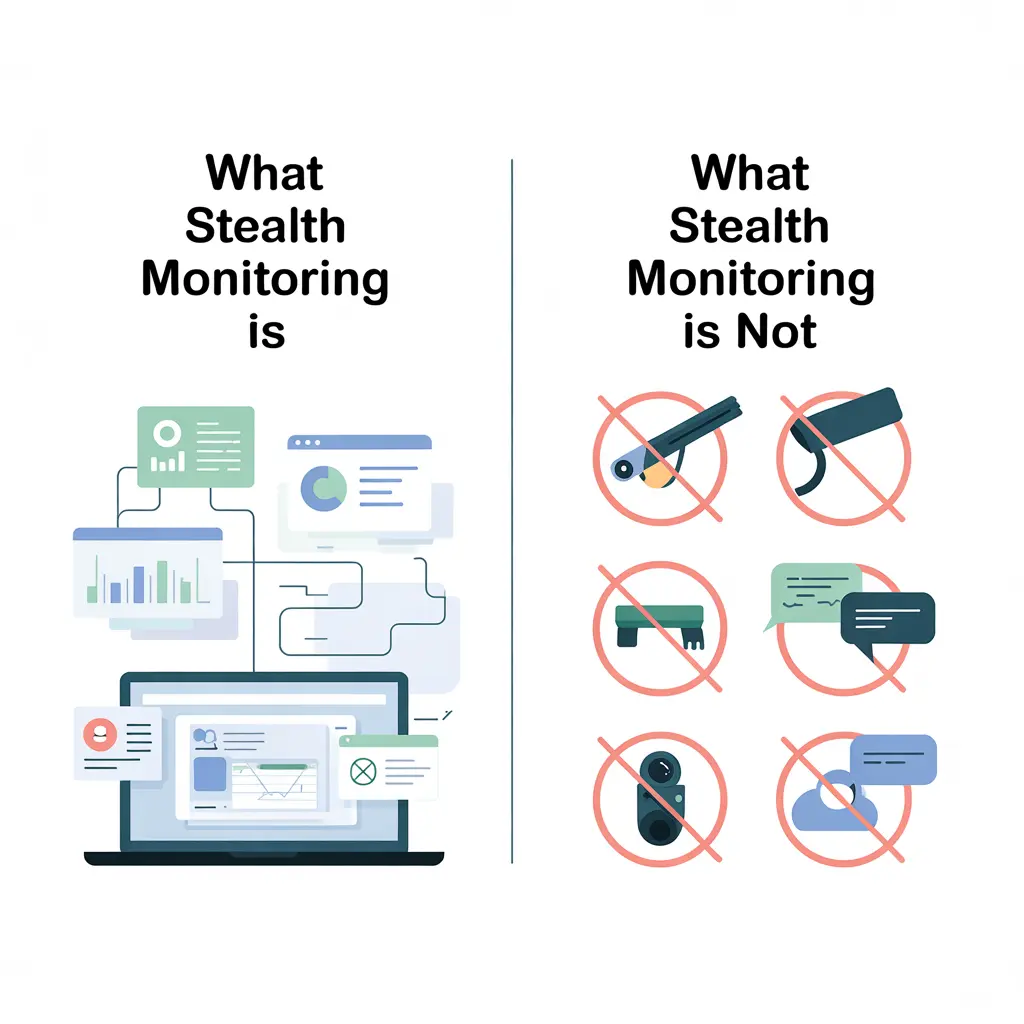
In simple terms, stealth means to be discreet. And that’s exactly how stealth monitoring works. It's a discreet surveillance running in the background. It’s similar to a hidden camera that parents install to monitor their kids.
What it is Not
Stealth monitoring is not spying, nor is it illegal. It is a common employee monitoring system used by many companies nowadays. However, the legality depends on how people use the monitoring. If a company is tracking the personal data of employees, then it can have severe consequences.
Why is Stealth Monitoring Used in Various Industries?
Different industries face internal challenges and various data breaches. To prevent those, stealth monitoring helps address those concerns significantly.
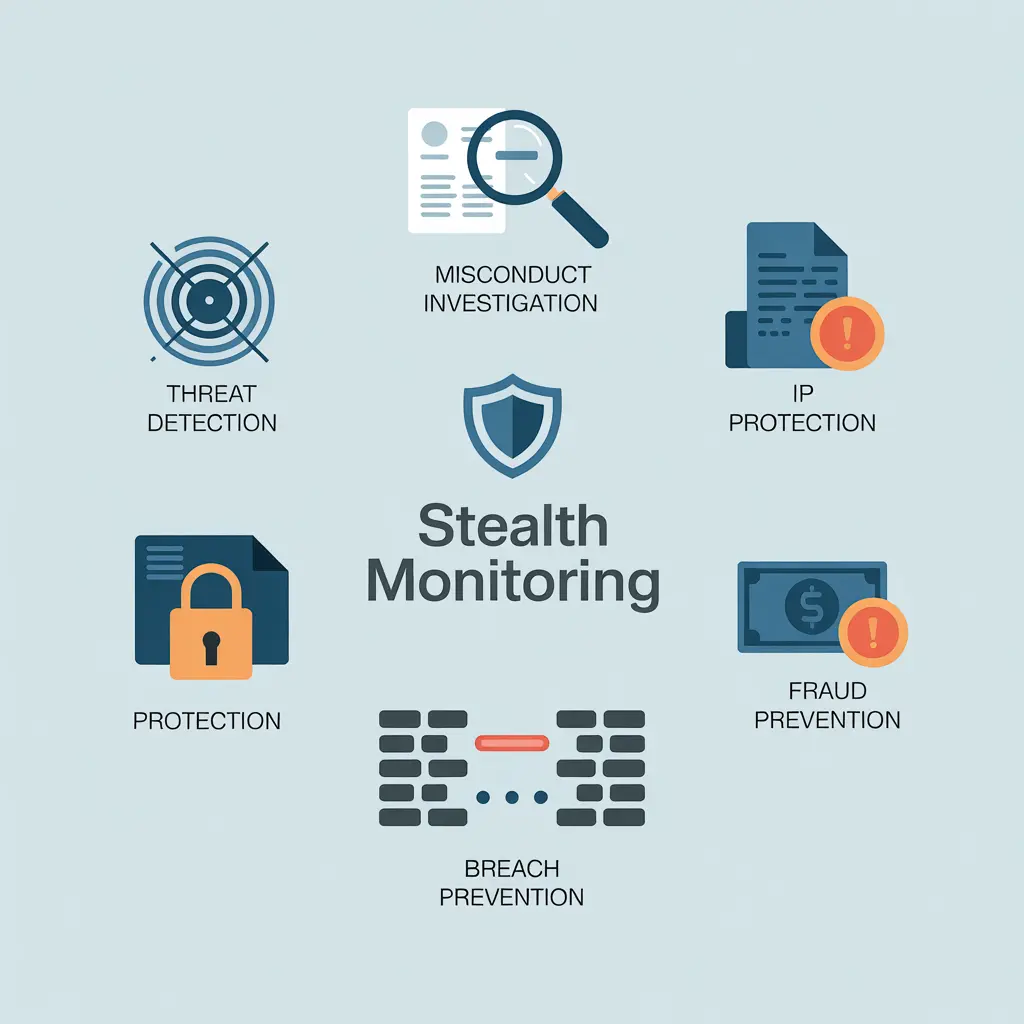
Security Threat Detection
Stealth monitoring helps in detecting abnormal behavior proactively. As per Verizon’s Data Breach Investigations Report, 74%+ breaches involve human errors. That’s where stealth monitoring can step in to identify errors.
Investigation of Suspected Misconduct
Sometimes, standard monitoring doesn't work. If people know they are being watched, they might change their behavior to hide the truth.
For that, hidden monitoring is often better for internal investigations. It allows you to see how employees actually act when they think no one is looking. This helps you gather honest evidence and find the real facts.
Protection of Intellectual Property
The best thing about stealth monitoring is that it can track sensitive information being transferred. And a study shows that trade secret damages can go up to $1B in R&D! So, it’s only fair for businesses to protect their IPs and secrets with stealth monitoring.
Prevention of Data Breaches
When you notice data breaches early, it reduces the cost hugely. As per Ponemon Institute’s report, early breach identification can reduce 35% cost to resolve issues. And stealth monitoring is best for identifying breaches early. That’s why many businesses opt for this type of monitoring.
Fraud Detection and Prevention
The most common type of insider threat involves money. Usually, dishonest employees mess with payroll or enter fake information into the ERP.
Secret monitoring helps bosses spot these warning signs early. By watching quietly, you can catch the problem before it grows too large. This makes it much easier to stop fraud before the company loses a lot of money.
Start monitoring threats invisibly today
What are the Main Features of Stealth Monitoring Technology?
Hidden installation, screen monitoring, silent tracking & reporting are some of the major ones. However, there can be custom features according to business needs.
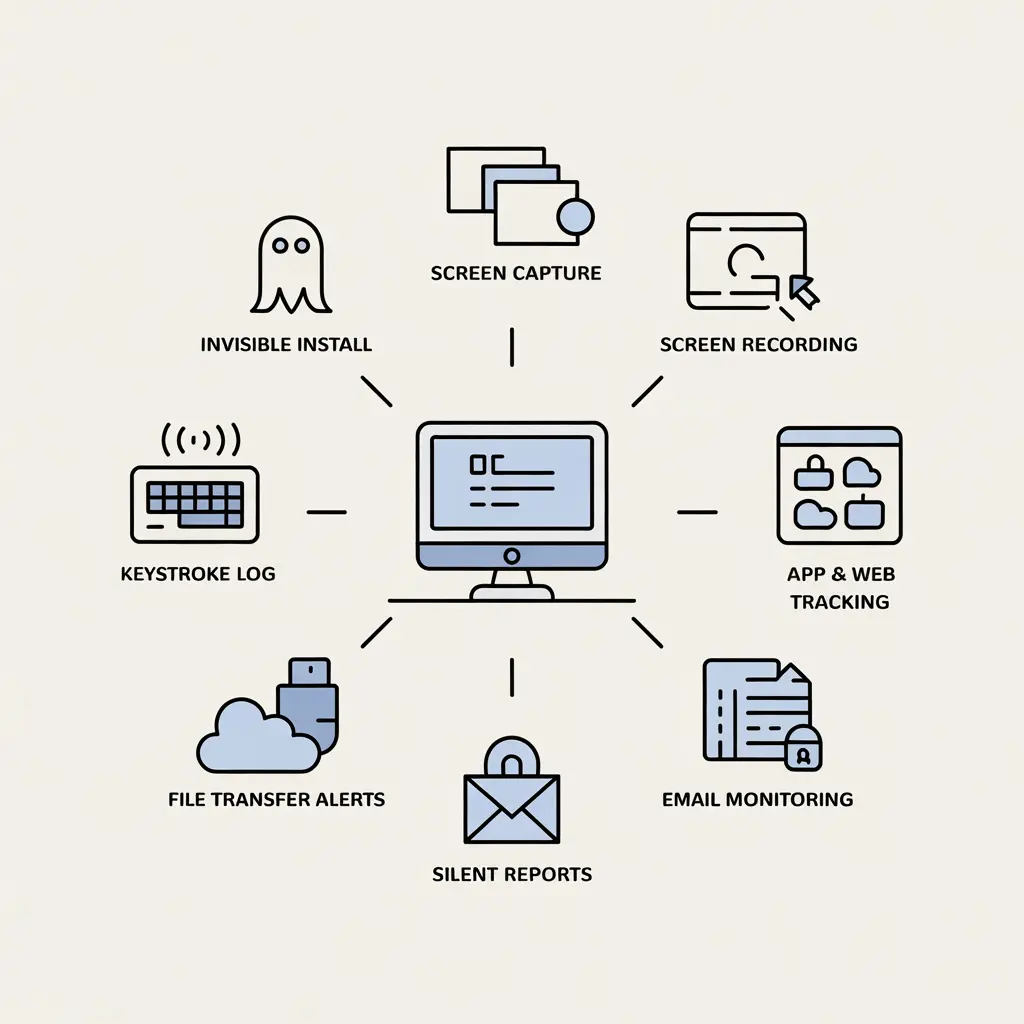
Invisible Installation and Operation
The first notable feature is obviously a silent or invisible installation. During installation, admins can make certain changes as per the company’s policy. The main goal is to keep the software hidden and out of employees’ radars. However, the company needs to make sure of employee privacy.
See how silent tracking actually works
Screen Capture and Recording Capabilities
The next part of stealth surveillance is capturing data, mostly via screenshots and screen recording. Screenshots are credible when it comes to investigations or audits. Visual proofs indicate strong accountability and transparency for a company.
Keystroke Logging
Whether it’s a stealth or transparent monitoring, tracking productivity is a must. Otherwise, an employee might turn on their computer and sit idly for hours. Keystroke logging can track productivity while ensuring added security. It can also help when you need to verify deleted emails or encrypted chats.
Application and Website Tracking
App & URL tracking are vital if you want to know your employees’ workflows. Are they really handling confidential data as securely as possible? When you track websites and apps, data flow and timestamps are recorded. So, you’ll know exactly when someone accesses shady sites or opens a sketchy app.
Track apps & URLs without detection now
File Transfer Monitoring
Even in the past 2 years, 61% of organizations experienced file-related breaches. That’s how serious file transfer threats are inside a company. With stealth monitoring, you can get instant alerts for file transfer to a USB or upload to cloud storage. It can also track email attachments.
Email and Communication Surveillance
Email and communication are necessary for the customer support team. However, most of the time, the team fails to meet a standard due to surveillance. Tracking emails actually reveals process optimization ideas. And ensures a better customer experience for your clients and customers.
USB and Peripheral Device Monitoring
USB device monitoring tracks any external devices plugged into a company device. Why is it crucial here? To make sure that no sensitive data is transferred to a foreign device or peripheral. Stealth monitoring is best in terms of monitoring USB devices.
How does Stealth Monitoring Differ from Traditional Monitoring Methods?
The main difference is obviously the method of tracking. Traditional tracking is active, visible, and anyone can notice it. However, stealth monitoring is invisible to the users. That’s why you can think of it as invisible tracking.
Here are the core differences:
Get unfiltered behavior data right now
How has Stealth Monitoring Evolved Over Time?
Stealth monitoring is not limited to user activity tracking anymore. It can now give you a detailed behavioural analysis with AI. Early invisible agents were recorders that captured keystrokes and screenshots. That resulted in a huge volume of data and processing power.
However, by 2026, the software architecture is looking to shift toward localized processing. And the analytics will seamlessly flow to admin devices. This change will drop threat detection latency to 50 ms from several seconds.
Moreover, software now focuses more on User and Entity Behavior Analytics (UEBA). It can reduce false alarms by 90% compared to traditional threshold-based triggers.
Which Industries Benefit the Most from Stealth Monitoring?
Finance, healthcare, and cybersecurity can hugely benefit from stealth monitoring. Here’s a quick table to get an idea of the pain points of the concerned industries:
Financial Services: Fraud Detection, Insider Trading Prevention
The latest data shows that the average insider threat cost in NA financial firms is roughly $22.2 million annually. Any type of financial crimes like embezzlement fall into this category. And financial criminals are always shrewd.
Because of this, stealth monitoring becomes necessary. It lets security teams watch for data theft in secret. Let’s take an ethical trader as an example. When you have stealth monitoring installed, the insider is being silently monitored.
With undercover observation, the person does not know that you already know! This keeps the evidence safe for the court. Recent data shows that 89% of these crimes are driven by monetary gains. Invisible oversight is now a vital defense for the financial industry.
Detect insider threats before damage starts
Healthcare: HIPAA compliance, patient data protection
Protected Health Information (PHI) is similar to banking data. A single medical record can fetch up to $1,000 on the dark web. That’s how valuable and sensitive the medical data is. In 2025 alone, breaches reported to the DHHS affected over 44.3 million Americans.
Stealth monitoring acts as an automated auditor in these environments. It detects when staff members access files of high-profile patients. Then, identifies and reports the credential theft in real-time.
By silently monitoring these access points, hospitals can ensure HIPAA compliance. Most importantly, it can secure patients’ sensitive data from insider threats.
Protect sensitive data with hidden oversight
Cybersecurity: Intellectual property protection, code security
In the cybersecurity industry, source code is everything. It’s their IP, their decades of hard work and passion. When that’s leaked, no business can sustain a competitive edge.
Recent reports show that malicious insiders account for 25% IP threats. It’s not tough to know why. Developers and engineers often require high-level admin access for their daily tasks. If they want, no one’s stopping them from leaking sensitive data.
Stealth monitoring serves as a silent tracker by monitoring "shadow data" movements. For example, a developer pushing protected code to a private cloud server. By operating discreetly, these tools can find out when the data flow is due to actual work and when it’s for malicious purposes.
Retail: Loss prevention, employee theft investigation
Most of us think of retail shops as being more vulnerable to physical theft, and that’s true. In 2025, reports clarify that 1 out of 35 retail employees was caught for internal theft.
However, that’s not a loss for any business. Until an insider decides to steal the inventory itself. Modern retail operations use stealth monitoring to identify these sophisticated frauds. Whenever a sales agent tries to manipulate sales or inventory data, the hidden mode of monitoring kicks in. That’s how retailers can now prevent massive employee theft proactively.
Stop employee theft with stealth tracking
Legal: Client confidentiality, document security
In the legal sector, the most valuable assets are case strategies. A 2025 industry report noted that 32% legal organizations experienced an insider threat in 2024. These are mostly revealed by ex-employees who take "proprietary templates" or clients.
Undetectable stealth mode completely eliminates these risks. No employee can hack their way out of the monitoring system if they are under hidden observation. Moreover, with USB transfer detection, it won’t be possible for employees to transfer any data at all.
Manufacturing: Trade secret protection
In 2023, 26% of global R&D spending was allocated to hardware and manufacturing. That’s $650 billion. So, when a trade secret of a large manufacturer gets stolen, they lose billions.
To avoid low & slow attacks, corporates can use stealth monitoring. It can benefit the manufacturing industry in two ways. First, it can obviously detect and prevent espionage attacks. And second, it’ll boost the productivity of employees via regular check-ins. No wonder manufacturers are now choosing this path as a countermeasure.
What Tools or Software are Commonly Used for Stealth Monitoring Purposes?
Apploye, Currentware, Teramind, Flowace, and various other tools offer stealth monitoring. They stay silent and track employees without them knowing.
Apploye
Everything that Apploye offers, but with silence. No indicators, no buttons, only stealth monitoring. The stealth or quiet mode performs as you expect. It tracks productivity levels, what apps & websites employees use.
It gently runs in the background and doesn’t use too much CPU and memory. So, employers don’t need to worry about device durability.
Try invisible monitoring free
Currentware
Known for its robust web filtering, Currentware is versatile with its hidden monitoring agent. It offers both transparent and stealth monitoring, with very affordable pricing.
Teramind
Teramind markets its stealth monitoring as a hidden monitoring tool. It offers concealed oversight of employee activity with proper accuracy. Whether it’s tracking app/website usage or data transfers, Teramind can do it all.
Conclusion
Stealth monitoring is not seen as just another spyware. It has become a core component for many businesses.
It enables early detection, protects critical data, and supports compliance without disruption. When implemented ethically, it solidifies both security and accountability.
Start your free stealth monitoring trial
Frequently Asked Questions
Can stealth be detected?
Advanced stealth monitoring tools are designed to run silently and are hard to detect. However, skilled users or system audits may still uncover traces. Detection depends on the tool and system access level.
How do I know if my employer is monitoring my computer?
Most employers disclose monitoring in IT policies or employment agreements. Monitoring usually applies only to company-owned devices. You can check internal policies or ask HR for confirmation.
How does stealth work?
Stealth monitoring runs quietly in the background without alerts or visible icons. It records user activity such as apps, files, and system access. The data is then reviewed and processed for evaluation.
What are the limitations of stealth?
It must comply with local laws and privacy regulations. Misuse can lead to legal issues and loss of employee trust. It also cannot prevent threats on its own, only detect them.
What are the benefits of using stealth?
It captures real behavior and bypasses the “performance acting”. This helps detect risks early and supports accurate investigations. It also strengthens data protection and compliance.
How is stealth used in cybersecurity?
Cybersecurity teams use it to detect insider threats and suspicious behavior. It helps monitor privileged access and data movement. This improves early threat detection and response.
About Author