How to Overcome Outsourced Call Center Challenges with Data
Key Takeaways
-

Use call center monitoring software to track key call center metrics like wait time, first-call fix, and customer scores, so you can spot weak areas fast and make better choices.
-
Compare teams, shifts, and vendors with call center workforce management tools to find gaps in quality, cost, and speed. Then focus on where it will have the most impact.
-
Turn data into action with simple dashboards, clear goals, and regular coaching, so your outsourced team can improve service and stay on target.
You outsourced your call center to reduce pressure, not to create new problems. But now, unfortunately, you’re dealing with multiple issues. CSAT complaints you can't trace, agents missing SLAs without control, and data you can't trust.
This is the defining challenge of outsourced customer service: distance creates blind spots.
The fix isn't micromanagement or in-house operation: it’s strategy backed with data. Call metrics, speech analytics, and workforce reports — these all ensure your outsourced call center doesn’t face any challenges. Here's how forward-thinking support centers are doing it.
Key Data-Driven Strategies to Overcome Outsourced Call Center Challenges
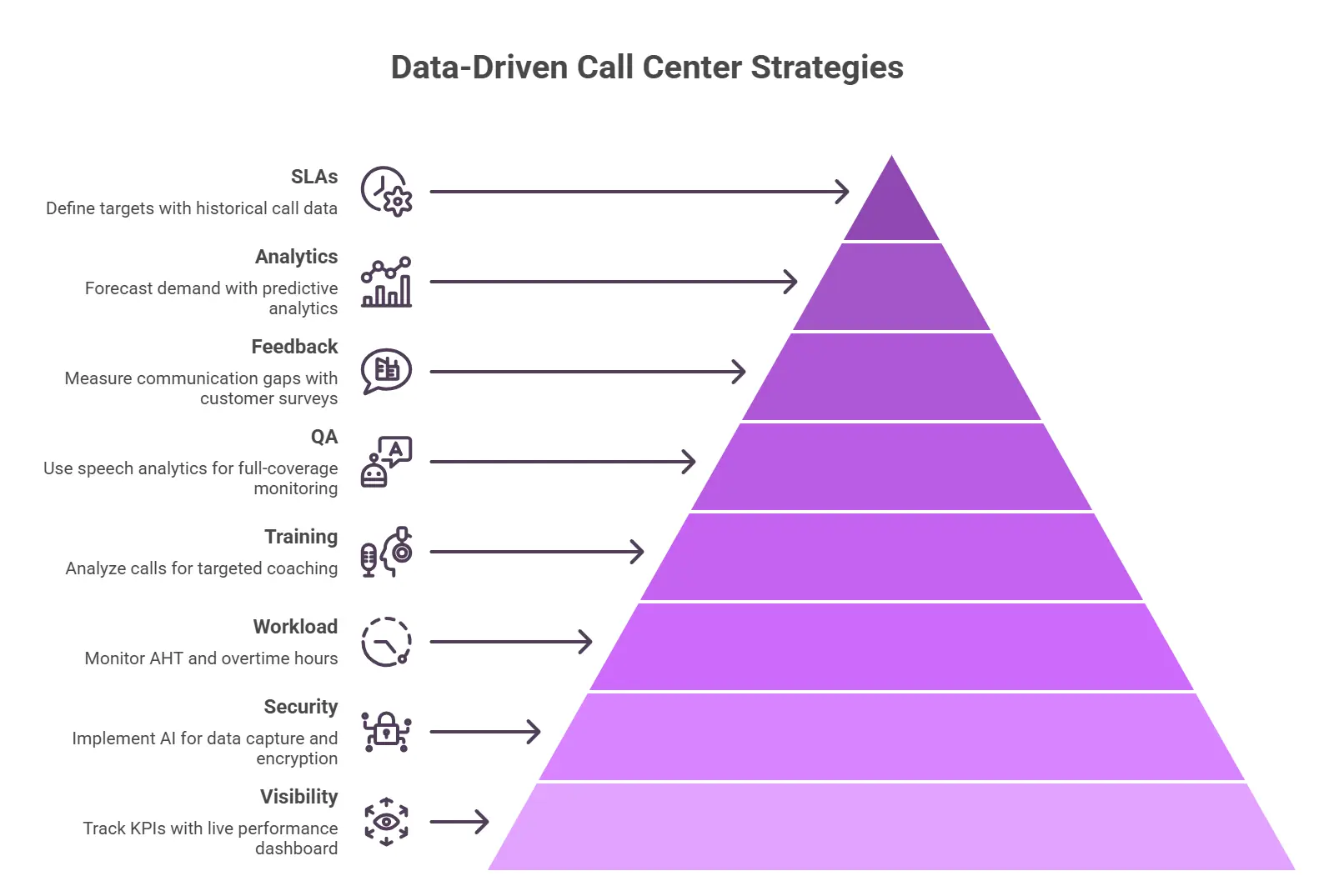
The strategies below cover 8 critical areas where outsourced contact centers typically break down. And they show how targeted data collection, monitoring, and analytics can turn each weakness into a managed, measurable system.
1. Gain Real Visibility Into Performance Before You Lose Control
Loss of oversight is the most common complaint about outsourced call center services. What you can’t see in real time, you can’t control at all. So, small problems creep up.
The solution is simple. Track all the required or agreed-upon KPIs with a live performance dashboard. First Call Resolution (FCR), Average Handling Time (AHT), ticket volume, CSAT scores, resolution rates, etc. Research shows that every 1% gain in FCR saves a midsize contact center roughly $286,000 annually. Try to go beyond the Industry standard of FCR, which is set at 70–79%. Apply similar tactics for all other metrics to be in control.
Apploye supports this full employee monitoring suite with continuous screenshots and productivity tracking. Moreover, its shift monitoring and productivity reports give you a clear picture of how agents are spending their time. Data that helps you get context on whether the team is actually maintaining the KPIs.
2. Lock Down Data Security Before It Becomes a Liability
Outsourced help desks handle sensitive customer data daily. Third-party data compromises are the 2nd most expensive type of breach. It can cost a business around $5 million for a single incident. So, before you decide to outsource your call center, you need to ensure your customers’ data is under the highest security protocols.
Implement AI-powered automation for data capture to reduce transcription errors. Prepare and follow strict data-sharing protocols: role-based access, audit logs, tokenized customer records, and encrypted transfers. Regular compliance audits—ideally monthly—should be built into your vendor contract, not left to good intentions.
Regular vendor security reviews are no longer optional. They are the minimum standard for any responsible outsourcing arrangement.
3. Spot Workload Imbalance Before It Becomes Burnout
Agent burnout is one of the most damaging and least visible problems in outsourced customer service centers. Over 63% of call center agents report experiencing burnout, contributing to annual attrition rates of 30–45%.
Surveys show why burnouts happen. Former call center workers describe being pushed through 50–100 calls per day with no meaningful recovery time. This is a pattern that destroys both morale and service quality.
Data makes this problem visible before it explodes. Track rising AHT by agent, monitor overtime hours and no-break working sessions, and flag task backlogs weekly. Historical workload trend analysis helps you spot under-resourced and overworked staff.
Apploye's shift management and work-hour reports are built for exactly this kind of oversight. It allows redistributing load and protects agents from unsustainable stretches before they resign.
4. Use Call Data to Train Smarter, Not Just More
Generic training doesn’t offer any specialized insights. Coaching that’s built upon actual calls your agents are handling is the one that really helps.
Speech analytics tools can now analyze 100% of recorded calls, surfacing keyword patterns, compliance gaps, emotional tone, and resolution paths. At NRTC, applying targeted training modules identified through call analytics produced a 12-point increase in average QA scores. It's a goal most companies dream of.
Use this data-driven approach to identify which agents struggle with specific call types. Fix scripts that lead to escalations and knowledge gaps that become costly. Pinpoint your top performers, extract what they do differently, and build that into onboarding. A great practice is to sit with agents on a weekly basis. With a simple 15-minute personalized one-on-one session, an agent can learn more than any generic hour-long training.
5. Move QA From Spot-Checking to Full-Coverage Monitoring
Traditional QA in an outsourced contact center is almost gone. If any business is relying on manually reviewing 2–5% of calls, then it’s losing out on almost 100% of coverage. Significant compliance and service quality risk.
Automated speech analytics now makes it possible to monitor 100% of calls for sentiment, compliance, and resolution quality. Tools like CallMiner, Observe.AI, and Sprinklr can flag compliance violations, track script adherence, and predict CSAT scores in near real time.
This shifts QA from a retrospective exercise to an early warning system. When you pair it with automated scoring & regular calibration sessions, the QA becomes almost automatic. Calibration ensures both sides are scoring against the same standards, and you get the result you wanted from the start.
6. Measure Communication and Cultural Gaps With Customer Feedback Data
When you’re dealing with overseas or remote call centers, you aren’t just facing communication gaps. There’s also cultural resistance. This is the challenge most companies hate. Customers can easily notice when agents sound scripted or miss emotional cues. When agents fail to acknowledge frustration in a culturally appropriate way, the CSAT score plummets.
Post-call customer surveys are the most direct way to quantify this. Track CSAT by agent cohort, by region, and by issue type. Look for patterns in interactions where the score drops consistently. That data helps you to fix your current communication issues and improve your score for future calls.
Use that data to build targeted cultural and communication training. A 2024 benchmark report found that top-performing outsourced call centers achieve CSAT scores of 85–90%. That parity is achievable, but it requires intentional measurement, not hope.
7. Use Predictive Analytics to Manage Capacity Before Demand Peaks
One of the clearest patterns from frustrated customers: long hold times caused by understaffing. If this often happens for your outsourced call center, then it’s a planning issue, not a staffing shortage.
Using predictive analytics tools turns that guesswork into a data-backed forecast. It analyzes historical call volume data, seasonal patterns, product launch cycles, and marketing calendars to forecast demand accurately. WFM platforms can then automatically recommend staffing adjustments before a spike hits.
Nearly 80% of customers expect short wait times, but that happens only 60% of the time. With predictive analysis of staffing needs, you can close that gap significantly. AI-driven scheduling also reduces the cost of last-minute overtime while ensuring your virtual call center is always ready.
8. Define SLAs With Historical Data, Not Guesswork
Vague SLAs are the root cause of most disputes between brands and their outsourced partners. If expectations are wrong in the first place, it’s hard to measure "good performance".
Using your historical call data is key here. Average handle times, ticket resolution rates, peak period volumes, CSAT baselines — define precise SLA targets for all core metrics.
For example: "FCR above 75%, AHT under 6 minutes and 30 seconds, CSAT above 82% monthly average." The industry average AHT is 6 minutes 10 seconds. So, SLAs set below that standard are already subpar. Build in weekly reporting requirements and define clear remediation triggers. Data-backed SLAs protect both parties, reduce conflict, and create a shared performance language.
Conclusion
The core of every outsourced call center challenge: visibility, quality, security, staffing, and culture. All issues lead to the same fix: measure it, track it, and act on the data. Start with your KPIs, build a feedback loop, and use tools that give you real-time insight into how your support center performs.
Apploye can help you maintain that workforce visibility even with overseas outsourced call centers.
Start your free trial and take control of your outsourced operations with data!
Frequently Asked Questions
What is call center outsourcing?
Call center outsourcing means hiring a third-party company to handle customer calls on behalf of your business. This includes inbound support, outbound sales, and technical help desk functions. The third-party provider supplies the agents, infrastructure, and technology.
How does call center outsourcing work?
You contract with a BPO (business process outsourcing) provider who trains agents on your brand and products. Calls, chats, or tickets from your customers are routed to those agents. The outsourced team follows your scripts, SLAs, and quality standards. You monitor performance using shared dashboards, reports, and regular review meetings.
How do I start outsourcing call center operations?
Begin by documenting your current call volume, issue types, and target KPIs. Then, shortlist vendors based on industry experience, language capabilities, and technology stack. Run a pilot with a small portion of call volume before full rollout. Set measurable SLAs from day one to establish a clear performance baseline.
How can I choose the right outsourced call center provider?
Look for providers with proven experience in your industry and strong compliance certifications (GDPR, HIPAA, PCI-DSS). Evaluate their technology, specifically AI tools, speech analytics, and CRM integrations. Request client references and benchmark their CSAT and FCR rates against industry averages. Cultural and communication alignment with your customer base should also be a key filter.
What industries benefit most from outsourcing?
Telecommunications, financial services, healthcare, retail, and technology companies are the most active users. Telecom leads, with over 60% of global providers outsourcing some support. Healthcare and fintech benefit from 24/7 coverage and multilingual capabilities. Retail and e-commerce use outsourcing heavily during seasonal demand peaks.
What factors should businesses consider when selecting an outsourced call center provider?
Key factors include data security standards, agent language and cultural fit, pricing structure, technology capabilities, and scalability. Check the provider's compliance certifications and ask for performance data from comparable accounts. Flexible contract terms and clear SLA frameworks matter as much as the initial cost.
How can businesses ensure data security when outsourcing call center operations?
Require vendors to hold active compliance certifications (GDPR, HIPAA, PCI-DSS) and conduct annual third-party security audits. Implement role-based access controls, encrypted data transfers, and strict data-sharing protocols in the contract. Use AI automation to reduce manual data handling and therefore reduce human-error risk. Build audit log reviews into your monthly governance process.
How can businesses address language barriers in outsourced call center services?
Use post-call CSAT surveys to track satisfaction by agent cohort and identify specific communication gaps. Invest in accent coaching, cultural awareness training, and product-specific language guides for outsourced agents. Speech analytics tools can flag calls where misunderstandings lead to repeat contacts or escalations. Target training at the specific gaps the data surfaces, rather than running generic communication workshops.
What call center metrics should I capture?
The core metrics are First Call Resolution (FCR), Average Handling Time (AHT), Customer Satisfaction Score (CSAT), ticket volume, and resolution rate. Industry targets are: FCR above 75–80%, AHT around 6 minutes, and CSAT above 82–85%. Supplement these with agent occupancy rate, schedule adherence, and escalation rate. Track trends over time, not just point-in-time snapshots, for meaningful operational insight.
How is AI changing contact center outsourcing?
AI is automating routine inquiry handling, QA scoring, call transcription, and predictive staffing in outsourced contact centers. Automated speech analytics now covers 100% of calls—replacing manual sampling that checked only 2–5%. Predictive AI forecasts call volume spikes and triggers staffing adjustments before service degrades.
What are the challenges faced by startups in the call center BPO industry?
Startups in the BPO space face high agent turnover (30–75% annually), technology investment costs, and intense competition from established players. Building client trust without a long performance track record is a persistent barrier. Compliance requirements for regulated industries like healthcare and finance add cost and complexity early on. Data security infrastructure—often expensive to build correctly—is increasingly a difficult requirement even for new entrants.
About Author