Why I Stopped Counting Commits and Started Measuring Focus Time (Dev Team Productivity Soared)
A few months ago, I noticed something odd about our dev team.
Some developers were clocking endless commits, but features were still delayed, and bugs kept slipping through. Meanwhile, others with fewer commits were delivering solid, well-tested code.
I realized counting commits wasn’t telling the full story. So, I decided to stop obsessing over numbers and started measuring focus time instead, and what happened next completely changed how our dev team works.
Kickstarting with Fixing the Focus Time
At first, I didn’t even know where to begin. How do you measure “focus,” right?
So, we started by setting clear focus blocks in the day. We fixed two to three hours where no one would be disturbed. Preferably at the start of the day. As most employees feel drained at the end of the day, we started doing repetitive and less productive tasks at that time
After months, the results weren’t exactly what we hoped for. It was as if we had built a perfect schedule, but something about it still wasn’t working.
That’s when I realized, measuring focus time alone doesn’t make a team more productive. Something deeper was missing.
Track when your team works best, not hardest
When We Brought a Robot to Watch the Humans
At that point, we needed clarity. So, we turned to the employee monitoring software to understand what was really happening during those “focus hours.”
We used the tool to track patterns, for instance, when our developers hit their peak flow, how often they were switching tasks, and what kind of interruptions broke their rhythm.
Can you guess what the tool revealed?
- Not everyone in the dev team has the same focus time.
- Long, uninterrupted sessions didn’t always mean higher output.
- Short breaks every hour often led to better problem-solving later in the day.
- The team performed better when they worked around their own focus patterns instead of a fixed schedule.
See real productivity patterns in your dev team
A New Way to Set Focus on Action
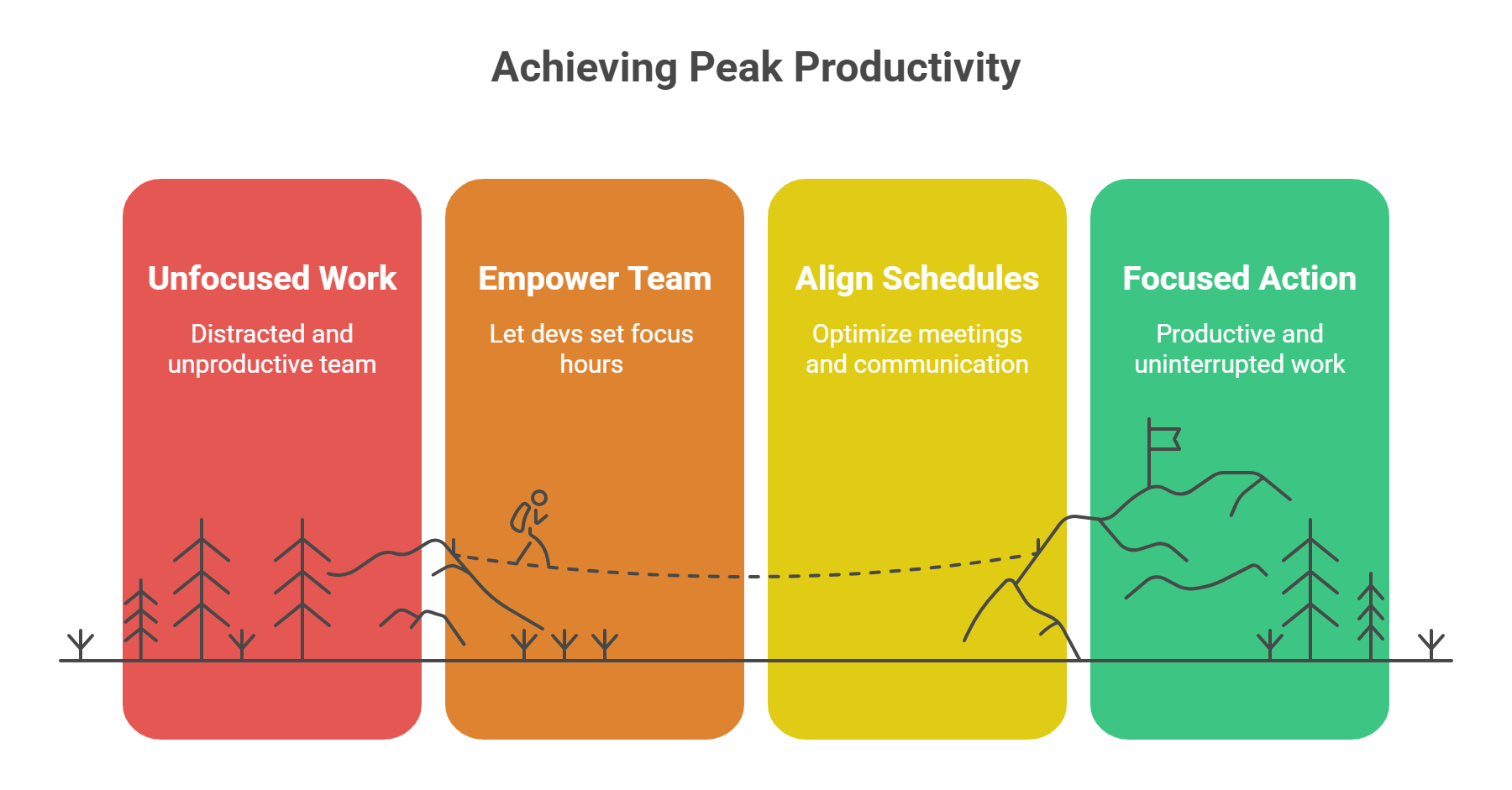
To fix our focus on work, we needed to change that old system. So, we decided to make the dev team part of the process instead of dictating it from the top.
- We let each of the dev team members set their own focus hours, the time when they feel most productive and least distracted. Some preferred early mornings, others hit their stride after lunch, and a few even worked best late at night.
- Once everyone defined their peak hours, we aligned meetings, task updates, and communication rules around those blocks. The idea was simple: when someone’s in focus mode, no pings, no calls, no interruptions.
More Focus Hours = Better Productivity
Soon after the new focus-driven work system, employees started bringing results that matter.
There was less feedback, bugs. The strangest thing was that we didn't even need to spend time arranging meetings throughout the day. As a result, our productivity increased, replacing that quantity of commits that would rarely push the company.
And the best part was that no one was forced to follow a rigid schedule anymore.
Everyone worked when they performed best, and the dev team’s overall performance soared. We learned that when people have control over their focus, productivity follows naturally.
Monitor activity levels, not just clock hours
Closure
We thought getting more commits done was the key to keeping the company running. But little do we know that real productivity is about how much impact that code creates, not how much code someone pushes.
When we stopped counting commits and started measuring focus through our employee monitoring tool, we began to see the bigger picture. We are now able to drive more quality with fewer distractions. And that fewer “busy” hours meant more meaningful progress for the team, which enhanced our productivity by making the team more confident and less burnt out.
Start tracking what really drives the dev team output
About Author