12 Essential Software and Technology for Modern Call Centers That Matter
Key Takeaways
-

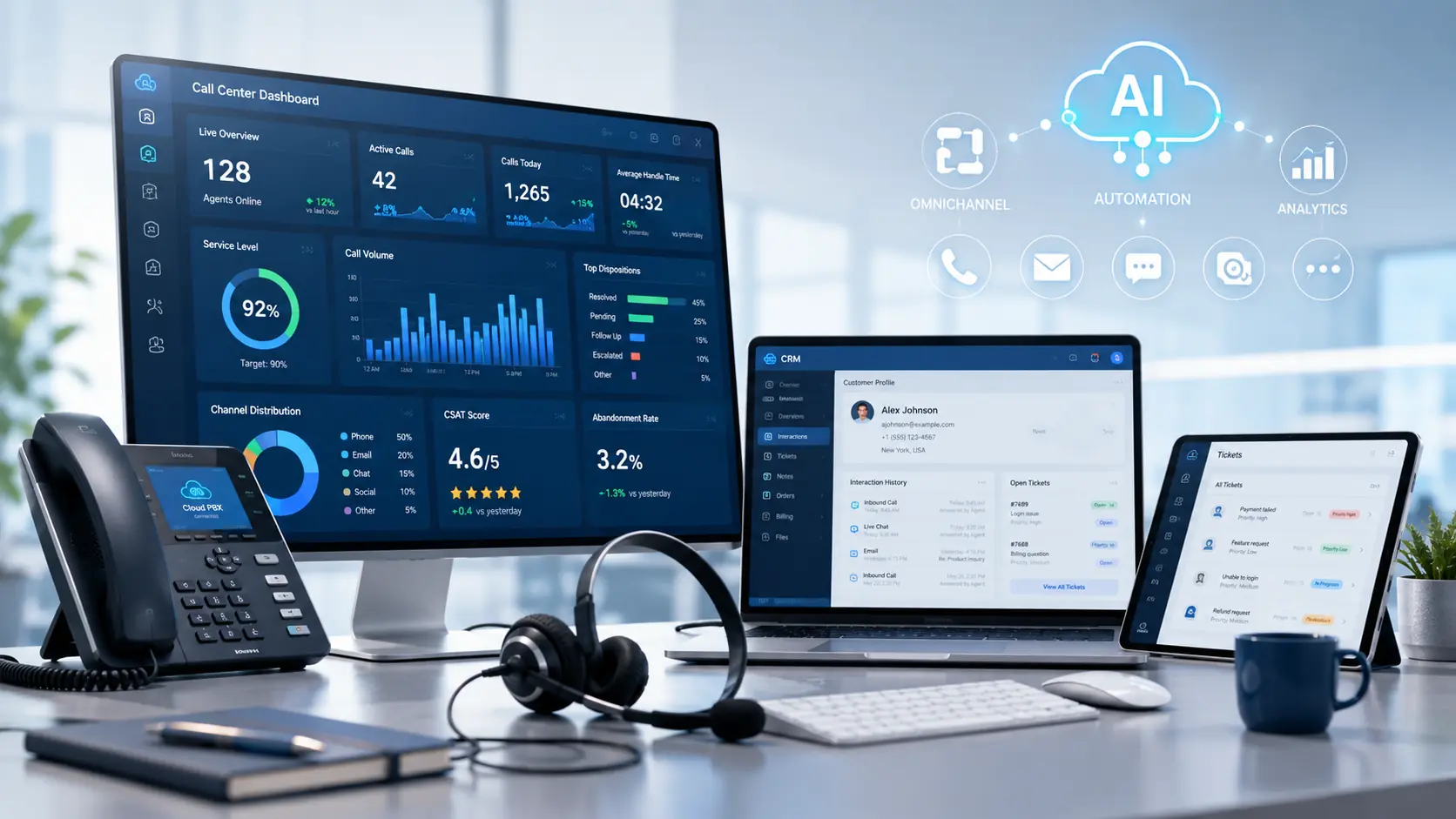
The essential software and technology for modern call centers include cloud platforms, smart call routing, AI chatbots, CRM connections, and workforce scheduling software.
-
The right tools work together. Routing sends calls to the best agent, CRM shows their history instantly, and QA software scores every interaction automatically.
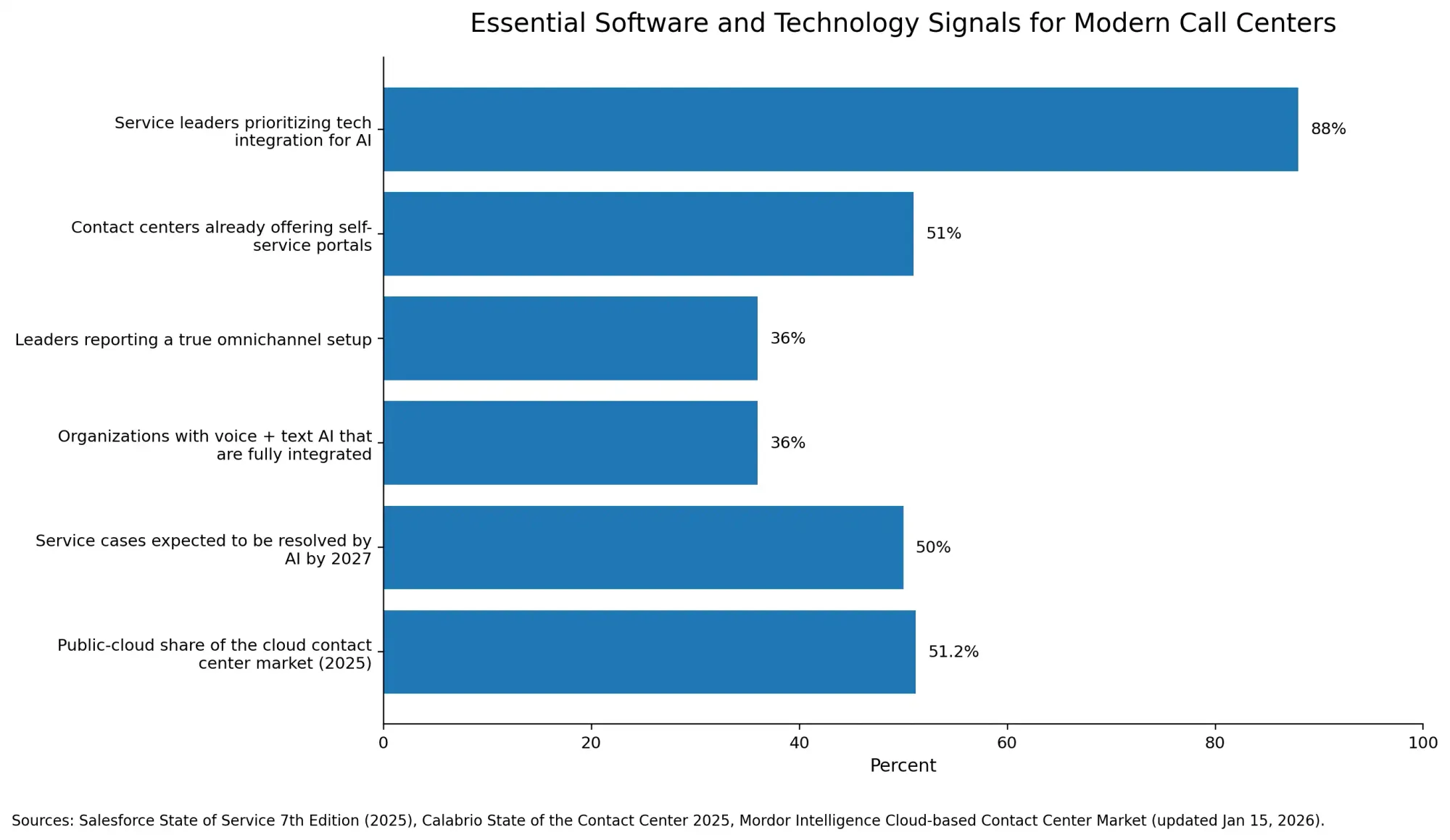
The wrong tools cost your call center more than you think. Slow routing hurts your results. Disconnected data breaks the workflow. And when agents jump between systems, it adds delays. Together, these issues directly impact your numbers.
That said, you already know you need software. But the real question is which tools actually matter and why. I’ll cover the essential software and technology modern call centers use. You'll know exactly which tools to prioritize and what each one does.
Top 12 Essential Software and Technology for Modern Call Centers
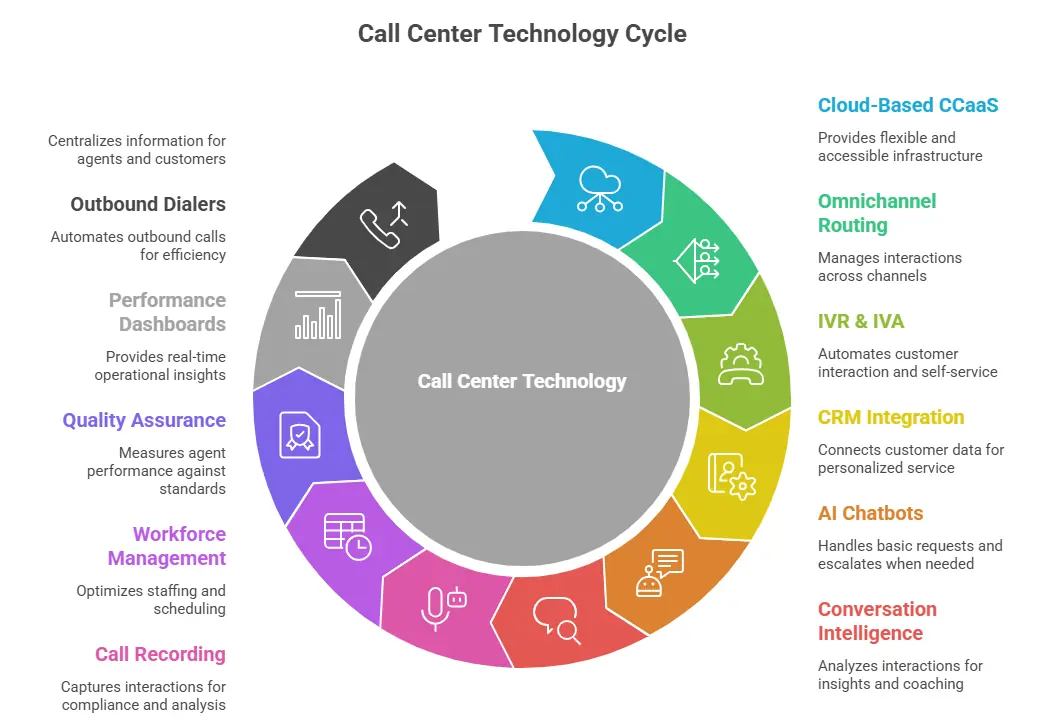
As far as I’ve seen and experienced, modern call centers rely on 12 core tools. Let’s know them one by one.
1. Cloud-Based CCaaS Platforms
CCaaS (Contact Center as a Service) replaces on-premise hardware with cloud infrastructure. Thus, your agents can access from any location with an internet connection.
Plus, CCaaS platforms integrate —
- VoIP calling
- Computer Telephony Integration (CTI)
- Multi-channel support
Hence, contact center agents get real-time screen pops, call routing controls, and customer data inside one interface.
2. Omnichannel Routing and ACD
Omnichannel routing manages customer interactions across —
- Voice
- Chat
- SMS
- Social media inside a single queue.
ACD (Automatic Call Distribution) works alongside omnichannel routing. It decides which agent receives each queued interaction through its predefined rules and skills-based routing.
Skills-based routing connects a customer’s problem to the agent who has the right skills for it. It reduces transfer rates and improves first-call resolution directly.
3. IVR Systems and Intelligent Virtual Agents
IVR (Interactive Voice Response) is an automated system that greets callers. It also routes them to the right agent or department without a live operator.
Here, callers interact through —
- Voice commands
- Touch-tone keypad input
IVA (Intelligent Virtual Agent) takes this further. It uses NLP (Natural Language Processing) to understand natural speech. Thus, customers self-serve tasks such as —
- Checking account balances
- Scheduling appointments
- Tracking orders
4. CRM Integration
CRM (Customer Relationship Management) integration connects your call center software directly to your customer database. In fact, one study found that 70% of businesses use a CRM, specifically for managing customer support.
When a call connects, the agent gets a screen pop with the caller's full profile. That profile typically includes —
- Past interaction history
- Purchase records
- Open support tickets
- Account details
5. AI Chatbots and Self-Service Tools
AI chatbots are automated conversational tools that handle customer requests without a live agent. They manage —
- FAQs and product questions
- Order status checks
- Basic account updates
- Appointment bookings
When a request exceeds the chatbot's scope, it hands off to a live agent with full conversation context intact. Thus, the agent picks up mid-conversation without asking the customer to repeat themselves.
In fact, Gartner projected that 80% of customer service organizations will apply generative AI technology in 2025, chatbots included.
6. Conversation Intelligence and Speech Analytics
Conversation intelligence software analyzes spoken interactions between agents and customers in real time.
It monitors —
- Agent tone and sentiment shifts
- Script adherence
- Customer frustration signals
- Keyword and phrase patterns
Speech analytics processes these interactions at scale. As a result, your team leaders can spot where coaching is needed among hundreds of customer calls. And that too without listening to each recording one by one.
7. Call Recording Software
Call recording software captures every agent-customer interaction in full. Yet its value goes well beyond storage. That said, compliance is the most operationally critical use. Industries that handle sensitive data, like healthcare, finance, and insurance, must meet standards such as —
- HIPAA (Health Insurance Portability and Accountability Act)
- PCI DSS (Payment Card Industry Data Security Standard)
Moreover, call recording software addresses this by logging, encrypting, and archiving every interaction. Hence, your operation stays audit-ready without manual documentation effort.
8. Workforce Management Software
Workforce management software (WFM) forecasts call volume and schedules agents to match that demand. It efficiently handles —
- Call volume forecasting
- Agent shift scheduling
- Intraday staffing adjustments
- Adherence tracking
See, overstaffing wastes money and collapses your service levels. Thus, WFM removes both problems by aligning headcount with actual demand patterns throughout the day.
9. Quality Assurance and Call Scoring Tools
QA (Quality Assurance) tools measure agent interactions against defined performance standards.
Each call gets scored on —
- Script adherence
- Resolution accuracy
- Customer handling
- Compliance requirements
Automated QA tools use AI to score every single interaction. Therefore, you can make coaching decisions from complete data.
10. Performance Dashboards and Analytics
Performance dashboards give supervisors a real-time view of call center operations from a single screen.
Its call center metrics and KPIs tracked include —
- AHT (Average Handle Time)
- FCR (First-Call Resolution)
- CSAT (Customer Satisfaction Score)
- NPS (Net Promoter Score)
- Call abandonment rate
Historical analytics sit alongside real-time data. Thus, managers locate long-term trends and act before they become operational problems.
11. Outbound Dialers
Outbound dialers automate the process of placing calls. So, your agents can spend more time talking with customers. Now, there are two main types —
- Predictive dialers call multiple numbers simultaneously and connect agents only to live answers.
- Power dialers call one number per agent at a controlled, sequential pace.
Meanwhile, voicemail detection filters unanswered calls automatically. Hence, agents connect only to live conversations.
12. Knowledge Base Management
Knowledge base management software stores product information, policies, and resolution guides in one centralized location.
It serves two audiences —
- Agents access answers during live calls without placing customers on hold.
- Customers self-serve common questions through a public-facing portal.
AI-powered search pulls the most relevant article based on the agent's query. Thus, resolution time drops because agents find accurate answers fast.
How Does Apploye Help Call Centers Track Agent Productivity and Workforce Analytics?
Your call center runs WFM for scheduling, QA for call scoring, and call center monitoring for KPIs. But none of those tools show what your agents actually do during scheduled hours.
Apploye closes that gap. It lets you track —
- Active work time and billable hours
- App and URL usage during shifts
- Idle time and screenshots
- Productivity scores per agent
Employee monitoring and productivity tracking show which agents hit output targets and which fall short. So your managers can coach based on real performance gaps. For remote and hybrid call center teams, Apploye adds the one layer that the rest of the stack doesn’t cover.
Complete your call center tech stack
Wrapping Up
When it comes to the essential software and technology for modern call centers, tour priorities depend on how your team operates.
High inbound volume teams start with CCaaS, IVR, ACD, and CRM integration. Meanwhile, remote teams need workforce analytics in the stack. Again, outbound operations prioritize predictive dialers and performance dashboards first.
Frequently Asked Questions
What is CCaaS, and how is it different from traditional call center software?
CCaaS (Contact Center as a Service) is cloud-based software that replaces on-premise hardware. Traditional systems require physical servers and IT maintenance. On the other hand, CCaaS scales on demand and integrates with CRM, IVR, and analytics tools without hardware investment.
Which CRM platforms integrate best with call center software?
Salesforce, HubSpot, and Zendesk integrate best with most call center platforms. They sync customer history, open tickets, and interaction data directly to the agent's screen during live calls. Thus, they reduce handle time and improve first-call resolution.
How does IVR improve first-call resolution rates?
IVR (Interactive Voice Response) routes callers to the right agent or department based on their input. This removes unnecessary transfers and ensures customers reach qualified agents on first contact. That directly improves FCR (First-Call Resolution) rates.
What does omnichannel routing mean in a call center context?
Omnichannel routing manages customer interactions across voice, chat, email, SMS, and social media inside a single queue. Agents handle all channels from one interface, with full conversation context preserved across every channel switch.
How does AI help call center agents during live calls?
AI helps agents during live calls through real-time sentiment analysis, script adherence alerts, and suggested responses. It flags frustrated customers, guides agents through complex issues, and generates call summaries automatically after each interaction.
What KPIs should call center analytics software track?
Call center analytics software should track AHT (Average Handle Time), FCR (First-Call Resolution), and CSAT (Customer Satisfaction Score). It should also track NPS (Net Promoter Score), call abandonment rate, and agent occupancy to measure both performance and customer experience.
How does a predictive dialer work?
A predictive dialer automatically calls multiple numbers simultaneously and connects agents only when a live person answers. It filters out voicemails, busy signals, and unanswered calls to maximize agent talk time during outbound campaigns.
What is the difference between call monitoring and call recording?
Call monitoring lets supervisors listen to live calls in real time without agents or customers knowing. Meanwhile, call recording captures completed interactions for later review, compliance documentation, and agent coaching. Both serve quality assurance, but at different stages.
How can time tracking software help remote call center teams stay productive?
Time tracking software like Apploye captures active hours, app usage, idle time, and productivity scores per agent. It gives call center managers real visibility into what remote agents do during shifts.
About Author