The real cost of overtime: more errors, lower quality, higher churn – quantified

Key takeaways from my journey
-

Transparent time tracking helped identify hidden overtime hours and their impact on output.
-
Task prioritization frameworks (Eisenhower Matrix, Kanban boards) improved quality and reduced rework.
-
Clear policies around work hours lowered burnout and kept team churn in check.
-
Regular check-ins and async updates kept productivity high without pushing people beyond limits.
Why I Stopped Glorifying Overtime
For a long time, I equated extra hours with commitment. If someone in my team stayed late, I saw it as dedication. But when deadlines stacked up and customer churn started creeping in, I noticed a disturbing pattern. More overtime didn’t mean more output. It meant more mistakes, patchy quality, and, worst of all, talented people leaving.
The wake-up call came when one of my best developers admitted, “I’m making mistakes I’d never make if I wasn’t this exhausted.” That’s when I started quantifying the real cost of overtime.
Cut hidden overtime with Apploye
Overtime = More Errors (and More Rework)
What looked like “hard work” was actually slowing us down. I pulled numbers from bug reports and realized:
- Errors spiked by almost 30% in weeks with consistent overtime.
- QA teams spent extra hours fixing issues created by tired devs.
- Project timelines didn’t shrink—they expanded.
The logic is simple: when brains are fried, even top performers can’t function at their best. Instead of pushing harder, I experimented with task prioritization frameworks.
✅ The Eisenhower Matrix helped us sort tasks into urgent vs. important.
✅ Kanban boards visualized workloads so no one overcommitted.
Within a month, the rework rate dropped noticeably.
Lower Quality isn’t Just a Technical Problem
The impact went beyond code. Overtime started showing up in customer experience:
- Delayed responses from support reps working late.
- Sloppy handovers between tired teammates.
- Rushed features pushed to production, later rolled back.
I realized that quality is not just about output but also about consistency. To fix this, I leaned on transparent productivity tracking tools that helped us spot inefficiencies before they became bottlenecks.
We set a simple policy: no “hero hours.” If work consistently required overtime, it wasn’t a people issue but a planning issue.
Fix planning, not people, with Apploye
Higher churn: the silent business killer
Here’s what shook me:
- In just one quarter, two team members left, citing burnout.
- Exit interviews revealed overtime as the #1 frustration.
- Replacing them cost us far more than the “extra” hours they were putting in.
The hidden churn costs knowledge loss, hiring time, and onboarding. All of these outweighed whatever benefit we thought we got from overtime.
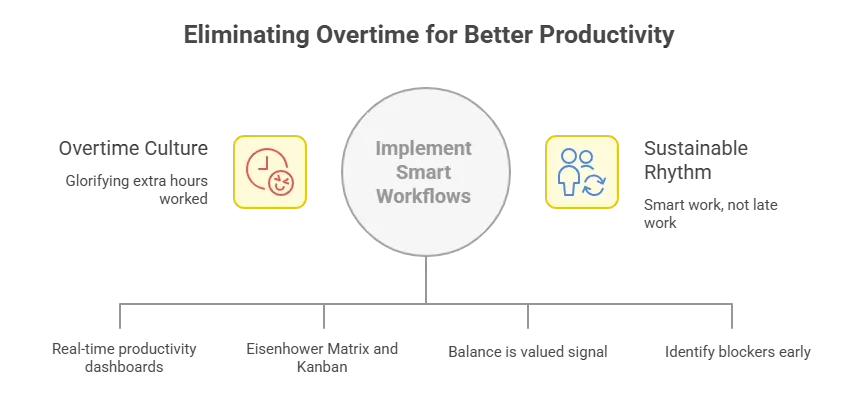
So, we built a sustainable rhythm:
- Core hours for collaboration, flexibility for deep work.
- Async updates on Slack instead of dragging people into late-night calls.
- Recognition for smart efficiency, not staying late.
Protect your A-players from burnout
What actually worked (and still works today)
If you’re wondering what concrete steps helped us cut overtime without cutting productivity, here’s the short list:
- Time tracking & workload visibility: Productivity tools gave us real-time dashboards.
- Prioritization systems: Eisenhower Matrix + Kanban stopped work from piling up chaotically.
- Clear “no overtime” policy: Sent the signal that balance is valued.
- Weekly reflection sessions: Quick 15-minute team check-ins helped us identify blockers early.
Get overtime and capacity reports
Closing thought: Overtime is a symptom, not a solution
Overtime isn’t proof of commitment rather a proof of broken processes. Once I stopped seeing it as a badge of honor, my team got sharper, customers noticed better quality, and churn dropped.
If you’re managing a team and facing similar issues, take a hard look at the patterns. Track the data. Talk to your people. Then design workflows that reward smart work, not late work.
And if you need a place to start, explore tools like Apploye that make productivity visible without micromanaging. That shift changed everything for us—and it might for you too.
Measure productivity, not presence
About Author